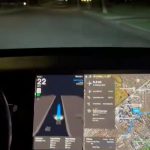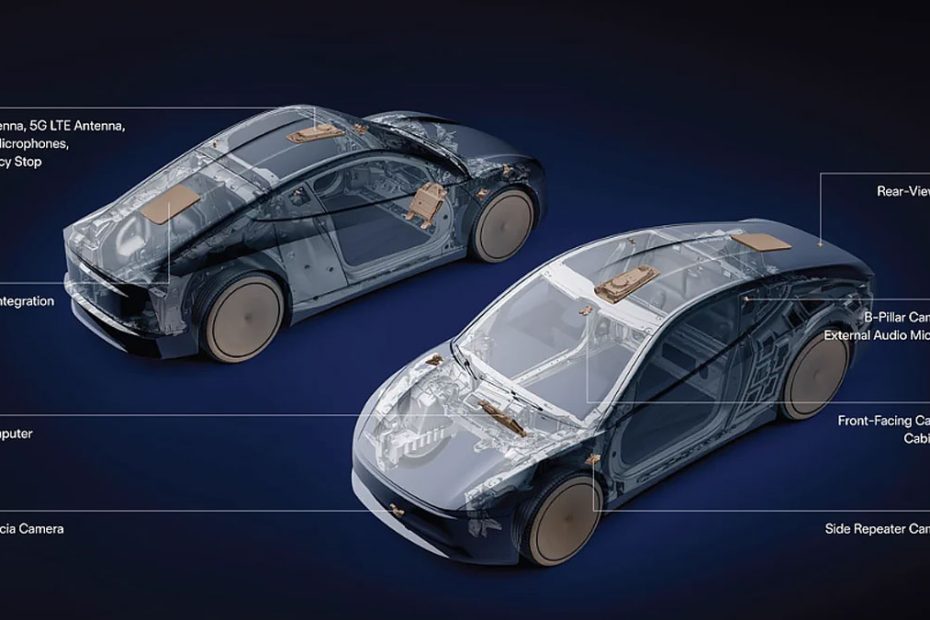
Tesla has disclosed new technical details about its upcoming Cybercab autonomous vehicle, confirming that every production unit will include an integrated Starlink satellite communication terminal concealed beneath the rear liftgate. While the company insists the system is not currently required for safe autonomous driving, the announcement highlights how Tesla’s dedicated Robotaxi platform is evolving into a fundamentally different vehicle from the consumer models that Elon Musk previously suggested could eventually join an autonomous ride hailing fleet.
Integrated Starlink hardware
The newly released engineering illustration shows that Cybercab carries far more specialized hardware than previously known.
Alongside the Full Self Driving computer, multiple forward, side, rear, and cabin cameras, external microphones, emergency stop circuitry, and 5G connectivity, Tesla has integrated a dedicated Starlink antenna directly into the vehicle structure.
Unlike aftermarket Starlink installations that some Tesla owners have experimented with, this solution is fully embedded into the vehicle architecture and appears designed specifically for automotive operation.
Although Tesla has not disclosed detailed technical specifications, the integrated terminal is believed to be based on Starlink’s latest V5 hardware, adapted for the thermal and vibration demands of continuous vehicle use.
Satellite connectivity raises new questions
Tesla executives have emphasized that Cybercab can safely operate without satellite connectivity.
Ashok Elluswamy, Tesla’s Vice President of AI Software, stated that Starlink is primarily intended for navigation, customer support, and fleet management rather than core autonomous driving functions.
However, one detail immediately attracted attention within the autonomous vehicle industry.
The statement that Starlink is “still not required” for safe operation suggests the communication system could become increasingly important as Tesla expands Robotaxi capabilities.
Satellite connectivity offers advantages that traditional cellular networks cannot always guarantee.
Remote regions, disaster zones, underground coverage transitions, or temporary mobile network outages could all benefit from a secondary communications channel. Even if autonomous decision making remains entirely onboard, continuous connectivity simplifies fleet monitoring, software diagnostics, remote assistance, and route optimization.
Cybercab hardware separates itself from customer Teslas
Perhaps the biggest takeaway is not the Starlink antenna itself but what it represents.
Tesla originally promoted the idea that existing customer vehicles equipped with Full Self Driving hardware could eventually participate in a Robotaxi network. Cybercab increasingly appears to challenge that assumption.
The dedicated autonomous platform already includes hardware not available on consumer Teslas, including upgraded autonomous computing hardware, optimized sensor placement, camera cleaning systems, and now factory integrated satellite communications.
Each additional component makes Cybercab less comparable to Model 3, Model Y, or even Cybertruck.
If Tesla eventually certifies only vehicles built with this complete hardware package, the long discussed concept of privately owned Teslas generating income through autonomous ride sharing could become considerably more difficult to achieve than originally envisioned.
Engineering perspective
From an engineering standpoint, integrating Starlink is a logical decision rather than a headline feature.
Autonomous vehicles rely not only on perception and artificial intelligence but also on reliable fleet connectivity. Separating safety critical driving from communication services is considered best practice throughout the autonomous vehicle industry. A satellite backup channel increases operational resilience without necessarily controlling the vehicle itself.
However, the integration also signals that Robotaxi platforms are becoming purpose built commercial products rather than software upgrades for conventional passenger cars. As regulatory requirements grow stricter, dedicated hardware redundancy will likely become an increasingly important differentiator.
In that context, Cybercab may represent Tesla’s transition from consumer assisted driving toward professionally managed autonomous transportation infrastructure.
About Tesla
Founded in 2003, Tesla has become the world’s largest battery electric vehicle manufacturer by market value. In 2025, the company delivered approximately 1.79 million vehicles globally and generated more than $97 billion in annual revenue. Beyond electric vehicles, Tesla operates businesses in energy storage, solar power, artificial intelligence, robotics, autonomous driving, and charging infrastructure, while maintaining one of the world’s largest fast charging networks with over 7,000 Supercharger stations and more than 70,000 charging connectors worldwide.
Source: www.tesla.com