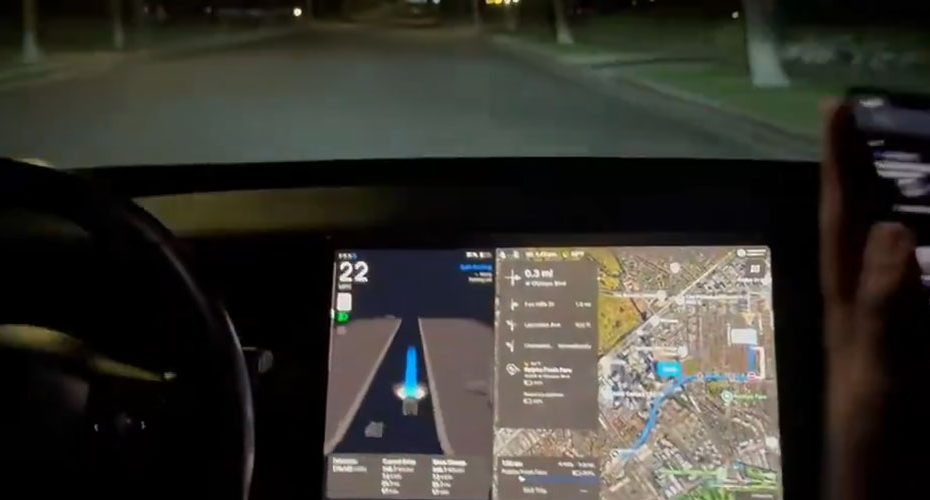
Tesla has officially started the first early access rollout of FSD V14 Lite, a streamlined version of its latest Full Self Driving software designed specifically for vehicles equipped with the older Hardware 3 (HW3) computer. The release represents Tesla’s first significant attempt to bring the modern V14 driving stack to legacy vehicles after more than a year of separate software development.
Rather than delivering every capability of the AI4 platform, Tesla has reengineered the neural network to operate within the hardware limitations of HW3 while preserving many of the improvements introduced in the latest FSD generation.
FSD V14 Lite Brings AI4 Technology to HW3
Since Tesla introduced its AI4 computer, software development has effectively split into two branches. Vehicles equipped with HW3 continued receiving updates based on the mature FSD V12 architecture, while AI4 vehicles advanced through newer V13 and V14 releases that use significantly larger end to end neural networks.
The biggest obstacle has never been computing power alone. Memory capacity on the HW3 computer became one of the primary constraints once Tesla abandoned most manually written driving logic in favor of large neural network models.
To overcome this limitation, Tesla created what it calls FSD V14 Lite, a compressed version of the AI4 neural network. According to early information, the model has been distilled to roughly 15 percent of the size of the original V14 network while maintaining much of its learned driving behavior.
This allows Tesla to deploy the newer software architecture without exceeding the memory limits of existing HW3 vehicles.
Neural Network Distillation Explained
Model distillation is a common machine learning technique in which a smaller neural network is trained to imitate the behavior of a much larger and more capable model.
Instead of copying every parameter, the compact model learns the decision making patterns produced by the larger network. The result is software that requires significantly less memory and computing resources while preserving much of the original performance.
For automotive applications, this approach offers several important advantages:
- Smaller memory footprint.
- Faster loading times.
- Lower hardware requirements.
- Better compatibility with older onboard computers.
- Easier deployment across larger vehicle fleets.
The tradeoff is that distilled models may occasionally lose some precision in complex driving situations compared to the full size version.
Driving Performance Shows Noticeable Improvements
Early access users report that FSD V14 Lite feels substantially smoother than the long running V12 software used on HW3 vehicles.
Several of the newest autonomous driving features have also been successfully transferred from AI4 models, including Start from Park, which allows the vehicle to begin a drive without driver intervention after activation, and Arrival Options, which improves how the vehicle completes trips and handles parking maneuvers.
Reviewers note that parking behavior appears nearly identical to the standard V14 implementation.
Traffic handling has also improved, with smoother acceleration, more natural braking, and better anticipation of surrounding vehicles. Although decision making remains slightly slower than on AI4 hardware, most testers describe the overall driving experience as a significant upgrade over previous HW3 releases.
Rollout Strategy
Tesla is initially distributing FSD V14 Lite only to members of its Early Access Program.
The company plans to collect real world driving data and user feedback before expanding availability to a wider group of owners over the coming weeks.
Because the Lite version shares the same software foundation as the primary V14 branch, it could eventually simplify deployment in regions where Tesla continues expanding Full Self Driving support, including Europe, Australia, New Zealand, China, and South Korea, subject to local regulatory approval.
What This Means for Existing Tesla Owners
For owners of HW3 vehicles, this release is particularly important because it extends the useful life of hardware that many feared had reached its practical software limits.
Tesla has previously indicated that certain customers may eventually receive hardware upgrades where necessary. However, successfully adapting V14 through neural network distillation demonstrates that software optimization can continue extracting meaningful improvements from existing hardware.
This strategy could also reduce upgrade costs while allowing millions of vehicles already on the road to benefit from the latest AI driving advances.
Expert Analysis
From an engineering perspective, FSD V14 Lite may prove to be one of Tesla’s most significant software achievements in recent years.
Building a neural network that retains much of the capability of a substantially larger model while fitting into older automotive hardware is a difficult optimization challenge. Success here suggests Tesla’s AI team is focusing not only on creating larger and more powerful models, but also on making them practical across an existing fleet numbering in the millions.
While HW3 owners should not expect identical performance to AI4 equipped vehicles, the reported improvements indicate that intelligent model compression can deliver meaningful gains without requiring immediate hardware replacement. If real world performance continues matching early impressions, V14 Lite could become an important bridge between Tesla’s legacy hardware and its next generation autonomous driving platform.
About Tesla
Founded in 2003, Tesla has grown into the world’s leading electric vehicle manufacturer and one of the largest developers of automotive artificial intelligence. The company delivered approximately 1.79 million vehicles in 2025, operates Gigafactories across North America, Europe, and Asia, and continues investing heavily in AI, robotics, energy storage, and autonomous driving technology. Tesla’s Full Self Driving program relies on billions of miles of fleet data collected from customer vehicles, making it one of the largest real world autonomous driving datasets in the industry.