Ouster has announced that its latest Rev8 OS digital LiDAR family now complies with the Build America Buy America (BABA) Act, making the sensors eligible for deployment in federally funded transportation and infrastructure projects across the United States. The certification removes an important procurement barrier for public agencies investing in intelligent transportation systems, smart city infrastructure, tolling networks, and connected mobility applications.
The announcement represents more than a regulatory milestone. As infrastructure modernization accelerates across the U.S., compliance with domestic sourcing requirements has become increasingly important for technology suppliers competing for government backed projects.
BABA Compliance Opens New Infrastructure Opportunities
The Build America Buy America Act requires federally funded infrastructure projects to prioritize products manufactured and sourced within the United States. Agencies receiving federal transportation funding must increasingly demonstrate that purchased equipment satisfies domestic procurement standards before projects can move forward.
With Rev8 meeting these requirements, state Departments of Transportation, municipalities, engineering firms, and system integrators can now integrate Ouster sensors into projects supported by federal grants without facing additional sourcing restrictions.
This significantly expands the addressable market for Ouster’s infrastructure business, particularly as billions of dollars continue to flow into transportation modernization programs.
Rev8 Brings Longer Range and Native Color LiDAR
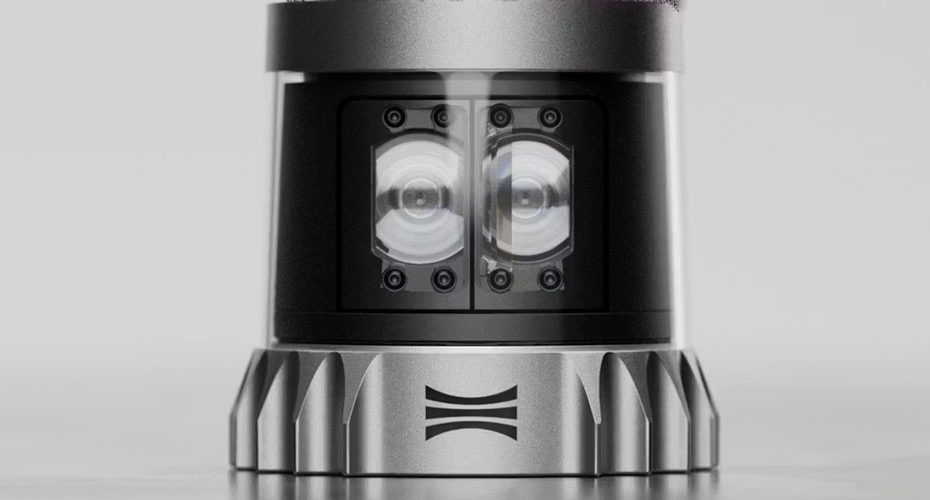
Rev8 represents the newest generation of Ouster’s digital LiDAR platform. While the entire OS family benefits from updated hardware, the flagship OS1 Max targets demanding long range perception applications.
| Specification | OS1 Max |
|---|---|
| Detection range at 10% reflectivity | 200 m |
| Maximum measurable range | 500 m |
| Vertical field of view | 45° |
| Minimum detection distance | 0.0 m |
| Point cloud density | Up to 10.4 million points per second |
| Color capability | Native color 3D vision |
One of the most notable additions is native color sensing, allowing each 3D point in the cloud to be associated directly with color information without requiring external cameras. This simplifies sensor fusion while improving object classification, traffic analysis, and AI perception in complex urban environments.
The OS1 Max is also designed to automotive reliability standards, enabling continuous operation under demanding environmental conditions.
BlueCity Gains Federal Procurement Eligibility
The BABA certification also extends to Ouster BlueCity, the company’s complete traffic management platform that combines digital LiDAR with proprietary perception software.
BlueCity uses three dimensional sensing rather than traditional video cameras to monitor roads, intersections, pedestrians, cyclists, and vehicles in real time. The platform supports applications including adaptive traffic signal control, pedestrian safety systems, congestion monitoring, and transportation analytics.
With Rev8 integrated, BlueCity now offers:
- Detection distances up to 500 meters.
- Native color 3D perception.
- Multimodal traffic monitoring.
- AI based traffic analytics.
- Real time infrastructure alerts.
For cities seeking federal funding, having both the hardware and complete sensing platform satisfy procurement requirements can simplify deployment planning.
Why This Matters Beyond Compliance
While the technical improvements in Rev8 are significant, the certification itself may ultimately have an even larger commercial impact.
Public infrastructure projects often move slowly because procurement regulations limit eligible suppliers. By satisfying BABA requirements, Ouster positions itself as one of the relatively small number of advanced LiDAR manufacturers capable of participating directly in federally funded U.S. transportation programs.
At the same time, the combination of high resolution digital LiDAR, native color imaging, and AI based perception reflects a broader shift away from conventional traffic cameras toward richer three dimensional sensing. LiDAR is less affected by lighting conditions, provides accurate distance measurements, and enables more reliable object tracking for increasingly automated transportation infrastructure.
As cities continue investing in connected intersections and intelligent mobility, procurement readiness may become just as important as raw sensor performance.
About Ouster
Founded in 2015 and headquartered in San Francisco, California, Ouster develops digital LiDAR sensors and AI powered perception software for automotive, industrial automation, robotics, smart infrastructure, and security markets. The company became publicly traded on NASDAQ (ticker: OUST) in 2021 and significantly expanded its product portfolio following its merger with Velodyne in 2023. Today, Ouster’s sensors are deployed across thousands of customer applications worldwide, with its digital architecture designed to deliver scalable manufacturing, high reliability, and continuously improving perception capabilities through software updates.