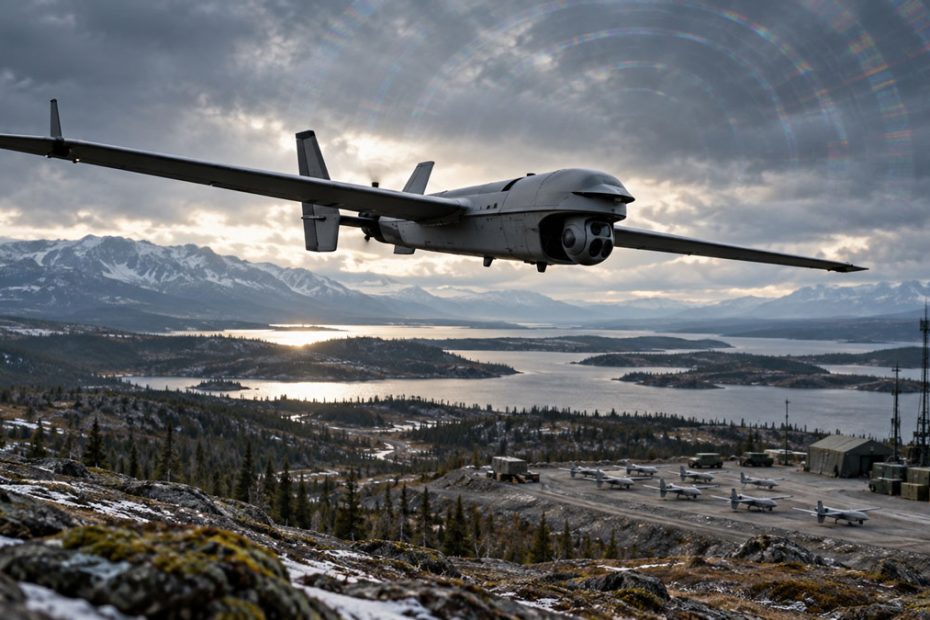
Volatus Aerospace has completed the first flight tests of its V-Cortex AI Flight Controller and Autonomy Operating System, demonstrating that an aircraft equipped with the Canadian-developed platform can maintain flight without GNSS, external navigation sensors, or high-performance external computing.
The September 22 test moves V-Cortex from a development program into actual flight demonstration at an important time for Volatus. Less than two weeks earlier, the company announced a Canadian government contract covering an initial 100 low-cost tactical intelligence, surveillance, and reconnaissance UAS, with options that could expand procurement to as many as 5,000 systems.
The timing makes the technology more significant than another experimental autonomy project. Volatus is simultaneously trying to establish a domestic production capability for military drones and develop more of the flight-control technology inside those aircraft.
V-Cortex Flies Without GNSS
During the initial tests, V-Cortex maintained flight using the aircraft’s standard onboard sensors rather than GNSS or additional external navigation hardware. Volatus specifically says the demonstration was performed without visual sensors.
That distinction matters.
Many GNSS-denied navigation systems compensate for the loss of satellite positioning by adding cameras, LiDAR, specialized inertial sensors, terrain databases, or substantial onboard computing. These approaches can work well, but they increase weight, power consumption, cost, and system complexity.
V-Cortex is attempting a different approach: place flight control and autonomous decision-making into a very small common computing architecture that can work across different aircraft.
When Volatus introduced the platform at CANSEC 2026 in May, it said the V-Cortex hardware measured approximately 3.5 by 3.5 centimeters and weighed less than 15 grams. The company designed it around a Modular Open Systems Architecture, or MOSA, allowing sensors, payloads, autonomy functions, and third-party systems to be integrated without redesigning the entire flight-control architecture.
Why GNSS-Denied Flight Matters
The ability to operate without satellite navigation has become one of the most important requirements for military UAS.
GNSS provides drones with highly accurate position, velocity, and timing information, but the radio signals received from navigation satellites are extremely weak by the time they reach an aircraft. That makes them vulnerable to deliberate jamming and potentially to spoofing, where false navigation signals cause a receiver to calculate an incorrect position.
Removing GNSS from the navigation loop therefore changes the failure mode of the aircraft. A jammer can no longer simply eliminate the drone’s primary positioning source and expect the platform to become unusable.
The same capability has applications outside combat. Satellite signals can become unreliable around dense structures, infrastructure, indoor environments, and high-latitude operations. Volatus specifically identifies Canada’s Arctic as one target environment for the technology.
What the Test Does Not Prove Yet
The first flights are technically meaningful, but they should not be confused with operational qualification.
Volatus has not disclosed the distance flown without GNSS, flight duration, accumulated position error, navigation drift rate, environmental conditions, aircraft speed, repeatability across multiple flights, or performance after extended GNSS outages.
Those numbers will ultimately matter more than the simple fact that the aircraft remained in controlled flight.
A GNSS-denied system that can navigate accurately for several minutes is useful. A system that maintains mission-level accuracy over long distances is considerably more valuable. Performance against spoofing, sensor degradation, vibration, wind, temperature extremes, and rapidly changing flight dynamics will also determine how broadly the architecture can be deployed.
Volatus says additional flight testing and capability demonstrations will continue throughout 2026 as V-Cortex moves toward operational deployment.
One Autonomy Stack for Multiple Drones
Potentially more important than the individual test is the architecture behind it.
V-Cortex is designed as a platform-agnostic autonomy layer rather than a flight controller developed exclusively for one aircraft. Volatus intends to integrate the technology into its own V-Series aircraft and Condor platform while also making the architecture suitable for other uncrewed systems.
That could give the company a different position in the drone supply chain.
Airframes can be replaced relatively easily. A mature autonomy architecture integrated with sensors, mission software, payloads, ground-control systems, and operational procedures is considerably harder to replace.
If V-Cortex eventually works across multiple aircraft classes, Volatus could reuse the same underlying software and flight-control architecture instead of developing a separate autonomy system for every drone.
That is where I think the real technical value of V-Cortex lies. GNSS-denied flight attracts attention, but a lightweight, reusable autonomy layer could be more important commercially. It could turn Volatus from primarily a drone manufacturer and service provider into a supplier of a common flight architecture.
The next tests need to demonstrate that this architecture remains reliable outside controlled demonstrations.
Canada Orders First 100 Tactical UAS
The V-Cortex milestone follows a Canadian Department of National Defence procurement awarded in September.
CanadaBuys lists a C$496,001 contract awarded to Volatus Aerospace Corp. on September 9 for low-cost UAS, including associated equipment and support. Volatus subsequently said the initial procurement covers 100 tactical ISR systems under a five-year framework that gives Canada the option to purchase another 4,900 systems.
If every option were exercised, the procurement pathway could reach 5,000 systems and a maximum value of approximately C$25 million, according to the company. Deliveries of the initial systems are expected to begin during the fourth quarter of 2026.
The optional quantity is important, however. The agreement should not be interpreted as a firm 5,000-drone order. The initial 100 systems are the immediate procurement commitment, while subsequent quantities remain at the Canadian government’s discretion.
Volatus also qualified for Canada’s Defence Drone Initiative Marketplace in August, giving the company access to a procurement framework covering uncrewed and autonomous systems, counter-UAS technologies, communications, integration, testing, training, and related capabilities. Canada’s official procurement record lists Volatus among the qualified suppliers under a 59-month arrangement running through July 2031.
Production Is the Next Test
Volatus now has two separate challenges: proving V-Cortex technically and proving that it can manufacture and deliver aircraft at scale.
The second challenge should not be underestimated.
The company’s Q2 2026 revenue was C$8.42 million, down from C$10.59 million a year earlier. Volatus said approximately C$2.6 million of anticipated defense revenue was delayed because of continuing supply-chain disruption. The company reported a Q2 adjusted EBITDA loss of C$4.35 million.
Its balance sheet is substantially stronger than it was previously, with cash of approximately C$59.2 million at June 30, 2026. First-half revenue totaled C$14.05 million, with products and equipment generating C$6.22 million and services and training contributing C$7.83 million.
Those figures explain why the upcoming Canadian deliveries matter.
A successful flight demonstration proves a technology concept. Consistently producing aircraft, integrating that technology into them, meeting military delivery schedules, and maintaining acceptable manufacturing margins proves a business model.
For Volatus, the fourth quarter of 2026 begins that second test.
About Volatus Aerospace
Volatus Aerospace Inc. is a Canadian aerospace and defense company providing uncrewed aircraft systems, aerial intelligence, drone services, training, equipment, and autonomous technologies across Canada and international markets.
The current company was formed following the August 30, 2024 combination of Volatus Aerospace Corp. and Drone Delivery Canada Corp. The combined business operates in Canada, the United States, the United Kingdom, and other international markets.
Volatus generated C$34.2 million in revenue in 2025, up 26% from C$27.1 million in 2024. Product and equipment revenue more than doubled to C$16.3 million, while services generated C$17.9 million. Gross profit reached C$11.1 million, representing a 32% gross margin.
For the first six months of 2026, the company reported C$14.05 million in revenue and C$4.44 million in gross profit, with approximately 35% of revenue generated outside Canada. Volatus shares trade in Canada under the ticker FLT and in the United States under TAKOF.