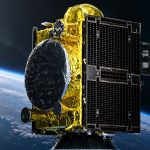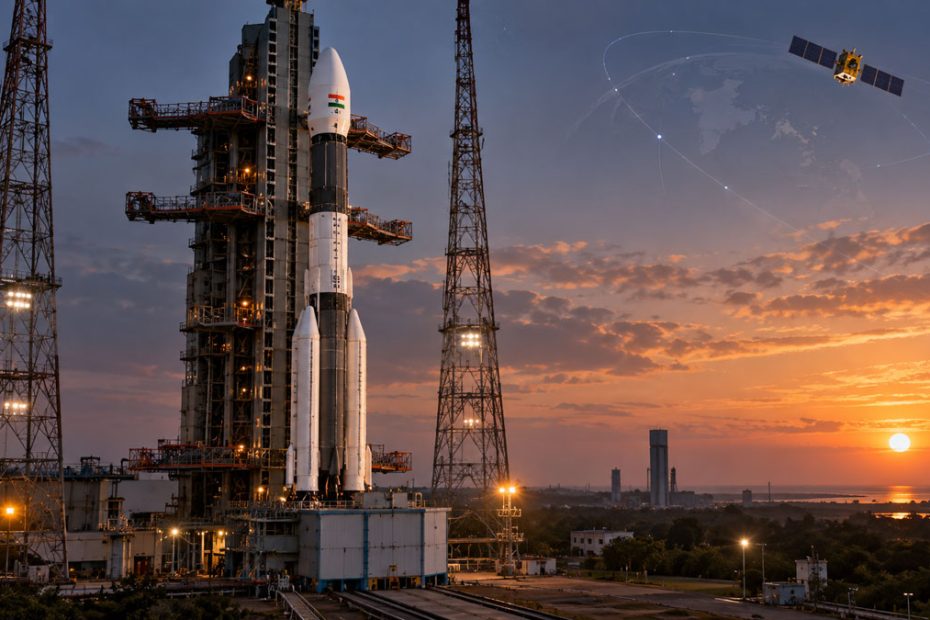
India’s space agency, ISRO, is preparing to launch the NVS-03 navigation satellite between October 15 and 20, 2026, as it works to restore the positioning capabilities of its NavIC satellite navigation system. The spacecraft will be carried aboard a GSLV Mk II rocket from the Satish Dhawan Space Centre in Sriharikota, India.
The upcoming mission comes at a critical stage for India’s independent satellite navigation infrastructure. With only three NavIC satellites currently available for positioning, the constellation cannot provide standalone navigation services, although its timing service remains operational.
NVS-03 is intended to help address that shortfall while continuing the deployment of India’s second-generation navigation satellites. Its launch will also provide an important opportunity to demonstrate corrective measures introduced after the NVS-02 satellite encountered a propulsion system failure following its January 2025 launch.
NVS-03 Launch Scheduled for October 2026
According to a September 21 report by The Times of India, ISRO is targeting a launch window of October 15-20, with preparations underway to support the earliest possible launch date.
The GSLV Mk II launch campaign began on September 14, and assembly of the rocket’s first stage has already been completed. NVS-03 is also reportedly at the Sriharikota spaceport, eliminating the need to transport the spacecraft to the launch site.
The satellite had been awaiting government authorization alongside the GISAT-1A spacecraft. Approval was granted in September, allowing preparations for the navigation mission to proceed.
The announced dates remain a target rather than a confirmed launch schedule. Final timing will depend on the completion of launch vehicle integration, spacecraft checks, mission readiness reviews, and other operational requirements.
NavIC Constellation Needs Four Operational Satellites
The NVS-03 mission is particularly important because NavIC currently lacks enough operational spacecraft to deliver independent positioning services.
The regional navigation system was originally designed around seven satellites. However, aging spacecraft and technical failures have reduced the number available for navigation.
According to information presented to India’s Parliament, only three satellites remain available for positioning, navigation, and timing services:
- IRNSS-1B
- IRNSS-1I
- NVS-01
A satellite navigation receiver normally needs signals from at least four satellites to calculate three-dimensional position and resolve its internal clock offset. With only three operational satellites, NavIC cannot currently provide standalone positioning.
Adding NVS-03 would potentially restore the minimum satellite count required for independent navigation. However, the spacecraft must first reach its designated operational orbit, complete commissioning, and demonstrate the required signal performance.
Restoring the minimum number of satellites would also leave limited redundancy. Additional spacecraft will be necessary to improve service continuity and reduce the risk of future interruptions.
NVS-02 Propulsion Failure and Corrective Measures
The previous NavIC satellite launch illustrates why the NVS-03 mission will require particular attention to spacecraft reliability.
On January 29, 2025, ISRO launched NVS-02 aboard the GSLV-F15 rocket. The launch vehicle successfully delivered the spacecraft into an elliptical transfer orbit measuring approximately 170 by 37,785 kilometers, with an inclination of 20.8 degrees.
Following separation, NVS-02 deployed its solar panels and stabilized its orientation. However, the spacecraft could not execute the propulsion maneuvers required to reach its intended operational orbit.
The subsequent investigation identified an electrical problem affecting the pyrotechnic valve activation system in the propulsion assembly.
According to the investigation findings reported by The Times of India, the electrical command required to activate a pyro valve in the engine’s oxidizer line failed to reach the valve. Investigators identified disengagement of electrical contacts in both the primary and redundant connector paths as the most likely cause.
Consequently, the engine could not perform the orbit-raising maneuvers needed to transfer the satellite into its designated circular orbit.
The investigation recommended modifications to improve the redundancy and operational reliability of the pyrotechnic system. ISRO has reportedly implemented those corrective measures ahead of subsequent missions.
The failure is an important reminder that successful launch vehicle performance does not guarantee a successful satellite mission. The spacecraft must also complete orbital insertion maneuvers, deploy its operational systems, and pass in-orbit testing before it can provide navigation services.
Second-Generation NavIC Satellite Technology
NVS-03 belongs to India’s second-generation navigation satellite program, which is designed to maintain and improve the capabilities of the existing NavIC constellation.
The program includes five planned spacecraft, designated NVS-01 through NVS-05, which are intended to augment the original satellite network and maintain continuity of navigation services.
A significant technological development in the second-generation series is the introduction of civilian navigation signals in the L1 frequency band at 1575.42 MHz.
The original NavIC system provides navigation signals in the L5 band at 1176.45 MHz and the S band at 2498.028 MHz. Adding L1 enables broader compatibility with GNSS receiver architectures that already support this widely used navigation frequency.
The first second-generation spacecraft, NVS-01, was launched on May 29, 2023. It also introduced an indigenous atomic clock developed for India’s navigation satellite program.
For GNSS equipment manufacturers, the expansion of NavIC’s signal capabilities creates additional opportunities to incorporate India’s regional navigation system into multi-constellation receivers.
However, actual receiver performance depends on satellite availability, signal geometry, receiver hardware, firmware support, and the conditions under which positioning measurements are collected.
NavIC Applications in Surveying and Precision Agriculture
NavIC is designed to provide regional positioning, navigation, and timing services across India and an area extending approximately 1,500 kilometers beyond its borders.
Its stated applications include transportation, surveying, geodesy, personal navigation, resource monitoring, and timing synchronization.
ISRO specifies a standard positioning accuracy better than 20 meters at the two-sigma level for NavIC’s primary service area under its stated service conditions.
For professional GNSS applications, NavIC signals can provide additional satellite observations when integrated into compatible multi-constellation receivers.
In land surveying and precision agriculture, the availability of additional usable satellites may improve positioning geometry and observation availability, particularly where buildings, terrain, or other obstacles restrict satellite visibility.
However, additional navigation signals do not automatically translate into centimeter-level positioning.
Survey-grade accuracy still requires suitable GNSS hardware, appropriate correction services, and reliable carrier-phase measurements.
For precision agriculture, the practical value of additional satellite observations lies in their potential to improve the availability and continuity of positioning during operations such as automated steering, field mapping, and machine guidance.
The operational availability of NavIC’s satellites therefore matters beyond consumer navigation. A sufficiently populated constellation would give compatible professional receivers another source of measurements alongside GPS, Galileo, GLONASS, and BeiDou.
Why NVS-03 Matters for GNSS Reliability
The most significant aspect of the NVS-03 mission is the distinction between restoring basic navigation capability and establishing a resilient operational constellation.
A fourth operational satellite could allow NavIC to resume standalone positioning, but four spacecraft represent the minimum needed for a conventional three-dimensional satellite navigation solution with an unknown receiver clock offset.
Such a configuration provides limited flexibility when a satellite becomes unavailable or when local obstructions prevent a receiver from tracking the necessary signals.
From a GNSS engineering perspective, satellite availability, orbital geometry, signal integrity, and spacecraft reliability must be considered together when evaluating the performance of a navigation system.
The previous NVS-02 failure also highlights an important distinction between launch success and operational spacecraft delivery.
A satellite that reaches transfer orbit but cannot complete its subsequent propulsion maneuvers may be unable to provide its intended navigation service, even when the launch vehicle performs as planned.
For NVS-03, successful deployment will therefore need to be followed by reliable orbital insertion, satellite commissioning, and navigation signal validation.
The planned deployment of NVS-04 and NVS-05 will be equally relevant to the constellation’s longer-term reliability. According to the September 21 report, both spacecraft are already in advanced stages of development.
The broader technical objective should be a sufficiently populated and reliable constellation capable of maintaining positioning and timing services when individual satellites experience technical problems or reach the end of their operational lives.
About ISRO
The Indian Space Research Organisation (ISRO) is India’s national space agency, headquartered in Bengaluru and operating under the Department of Space, Government of India.
Established on August 15, 1969, ISRO develops and operates satellite systems, launch vehicles, navigation infrastructure, and space exploration missions. Its principal launch vehicle programs include the Polar Satellite Launch Vehicle (PSLV) and Geosynchronous Satellite Launch Vehicle (GSLV).
ISRO operates seven major centers, including the Vikram Sarabhai Space Centre, U R Rao Satellite Centre, and Satish Dhawan Space Centre.
Its NavIC navigation program was designed around a seven-satellite constellation supported by a continuously operating ground infrastructure. The system provides regional coverage extending approximately 1,500 kilometers beyond India’s borders.
The second-generation NavIC development program includes five NVS-series satellites, with NVS-01 launched in May 2023 and NVS-03 currently being prepared for its planned October 2026 mission.