The first Emirati navigation technology satellite begins testing Low Earth Orbit signals that could reshape the future of satellite positioning.
The United Arab Emirates has taken another significant step in space technology with the successful launch of LEONAV 1, the country’s first satellite dedicated specifically to satellite navigation research. Developed by the National Space Science and Technology Center (NSSTC) at United Arab Emirates University with support from the UAE Space Agency, the mission is designed to evaluate how Low Earth Orbit satellites could improve future positioning, navigation, and timing services.
Rather than becoming an operational navigation satellite immediately, LEONAV 1 serves as a technology demonstrator. Its primary role is to validate key navigation concepts and gather engineering data that could support the development of an entirely new LEO based navigation architecture in the coming years.
LEONAV 1 Begins Early Orbit Testing
Following launch, LEONAV 1 has entered the Launch and Early Orbit Phase, commonly known as LEOP. During this critical stage, engineers will verify spacecraft health, establish stable communications, test onboard systems, and confirm that all payloads perform according to mission requirements.
Only after completing these initial checks will the satellite begin its planned navigation experiments.
Testing GNSS Signals from Low Earth Orbit
One of the mission’s most important objectives is demonstrating the transmission of GNSS like navigation signals from Low Earth Orbit using the L5 E5 and S band frequencies while ensuring compatibility with existing global navigation satellite systems.
Researchers will evaluate:
- Signal transmission and reception through ground stations.
- Orbit Determination and Time Synchronization (ODTS) software.
- Navigation signal stability and accuracy.
- Integration with existing GNSS infrastructure.
- Overall feasibility of future LEO navigation constellations.
The mission is intended to generate technical data rather than provide commercial positioning services.
Why LEO Navigation Matters
Traditional navigation systems such as GPS, Galileo, BeiDou, and GLONASS operate from Medium Earth Orbit approximately 20,000 kilometers above Earth. Although highly reliable, those long distances result in extremely weak signals by the time they reach receivers.
Low Earth Orbit satellites fly hundreds instead of tens of thousands of kilometers above Earth. Their closer proximity enables significantly stronger signals, potentially improving positioning performance in dense urban environments, mountainous terrain, and areas where conventional GNSS signals are degraded or intentionally disrupted.
LEO constellations could also shorten signal travel times and improve resilience by combining traditional GNSS with additional navigation layers.
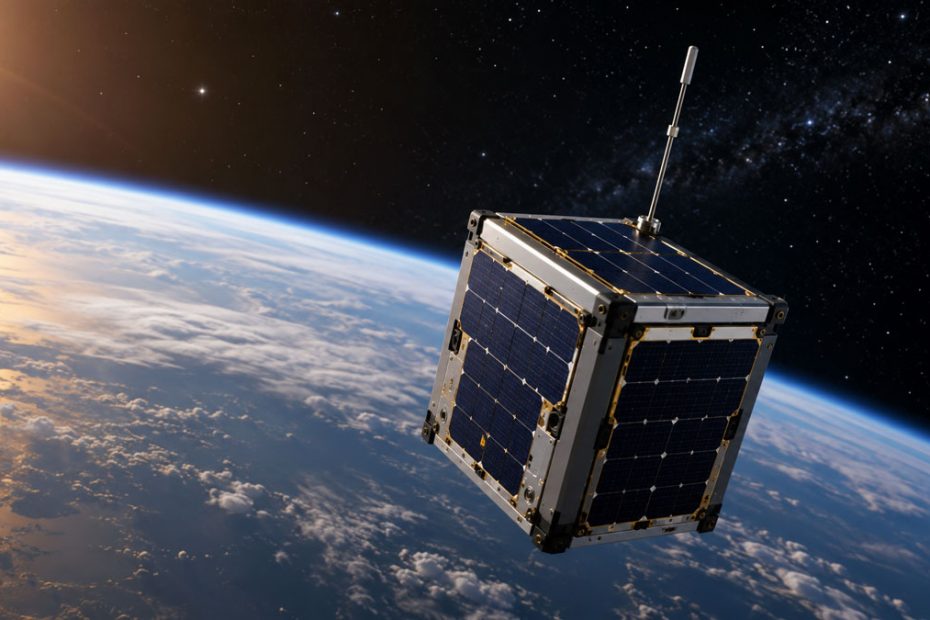
Although LEONAV 1 is only a single CubeSat, it represents the first practical step toward evaluating whether future hybrid navigation systems can complement existing global constellations.
Industry Perspective
The global navigation industry is increasingly exploring Low Earth Orbit as the next major evolution beyond traditional GNSS. While satellite navigation from Medium Earth Orbit will remain the backbone of positioning services for decades, multiple organizations are now investigating how LEO constellations can enhance accuracy, signal strength, and resilience rather than replace existing systems.
The UAE’s decision to begin with a technology demonstrator is a technically sound approach. Before investing in expensive multi satellite constellations, validating signal behavior, timing performance, and orbit determination in real space conditions provides valuable engineering knowledge while minimizing program risk. If the mission delivers positive results, it could position the UAE as an active contributor to one of the fastest developing areas of satellite navigation research.
About the UAE Space Agency
Established in 2014, the UAE Space Agency leads the country’s national space strategy and supports research, commercial space development, and international partnerships. The UAE has rapidly expanded its space capabilities through missions such as the Hope Probe to Mars, multiple Earth observation satellites, astronaut programs, and investments in advanced satellite technologies. Working alongside universities and research institutions like the National Space Science and Technology Center, the agency continues to strengthen the country’s position as one of the Middle East’s fastest growing space nations.