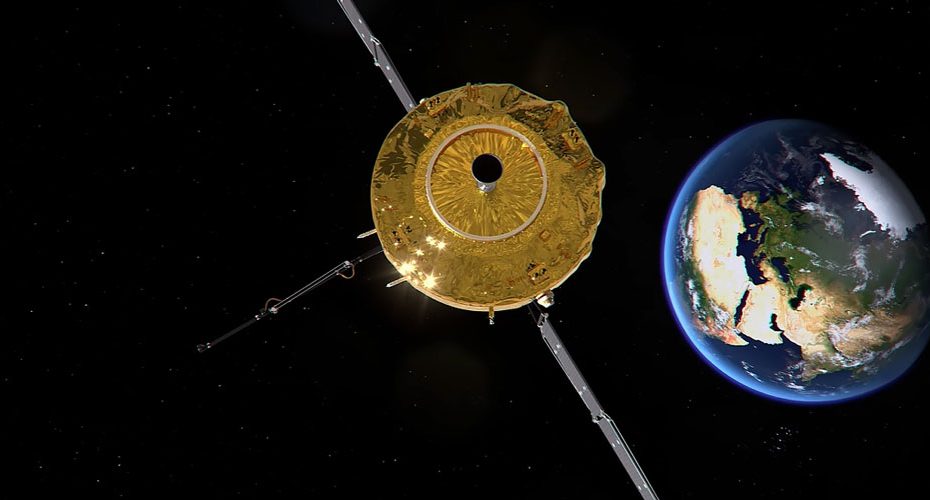
Low Earth orbit positioning signals are moving from concept to real-world testing, and u-blox is positioning itself early in this transition. Following the first in-orbit demonstration of European Space Agency’s Celeste LEO-PNT satellites, the company has begun assessing how these new signals can be integrated into mainstream GNSS receivers.
ESA Celeste LEO PNT mission introduces a new signal layer for resilient positioning
Celeste LEO-PNT represents Europe’s first structured attempt to extend positioning, navigation, and timing into low Earth orbit. The current demonstration phase includes a constellation of 11 satellites plus one spare, designed to test signal transmission across multiple frequency bands.
Unlike traditional GNSS systems such as Galileo, which operate in medium Earth orbit, LEO satellites orbit much closer to Earth.
This shift fundamentally changes signal behavior:
- Higher signal power at the receiver level.
- Faster-changing satellite geometry.
- Increased resilience in obstructed environments.
The goal is not to replace GNSS, but to introduce an additional layer that improves reliability, especially in urban canyons, dense vegetation, and interference-prone environments.
u-blox tests LEO signal integration on X20 platform for future GNSS receivers
Within ESA’s NAVISP Element 2 framework, u-blox is running a structured technical evaluation of how LEO signals interact with existing GNSS measurements.
The work focuses on several core areas:
- Characterizing real LEO signal transmissions from orbit.
- Studying how LEO and GNSS signals behave together in hybrid positioning.
- Measuring the impact of rapidly changing satellite geometry.
- Testing integration strategies for future receiver architectures.
This is already being explored on the company’s X20 GNSS platform, which serves as a testbed for next-generation multi-layer positioning.
The key shift here is architectural. Instead of treating GNSS as a standalone system, u-blox is moving toward a layered model where:
- GNSS provides baseline global coverage.
- LEO adds robustness and faster convergence.
- Future corrections and services sit on top as additional layers.
- Dynamic LEO geometry could improve convergence speed and urban positioning accuracy.
One of the most important differences introduced by LEO satellites is geometry dynamics. GNSS satellites move relatively slowly from the receiver’s perspective, which limits how quickly positioning solutions can converge.
LEO satellites, by contrast, move rapidly across the sky.
This creates:
- Faster geometry changes.
- More frequent measurement updates.
- Potentially quicker ambiguity resolution in RTK-like workflows.
In practical terms, this could reduce time-to-first-fix and improve positioning stability in difficult environments.
However, this advantage comes with complexity.
Rapid geometry changes also require:
- New filtering approaches in receivers.
- More advanced signal tracking algorithms.
- Tight synchronization between LEO and GNSS measurements.
- LEO PNT remains a complement to GNSS, not a replacement.
Despite the momentum around LEO-based positioning, the current direction is clearly additive.
GNSS remains the backbone of global positioning due to:
- Established infrastructure.
- Global coverage.
- Proven interoperability.
LEO PNT is being positioned as a resilience layer rather than a standalone system. This is consistent with broader industry trends, including alternative PNT concepts such as terrestrial signals and LEO communication constellations.
Technical assessment
The direction is strategically sound, but the real challenge is not signal availability. It is system integration.
Adding LEO signals into GNSS receivers is not just a hardware problem. It is a system-level redesign:
- Signal fusion algorithms must handle different orbital dynamics.
- Power consumption must remain viable for mass-market devices.
- Cost must stay within consumer-grade constraints.
There is also a timing question. Demonstration missions like Celeste validate feasibility, but scaling this into a stable operational service will require:
- Larger constellations.
- Standardized signal structures.
- Receiver ecosystem readiness.
The most realistic near-term outcome is hybrid receivers that opportunistically use LEO signals when available, rather than relying on them continuously.
About u-blox
- Founded: 1997, Switzerland.
- Employees: ~1,300 globally.
- Core segments: GNSS positioning, cellular IoT, short-range communication.
- Market focus: automotive, industrial, consumer devices.
- GNSS platforms: includes X20 generation targeting multi-frequency and multi-constellation integration.
About European Space Agency (ESA)
- Founded: 1975.
- Member states: 22 countries.
- Annual budget: ~€7.5 billion.
- Key programs: Galileo, Copernicus, NAVISP.
- Celeste program: 11 satellites plus one spare in initial LEO-PNT demonstration phase.
- Celeste LEO-PNT program.
- Phase: In-orbit demonstrator.
- Constellation: 11 + 1 satellites.
- Supported by: ESA Council Ministerial 2022 and 2025.
- Industrial partners: GMV, OHB, Thales Alenia Space, over 50 entities across 14+ countries.