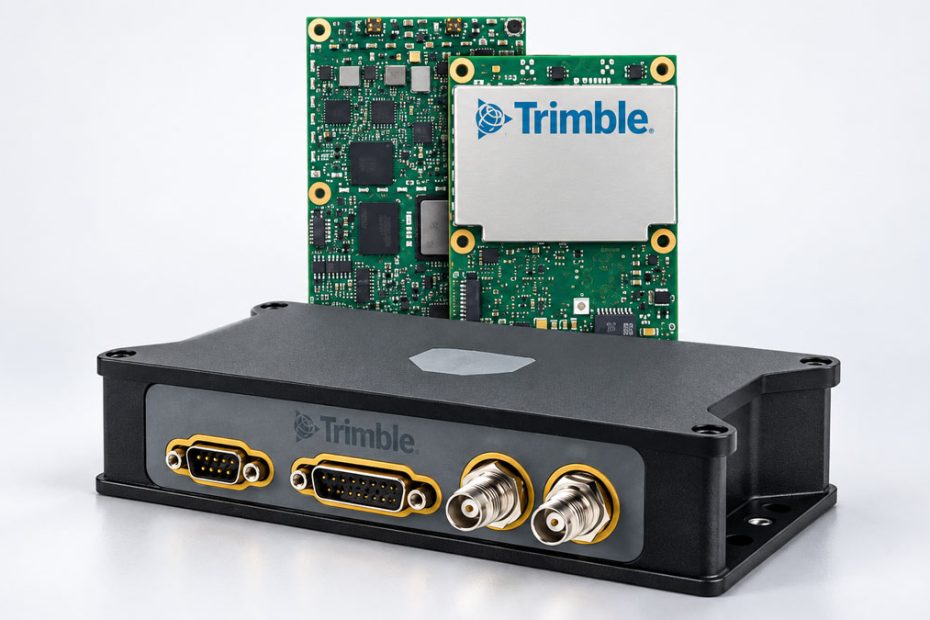
Trimble has introduced a new generation of high-precision OEM GNSS receivers built around its Maxwell 8 architecture, adding stronger protection against jamming and spoofing, significantly more processing power, improved vibration tolerance and hardware designed with future Low Earth Orbit navigation signals in mind.
The new family includes the Trimble BD1090, BD1092, BD1092i and BX1092i. Announced on September 10, 2026, the receivers target OEM manufacturers and system integrators building positioning systems for geospatial surveying, marine operations, construction, mining, autonomous equipment and other applications where losing GNSS availability can quickly become an operational problem.
The launch is notable because Trimble is no longer treating interference resistance as a secondary GNSS feature. With Maxwell 8, resilience against deliberate and accidental RF interference becomes one of the central elements of the receiver architecture.
Maxwell 8 GNSS Architecture
At the hardware level, Maxwell 8 introduces a quad-core processor paired with DDR4 memory. Trimble says the platform provides four times the processing capability of the previous generation, giving the receiver considerably more headroom for GNSS calculations, inertial integration, sensor fusion, signal monitoring and interference mitigation.
That additional processing capacity matters because modern high-end GNSS receivers increasingly have to do much more than calculate coordinates from satellite measurements.
A receiver may simultaneously track multiple frequencies from several constellations, run RTK or PPP-style positioning algorithms, analyze the RF environment, integrate IMU data, estimate orientation, detect suspicious satellite signals and maintain multiple communication interfaces.
Maxwell 8 also expands Trimble’s “all-in-view” tracking capability, allowing simultaneous multi-constellation and multi-frequency reception across a larger number of available signals. The current receiver family is described as quad-band, with Trimble listing support around the L1, L2, L5 and E6 frequency groups.
JammerGuard Targets RF Interference
The most significant addition is Trimble JammerGuard.
Rather than relying solely on conventional notch filtering against a limited number of interference sources, Trimble says JammerGuard continuously monitors the RF environment and automatically mitigates unwanted signals across the receiver’s supported spectrum.
The company describes the system as capable of responding independently to a broad range of jamming scenarios. Maxwell 8 also includes an RF spectrum monitoring and analysis toolkit that can help integrators identify interference generated either externally or by electronics inside the host machine itself.
That distinction is important.
Not every GNSS interference problem comes from an intentional jammer. Poorly shielded DC/DC converters, radios, displays, computers, motors and other electronics integrated into a machine can raise the local RF noise floor or create narrowband interference.
For OEM developers, being able to visualize and isolate those sources directly through the receiver can be almost as valuable as protection from deliberate jamming.
Multi-Layer Spoofing Protection
Trimble is also combining JammerGuard with several existing signal integrity technologies rather than depending on a single protection mechanism.
RTX-NMA provides satellite signal authentication capabilities intended to help identify spoofed signals, while Galileo OSNMA can authenticate navigation data transmitted by Galileo satellites.
Trimble IonoGuard addresses a different problem: ionospheric disturbances that can degrade GNSS positioning even when no intentional interference is present.
ProPoint remains the positioning engine responsible for calculating high-accuracy solutions under difficult satellite geometry and signal conditions, while EVEREST Plus is used to reduce multipath errors caused by reflected GNSS signals.
Taken together, Trimble is effectively building several defensive layers around the positioning engine:
RF interference mitigation, signal authentication, ionospheric disturbance handling and multipath suppression.
That layered approach is more technically interesting than the JammerGuard name by itself.
BD1090: Single-Antenna GNSS
The BD1090 is the entry point into the Maxwell 8 family.
It is a single-antenna, quad-band GNSS receiver module measuring approximately 100 x 60 x 11.6 mm. Trimble specifies centimeter-level positioning with position output rates of up to 50 Hz.
The receiver supports Trimble ProPoint positioning together with JammerGuard, IonoGuard, RTX-NMA and Galileo OSNMA authentication.
Available interfaces include Ethernet, RS-232, USB and CAN, while integrated Ethernet also allows configuration through a web interface. Precision Time Protocol, or PTP, is supported alongside NTP for timing applications.
For embedded machine control applications that require accurate position but do not need direct GNSS heading or integrated inertial navigation, the BD1090 is likely to be the simplest Maxwell 8 integration path.
BD1092 Adds Dual-Antenna Heading
The BD1092 moves to a dual-antenna architecture.
Using two GNSS antennas allows the receiver to calculate heading directly from the relative position of the antennas. Unlike heading calculated from vehicle movement, dual-antenna heading can remain available when the machine is stationary.
That makes the architecture particularly useful for machines, vessels and robotic platforms where orientation is required immediately after startup or during very low-speed operation.
Trimble lists the same compact 100 x 60 x 11.6 mm module dimensions while supporting position and heading output at high update rates. The platform is capable of update rates up to 100 Hz depending on configuration.
BD1092i Adds GNSS-INS
The BD1092i is the more advanced embedded board in the family.
It combines dual-antenna GNSS with an integrated MEMS inertial navigation system. Trimble specifies inertial sensors capable of handling acceleration up to ±8 g and angular rates up to ±300 degrees per second.
GNSS and inertial measurements are tightly coupled, allowing the receiver to continue estimating position and orientation when satellite signals are temporarily degraded or unavailable.
Output rates can reach 100 Hz, which makes the module relevant for dynamic machine control, autonomous platforms, marine applications and systems where orientation changes faster than conventional 10 or 20 Hz GNSS outputs can comfortably represent.
Dual antennas also accelerate heading initialization and allow heading to be established while stationary.
BX1092i Adds Rugged Enclosure
The BX1092i packages essentially the same dual-antenna GNSS-INS concept into an industrial enclosure instead of an embedded OEM board.
Trimble gives the unit an IP67 rating and provides Ethernet, RS-232, CAN and USB interfaces along with PTP timing support. RS-232 data rates have been increased to as much as 921,600 baud, and Trimble also lists drivers for both ROS 1 and ROS 2.
ROS support is particularly relevant to robotics and autonomous machine developers because it reduces the amount of custom integration required to bring high-accuracy GNSS and inertial data into robotic software stacks.
Better Performance Under Vibration
Another less visible Maxwell 8 improvement could be important for agricultural, construction and mining machinery.
Trimble has replaced conventional oscillator technology with MEMS-based oscillators that the company says provide approximately 10 times lower sensitivity to vibration.
A GNSS receiver mounted inside a survey instrument may operate in a relatively controlled mechanical environment. A receiver installed on an excavator, dozer, tractor, mining truck or marine vessel does not.
Continuous vibration can influence oscillator stability and complicate high-quality signal tracking. Reducing that sensitivity at the hardware level is therefore more meaningful for machine applications than the specification might initially suggest.
Maxwell 8 Prepares for LEO GNSS
Trimble has also designed Maxwell 8 with future Low Earth Orbit positioning signals in mind.
The company specifically mentions compatibility with demonstration signals from Xona Space Systems’ Pulsar constellation.
LEO navigation systems could eventually complement traditional GNSS constellations such as GPS, Galileo, BeiDou and GLONASS.
Because LEO satellites orbit far closer to Earth than conventional GNSS satellites in medium Earth orbit, their signals can potentially arrive with substantially greater received power. They also move rapidly relative to the user, producing different geometry and signal dynamics.
Those characteristics make LEO positioning especially interesting for environments where conventional GNSS signals are weak or vulnerable to interference.
It is important, however, to separate hardware readiness from operational availability. Trimble is not claiming that Maxwell 8 receivers can currently replace conventional GNSS with a mature LEO positioning service. The receivers have been designed so the architecture can support emerging systems such as Xona Pulsar as those constellations develop.
Why Maxwell 8 Matters
The biggest story here is not the jump from one Maxwell generation to another.
It is the shift in what a professional GNSS receiver is expected to defend against.
For decades, high-end positioning development concentrated primarily on tracking more satellites, adding more frequencies and improving RTK convergence, multipath rejection and positioning algorithms.
Those problems remain important, but intentional interference has changed the engineering priorities.
A receiver can have excellent centimeter-level accuracy specifications and still become operationally useless if the RF environment prevents it from observing trustworthy satellite signals.
That makes JammerGuard, RTX-NMA, OSNMA authentication and RF spectrum monitoring more than additional features on a specification sheet. Together, they indicate that GNSS receiver design is moving from pure positioning toward positioning plus signal security.
The additional computing power is equally significant.
Quad-core processing and considerably more memory give Trimble room to run heavier sensor fusion and signal analysis algorithms directly inside the receiver instead of pushing those calculations into an external computer.
For autonomous machines and industrial OEM systems, that can simplify the overall architecture while reducing latency between signal reception, interference detection and the final navigation solution.
The LEO capability should be viewed with more caution. It is strategically important, but its immediate value remains limited until commercial LEO positioning constellations reach meaningful operational scale.
JammerGuard and the new processing architecture are technologies customers can benefit from now. LEO readiness is primarily protection against technological obsolescence later.
That combination makes Maxwell 8 less of a conventional receiver refresh and more of a foundation for Trimble’s next generation of resilient positioning hardware.
About Trimble
Trimble was founded in 1978 by Charles Trimble and two partners and is headquartered in Westminster, Colorado. The company became one of the early commercial pioneers of satellite positioning, selling what it describes as the world’s first commercially viable GPS receiver in 1984.
Today, Trimble, Nasdaq: TRMB, develops positioning, modeling, connectivity and data systems for construction, geospatial, transportation and related industries.
Trimble reported $3.587 billion in revenue for fiscal 2025, including $2.452 billion from subscriptions and services. Annualized recurring revenue reached $2.39 billion at the end of 2025 and increased to a record $2.51 billion by the second quarter of 2026.
The company says it maintains more than 1,000 active patents and invests approximately 15% of revenue in research and development. Its corporate network includes more than 150 offices, manufacturing, R&D, fulfillment and service locations across more than 30 countries.