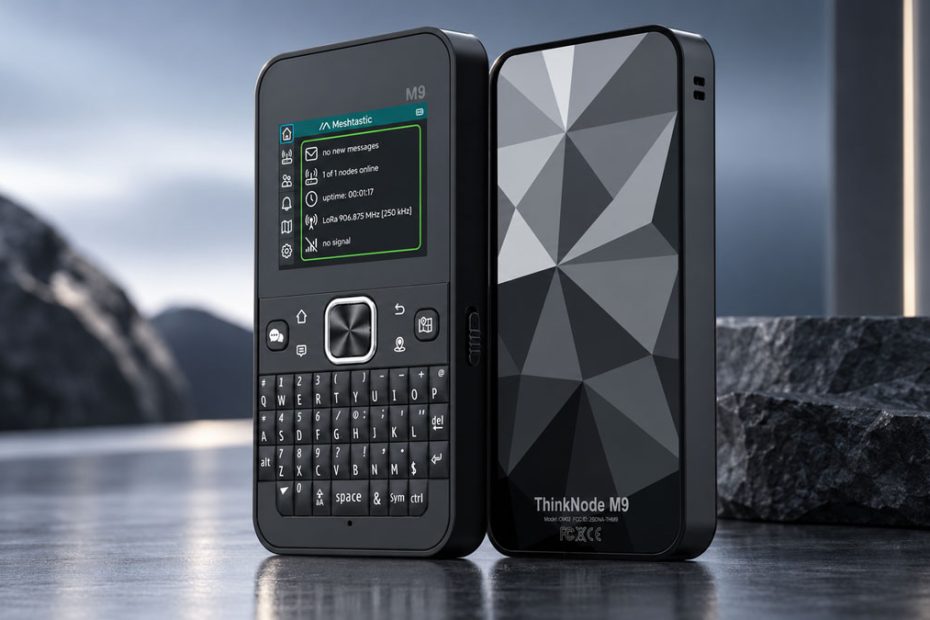
Elecrow has introduced the ThinkNode M9, a standalone LoRa mesh communication terminal built around an ESP32-S3 processor and Semtech LR1110 transceiver, combining off-grid messaging, multi-constellation GNSS positioning and a physical QWERTY keyboard in a phone-sized handheld device.
The M9 is designed to work without a paired smartphone. Its 2.4-inch color display, keyboard, LoRa radio, GNSS receiver, Wi-Fi, Bluetooth and 2300mAh battery are integrated into a 126 × 67 × 10.3 mm enclosure weighing approximately 123 grams.
Elecrow offers the terminal with either MeshCore or Meshtastic firmware, positioning it for decentralized communication networks where conventional cellular service may be unavailable or undesirable.
ESP32-S3 and LR1110 Hardware
The main processor is an Espressif ESP32-S3R8 using a dual-core Xtensa LX7 architecture with clock speeds up to 240 MHz.
Elecrow lists 512KB of SRAM, 8MB of PSRAM and 384KB of ROM. The commercial specification also lists 16GB of storage using an internal memory card.
More detailed hardware documentation reveals that the architecture is more complex than the basic product specification suggests. A separate ESP32-S2 controller handles the keyboard matrix, shortcut buttons and keyboard LED functions, while the ESP32-S3 manages the primary application environment.
Long-range wireless communication is handled by Semtech’s LR1110 transceiver. The M9 is offered in 868MHz and 915MHz configurations for different regional LoRa deployments.
The LR1110, display and microSD storage share an SPI bus, with individual chip-select lines. That architecture is particularly relevant to developers planning custom firmware because only one of the shared SPI peripherals should be selected at a time.
GNSS and Navigation Sensors
The ThinkNode M9 supports GPS, Galileo, BeiDou and GLONASS satellite signals for positioning and location sharing.
Elecrow’s hardware documentation identifies the GNSS hardware as either an ATGM336H-5NR32 or BM72A module, depending on the implementation. The receiver can support trajectory recording and location sharing through the terminal’s mesh applications.
Navigation hardware also includes a QMC6309 magnetic sensor used as an electronic compass.
A QMI8658B motion sensor is listed in Elecrow’s detailed hardware documentation, adding inertial sensing capability beyond the magnetic compass mentioned in the basic commercial specification.
The terminal also integrates a PCF8563 real-time clock, which can maintain system timing and help reduce the time required for synchronization after startup.
2.4-Inch Display and QWERTY Keyboard
The front of the M9 is dominated by a 2.4-inch TFT LCD and a compact physical keyboard.
The LCD has a 320 × 240 pixel resolution and a specified brightness of approximately 200 cd/m². It is not a touchscreen, so primary interaction is handled through physical controls.
The keyboard contains 37 QWERTY keys along with navigation and function controls.
Dedicated buttons provide faster access to functions including GPS, maps, chat, menus and back navigation. A hidden reset switch, buzzer and physical power toggle are also integrated into the enclosure.
The format makes the M9 considerably different from common Meshtastic nodes that operate primarily as Bluetooth peripherals for smartphones. Messaging and navigation can instead be handled directly on the terminal.
Meshtastic and MeshCore Support
Elecrow sells separate versions of the M9 with Meshtastic or MeshCore preinstalled.
Both platforms use LoRa radios to create decentralized mesh networks in which devices can relay data between nodes without relying on cellular infrastructure.
Typical applications include text messaging, position sharing, outdoor group communication, community networks and emergency communication systems.
The M9’s integrated keyboard is especially relevant to this use case. Many compact LoRa nodes can technically send text messages but depend on a connected smartphone for practical text entry. The M9 provides direct typing and message viewing on the device itself.
Developers can also work with C/C++, MicroPython, ESP-IDF and Arduino development environments, while Elecrow lists LVGL support for interface development.
Wi-Fi and Bluetooth Connectivity
The ESP32-S3 platform adds 2.4GHz Wi-Fi and Bluetooth connectivity alongside LoRa.
Elecrow specifies Bluetooth 5.0 and Bluetooth Low Energy support.
The company lists Wi-Fi support as part of the hardware platform, although its MeshCore product page notes that some Wi-Fi functions, including automatic map downloads, require an additional software license.
This gives the M9 several communication layers within the same device: LoRa for long-range low-bandwidth mesh networking, Bluetooth for nearby devices and Wi-Fi when conventional local network infrastructure is available.
2300mAh Battery
Power comes from an integrated 2300mAh, 3.8V lithium-polymer battery.
Elecrow rates standby operation at approximately two to three days, although actual runtime will depend heavily on LoRa transmission frequency, GNSS operation, display use, Wi-Fi activity and backlight settings.
The battery includes over-charge and over-discharge protection.
Charging and data transfer are handled through USB-C, with the interface supporting USB 2.0 full-speed operation. The same connection can also be used for firmware development and programming.
ThinkNode M9 Specs
Processor
- ESP32-S3R8
- Dual-core Xtensa LX7
- Up to 240MHz
Secondary controller
- ESP32-S2 keyboard controller
Memory
- 512KB SRAM
- 8MB PSRAM
- 384KB ROM
Storage
- 16GB internal memory card
- microSD/TF architecture documented by Elecrow
- 128Mbit ZD25Q128-series NOR flash listed in hardware documentation
LoRa
- Semtech LR1110
- 868MHz or 915MHz versions
- Integrated FPC antenna
GNSS
- GPS
- Galileo
- BeiDou
- GLONASS
- ATGM336H-5NR32 or BM72A receiver listed in hardware documentation
Display
- 2.4-inch TFT LCD
- 320 × 240 resolution
- Approximately 200 cd/m²
- Non-touch
Keyboard
- Physical QWERTY layout
- 37 keys
- Navigation and shortcut controls
Sensors
- QMC6309 magnetic compass
- QMI8658B motion sensor
- PCF8563 RTC
Wireless
- 2.4GHz Wi-Fi
- Bluetooth 5.0
- Bluetooth Low Energy
- LoRa
USB
- USB Type-C
- USB 2.0 full-speed
- Charging and firmware programming
Battery
- 2300mAh
- 3.8V lithium-polymer
- Approximately two to three days claimed standby time
Dimensions
- 126 × 67 × 10.3 mm
- Weight
- Approximately 123g
Development
- ESP-IDF
- Arduino IDE
- MicroPython
- C/C++
- LVGL
- ThinkNode M9 Price and Availability
Elecrow lists the ThinkNode M9 at prices starting from $74.90, with both 868MHz and 915MHz versions available depending on the firmware configuration and target region.
The company said its initial production batch had sold out and that additional units were being prepared for shipment in late September 2026.
Third-party seller Muzi Works has also listed the terminal at $89.
The package supplied directly by Elecrow includes the ThinkNode M9, a USB cable and starter card.
About Elecrow
Elecrow is a Shenzhen, China-based electronics and open-source hardware company founded on April 29, 2014.
Its business covers IoT hardware, embedded displays, development boards and turnkey PCB assembly services, including low-volume PCBA production for hardware developers and commercial customers.
Elecrow said in 2024 that it had accumulated more than 40,000 registered members, worked with more than 200 distributors and supplied products to more than 150 countries and regions. Its current corporate profile describes operations reaching customers and developers in more than 200 countries and territories.
The ThinkNode family fits within Elecrow’s broader focus on IoT products using technologies such as LoRa, Wi-Fi and Bluetooth, alongside the company’s display and PCBA manufacturing businesses.