A U.S. Department of Energy laboratory is reportedly examining Chinese-made lidar sensors for potential cybersecurity vulnerabilities, adding a new technical dimension to the growing political debate over whether Chinese perception hardware should be allowed to become a major part of America’s autonomous vehicle infrastructure.
The review is being carried out by Idaho National Laboratory, according to TechCrunch, citing people familiar with the project. The research is reportedly being financed by one or more companies involved in the electric and autonomous vehicle industries, although the identities of the sponsors have not been disclosed.
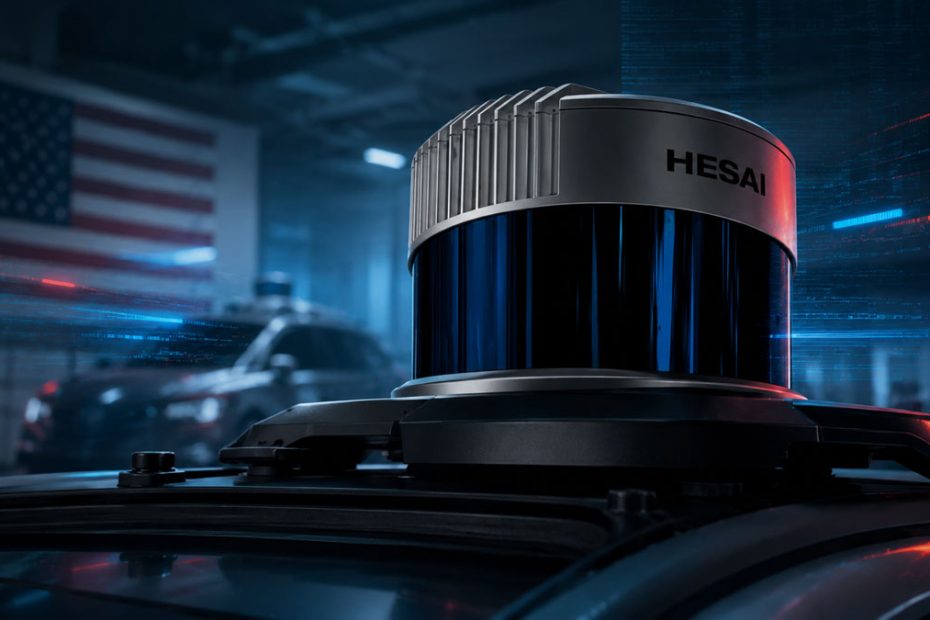
The investigation matters because lidar is rapidly moving from an expensive specialty sensor into a mass-produced component for advanced driver assistance systems, autonomous vehicles and robotics. Chinese manufacturers including Hesai and RoboSense have played a central role in driving that transition by dramatically increasing production volumes while lowering sensor prices.
That cost advantage is now colliding directly with U.S. national security concerns.
Chinese Lidar Security Review
Idaho National Laboratory has not publicly detailed what hardware is being examined or which vulnerabilities researchers are specifically testing.
TechCrunch reports that the work is focused on cybersecurity risks associated with Chinese lidar and may ultimately determine whether fears surrounding the technology can be demonstrated technically rather than simply discussed as hypothetical threats.
That distinction is important.
Lidar itself is fundamentally a perception sensor. It sends laser pulses into the environment, measures their return time and converts millions of measurements into a three-dimensional representation of nearby objects.
Modern automotive lidar, however, is no longer an isolated optical device.
Sensors can include increasingly sophisticated processors, firmware, networking interfaces and data-processing capabilities. Once integrated into an automated vehicle, lidar becomes one component of a much larger electronic architecture connected to perception computers, vehicle controllers and potentially external communication systems.
The security question is therefore not simply whether a lidar can “see” sensitive locations. The more important issue is whether the hardware or software could be manipulated, remotely disabled or used as an unauthorized pathway for collecting or transmitting information.
Vehicle Cybersecurity Risks
One frequently discussed scenario involves remotely disabling large numbers of sensors.
A single failed lidar does not necessarily make an automated vehicle uncontrollable. Modern autonomous systems typically combine cameras, radar, lidar, GNSS, inertial sensors and other sources of information.
But disrupting the same type of sensor across a large fleet could significantly degrade the redundancy that autonomous systems depend on.
Another concern involves data collection.
Lidar can create extremely detailed three-dimensional representations of roads, buildings, vehicles and infrastructure. If such information were accessible outside the intended vehicle architecture, large fleets could theoretically become distributed mapping platforms.
Whether commercially deployed Chinese lidar actually contains mechanisms capable of doing this is precisely the type of question that requires technical examination rather than political speculation.
There is currently no publicly disclosed evidence showing that Chinese lidar manufacturers are secretly transmitting large-scale environmental data from U.S. vehicles.
That makes independent hardware and firmware testing particularly important.
Washington Targets Chinese Lidar
The Idaho laboratory review comes as lawmakers increase pressure on Chinese lidar manufacturers.
Several members of Congress have proposed restrictions designed to prevent federal funding or U.S. infrastructure programs from supporting Chinese lidar technology. Supporters argue that allowing foreign-controlled perception hardware to become deeply embedded in transportation and critical infrastructure could create long-term security dependencies.
Chinese manufacturers Hesai and RoboSense have also faced scrutiny from the U.S. Department of Defense, which has included the companies on its Section 1260H list concerning entities allegedly connected with China’s military-industrial ecosystem.
The designation does not amount to a general prohibition on selling lidar to American commercial customers.
That distinction is significant because lidar sensors are not currently covered by all of the same restrictions Washington has applied to certain Chinese connected-vehicle technologies.
As a result, automakers can still evaluate Chinese lidar for U.S. vehicles while simultaneously facing uncertainty about what future regulations could look like.
Lidar Prices Change the Market
The political debate would be far less urgent if Chinese lidar remained a niche technology.
Instead, lidar economics have changed dramatically.
Early autonomous vehicle programs often relied on sensors costing tens of thousands of dollars. Today’s automotive units can be manufactured for hundreds of dollars depending on specifications, volumes and vehicle integration.
That reduction has opened the possibility of installing lidar not only on experimental robotaxis but also on mass-market passenger vehicles.
Chinese manufacturers have been among the biggest beneficiaries.
Hesai reported 1.62 million lidar shipments in 2025, up 222.9% from approximately 502,000 units a year earlier. Of those, about 1.38 million were ADAS lidar units. Revenue reached $432.9 million, while the company’s average lidar selling price fell from roughly $530 in 2024 to about $260 in 2025 as lower-priced ADAS sensors became a larger part of the sales mix.
The growth has continued in 2026.
Hesai shipped 628,275 lidar units in the second quarter alone, including 485,904 ADAS units and 142,371 robotics units. First-half shipments reached nearly 1.1 million units. Q2 revenue increased 21.9% year over year to $126.9 million.
RoboSense is scaling rapidly as well. The company reported 719,200 lidar units sold during the first half of 2026, up 169.6% from a year earlier. That included 436,600 ADAS units and 282,600 robotics lidar units.
Those volumes demonstrate why the debate has moved beyond theoretical supply-chain planning.
Chinese lidar is becoming inexpensive enough and available in sufficient quantities to potentially occupy a meaningful share of the sensors installed across future automated vehicles and robots.
US Automakers Face a Choice
For American automakers, the dilemma is becoming increasingly difficult.
Avoiding Chinese lidar reduces geopolitical and regulatory exposure, but alternative suppliers must still compete on price, manufacturing capacity, reliability and automotive qualification.
The Western lidar industry has already experienced substantial consolidation after years of expensive development programs and slower-than-expected autonomous vehicle adoption.
Meanwhile, Chinese suppliers have been able to scale alongside a domestic automotive market that is deploying advanced driver-assistance technology aggressively.
That scale produces lower component costs, which in turn makes lidar economically viable for more vehicles.
There is therefore a real possibility that security policy and industrial policy become inseparable.
If Washington eventually restricts Chinese lidar, automakers will need more than regulations. They will need competitive alternative suppliers capable of producing millions of automotive-grade sensors at comparable prices.
Why the Investigation Matters
The most valuable outcome from the Idaho National Laboratory investigation would not necessarily be evidence supporting a ban.
It would be evidence.
The lidar debate currently combines several different issues that are often treated as though they were the same problem: cybersecurity vulnerabilities, ownership of manufacturers, military connections, supply-chain dependence and the possibility of future geopolitical disruption.
They are not identical risks.
A sensor could theoretically pass an aggressive cybersecurity audit while still creating an undesirable strategic dependency on a foreign supply chain. Conversely, a sensor made by a politically trusted supplier could still contain serious security vulnerabilities.
Independent testing can separate those questions.
That is why the technical review may ultimately matter more than some of the political rhetoric surrounding it.
If researchers discover exploitable communication channels, undocumented remote-access mechanisms or weaknesses capable of disabling sensors at scale, the argument for restrictions would become substantially stronger.
If they do not, policymakers would still have legitimate supply-chain questions to consider, but the debate would move onto much clearer technical ground.
A Warning From a Lidar Failure
There is already an example of how unexpectedly widespread lidar disruption can affect autonomous systems, although it was not a cybersecurity incident.
In early 2024, a software problem involving leap-year date handling caused vehicles using certain Hesai lidar products to stop operating properly for roughly a day, according to reporting cited by TechCrunch.
The episode demonstrated something important about highly automated fleets: a seemingly minor software problem inside one sensor platform can propagate across many vehicles using identical hardware.
That does not demonstrate the existence of a deliberate remote shutdown mechanism.
It does demonstrate why regulators are increasingly interested in systemic sensor risk rather than simply the reliability of individual devices.
About Hesai and RoboSense
Hesai is one of China’s largest lidar manufacturers and is publicly traded on Nasdaq and the Hong Kong Stock Exchange. The company generated $432.9 million in revenue during 2025 and shipped approximately 1.62 million lidar units. It also reported $62.3 million in GAAP net income for the year. Hesai says it held more than 40% of the long-range automotive lidar market in 2025 and has planned annual production capacity exceeding 4 million units for 2026.
Its expansion continued into the first half of 2026, when shipments reached 1,099,998 units. In Q2 alone the company generated $126.9 million in revenue, shipped 628,275 lidar units and recorded $10.4 million in net income.
RoboSense, listed in Hong Kong, is another major Chinese lidar supplier with substantial exposure to both automotive ADAS and robotics. The company sold approximately 912,000 lidar units in 2025 and generated around RMB1.94 billion in annual revenue. Its 2025 robotics shipments reached roughly 303,000 units.
During the first half of 2026, RoboSense lidar sales increased to 719,200 units, including 436,600 ADAS sensors and 282,600 robotics units. The company’s ADAS order backlog exceeded 9 million units earlier in 2026, highlighting the scale at which Chinese lidar suppliers are now competing.