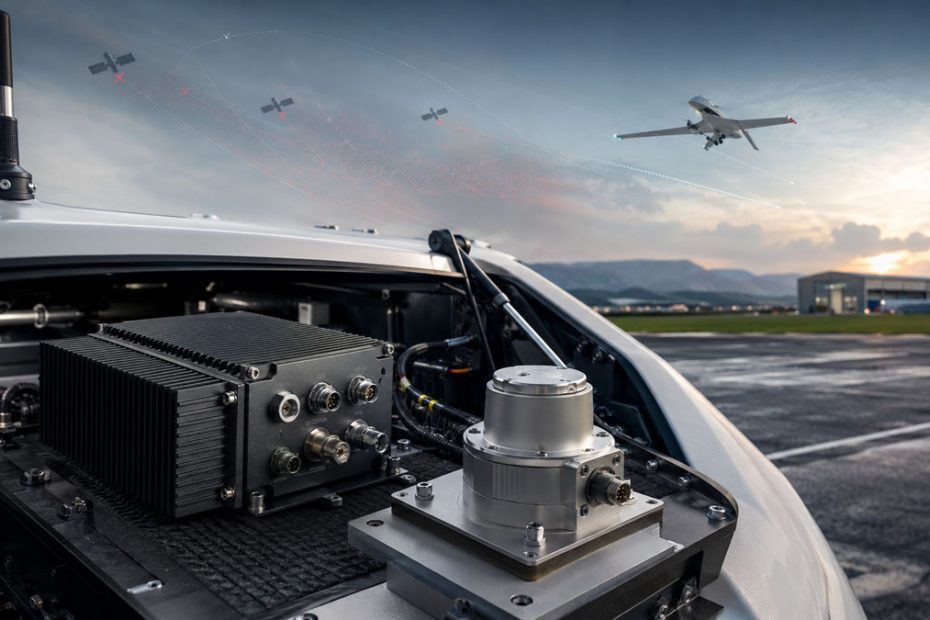
OSCP has introduced NavigationGate, a compact inertial navigation processing unit designed to keep vehicles, aircraft and autonomous platforms navigating when GNSS positioning becomes degraded, jammed or completely unavailable.
The Montreal-based inertial sensor manufacturer opened pre-orders for the first production batch on September 1, positioning NavigationGate as the processing layer between its MK2 inertial measurement units and a platform’s broader navigation system.
Instead of delivering raw acceleration and angular-rate measurements for another computer to interpret, NavigationGate performs sensor fusion locally and outputs a continuous position, velocity and attitude solution.
That distinction is increasingly important as GNSS jamming and spoofing move from isolated military environments into commercial aviation, drones, marine operations and other autonomous systems. EASA published Revision 4 of its GNSS interference safety bulletin on July 3, 2026, following continued analysis of jamming and spoofing events affecting European aviation.
NavigationGate Sensor Fusion
NavigationGate combines data from an OSCP IMU with a dual-antenna, RTK-compatible GNSS receiver and additional aiding sensors supplied by the vehicle or system integrator.
The navigation filter runs directly on the unit rather than relying on the platform’s main computer.
OSCP says the system uses a Kalman filter running on a Cortex-M7-class processor with hardware floating-point support. The filter is specifically tuned for the company’s inertial sensors rather than using a generic IMU model.
The onboard dual-antenna GNSS receiver can also establish true heading while stationary, while support for external GNSS receivers gives integrators more flexibility when NavigationGate is incorporated into an existing navigation architecture.
Navigation outputs can be transmitted over CAN 2.0B, CAN FD and RS-422 interfaces.
Additional aiding sources can include odometry, airspeed and external heading measurements. These inputs become particularly valuable during GNSS outages because they can constrain the rate at which the inertial navigation solution drifts.
Navigation Without GNSS
An inertial navigation system does not suddenly become inaccurate the moment GNSS disappears. Instead, positioning error gradually accumulates as small errors in acceleration and rotation measurements are integrated over time.
How quickly that error grows depends heavily on sensor quality.
NavigationGate works with OSCP’s MK2 IMU family, including the photonic MK2E2 for tactical-grade applications and the MK2Z for navigation-grade systems.
OSCP has published a road test intended to demonstrate that difference.
During a 21-minute test without satellite positioning, the company’s photonic IMU finished 5.7 meters from the ground-truth position. A MEMS reference unit operating with identical aiding finished 20.5 meters away.
The comparison was deliberately simplified, using gyroscope data and a 1 Hz speed input without the full NavigationGate filtering system. That means it should not be interpreted as a direct specification for NavigationGate positioning accuracy.
It does, however, demonstrate why gyro performance becomes increasingly important as a GNSS outage becomes longer.
Compact INS Hardware
NavigationGate measures 75.5 x 58.5 x 30 mm and operates from a 12 to 34 V supply.
The unit can also power the connected IMU and includes an onboard barometer and removable microSD storage. OSCP offers a board-level OEM version for manufacturers that want to integrate the processing hardware directly into another product.
The architecture makes NavigationGate potentially relevant to a wide range of platforms, including UAVs, autonomous ground vehicles, marine systems, defense equipment, robotics and other machines that cannot simply stop operating when satellite navigation becomes unreliable.
OSCP also announced ArduPilot support across its MK2 IMU family at the same time, giving drone developers a more direct integration path through CAN FD or RS-422.
Why NavigationGate Matters
The most interesting part of NavigationGate is not that OSCP has built another inertial navigation system. The market already contains numerous GNSS/INS products.
The more significant move is packaging the navigation filter as a dedicated processing layer around a scalable family of inertial sensors.
That addresses a practical integration problem.
A company building an autonomous machine may already have GNSS, wheel speed, airspeed or heading sensors and an onboard computer. Adding a high-performance IMU alone still leaves the engineering team responsible for writing, tuning and validating the sensor-fusion algorithm.
NavigationGate shifts much of that responsibility into a dedicated unit whose filter has already been designed around the characteristics of the OSCP sensors.
It also allows manufacturers to move between different inertial performance levels without redesigning the entire navigation architecture.
For systems operating in areas where GNSS interference lasts seconds or minutes rather than hours, that approach could be particularly attractive. The objective is not necessarily to replace satellite navigation indefinitely. It is to prevent a temporary GNSS outage from becoming an immediate navigation failure.
The real performance question will therefore be how accurately the complete NavigationGate system can maintain position and attitude across repeatable GNSS-denied tests under different vehicle dynamics, vibration levels and aiding configurations.
OSCP’s 21-minute road test is encouraging, but system-level testing will ultimately matter more than a standalone gyro comparison.
GNSS Interference Is Growing
The product is arriving as satellite navigation resilience receives considerably more attention from regulators and autonomous-system manufacturers.
EASA’s latest guidance addresses both GNSS jamming, where satellite signals are overwhelmed by interference, and spoofing, where receivers can be induced to calculate an incorrect position.
The agency’s July 2026 update added new operational and training recommendations following work with EUROCONTROL on the increasing scale of GNSS interference affecting aviation.
That environment creates a larger commercial opportunity for inertial navigation technologies that were previously concentrated in military, aerospace and other specialized applications.
About OSCP
OSCPS Motion Sensing Inc., operating as OSCP, is a privately held Canadian inertial sensor company headquartered in Montreal, Quebec.
The company says it was founded in 2015 and develops photonic gyroscopes and inertial measurement units for applications including space, defense, marine and subsea systems, rail, robotics and ground autonomy. Its sensors are designed and manufactured in Canada and are marketed as ITAR-free.
Public company profiles place OSCP in the 11 to 50 employee category. Its current product strategy combines conventional MEMS sensors with higher-performance photonic inertial technology, including the MK2M2 MEMS IMU and photonic MK2E2. The MK2M2 measures 40 x 40 x 25 mm, weighs 75 grams and consumes approximately 1.2 watts, illustrating the compact form factor OSCP is targeting across autonomous and embedded navigation applications.
NavigationGate extends that strategy beyond supplying individual sensors by giving customers a complete onboard navigation solution rather than requiring them to develop the INS processing layer themselves.