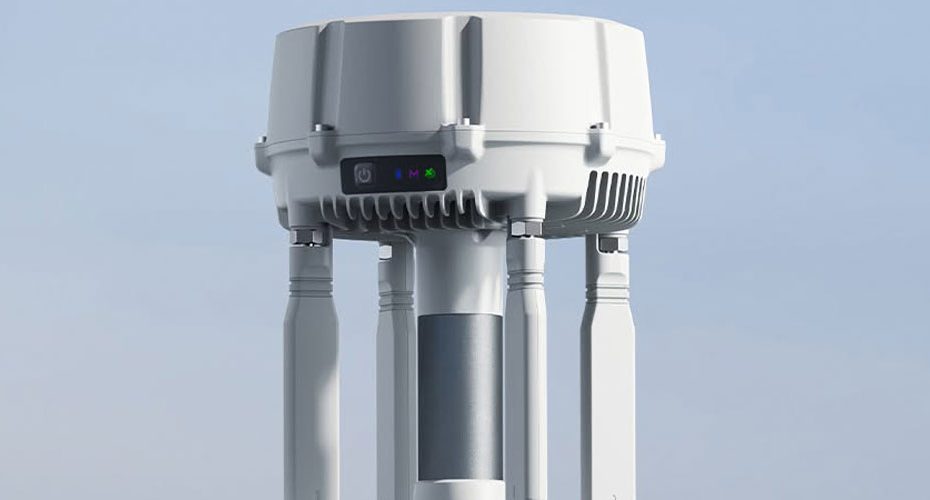
DJI has introduced the new DJI O4 Ground Station, a dedicated long range communications solution designed to expand the operational reach of DJI Dock 3 deployments and enterprise drone missions in areas where traditional network infrastructure is unavailable or unreliable.
As organizations increasingly rely on autonomous drone operations for inspections, public safety, energy infrastructure, mining, and security applications, communications reliability has become one of the most critical limiting factors. DJI’s latest ground station directly addresses that challenge by creating a resilient transmission layer capable of maintaining control and video connectivity far beyond conventional cellular coverage.
Long Range Drone Transmission
At the core of the O4 Ground Station is DJI’s latest transmission technology, built to support stable drone communications in difficult RF environments.
According to DJI, the system can deliver transmission distances of up to 40 km when paired with compatible platforms such as the DJI Matrice 400. The station continuously evaluates available frequencies and automatically selects the optimal transmission path to maintain stable communications under changing interference conditions.
One of the most significant technical improvements is support for automatic multi band operation combined with sub 2 GHz transmission capabilities. Lower frequency signals generally offer better propagation characteristics, particularly in terrain where obstacles, vegetation, or infrastructure can weaken traditional higher frequency links.
Gateway Mode for Remote Operations
The O4 Ground Station is designed to integrate directly with DJI FlightHub 2, allowing operators to remotely access drone missions from virtually anywhere with an internet connection.
In Gateway Mode, the station functions as a communications bridge between the drone and FlightHub 2.
Operators gain access to:
- Real time HD video transmission.
- Remote aircraft control.
- Fleet management capabilities.
- Signal Map visualization tools.
- Virtual Cockpit remote piloting environment.
From a technical perspective, this transforms fixed drone infrastructure into a much more scalable operation. Instead of requiring personnel on site, organizations can manage aircraft from centralized command centers while maintaining situational awareness through live video feeds and telemetry.
Relay Mode for Network Denied Areas
Perhaps the most interesting capability is Relay Mode.
Unlike Gateway Mode, which relies on internet connectivity, Relay Mode enables the O4 Ground Station to function as an offline communications repeater.
This configuration is particularly useful in environments where terrain blocks direct line of sight between the drone and operator. Valleys, mountainous regions, industrial facilities, forests, and critical infrastructure corridors often create communications dead zones that limit mission effectiveness.
By positioning an O4 Ground Station strategically, operators can effectively extend transmission coverage into areas that would otherwise be unreachable.
For emergency response agencies, utility operators, and mining companies, this could significantly expand operational flexibility without requiring additional communications infrastructure.
Built for Unattended Deployment
DJI has clearly targeted permanent and semi permanent installations with the O4 Ground Station.
The unit features:
- IP67 environmental protection.
- Support for solar powered deployments.
- Autonomous operation capability.
- Compatibility with DJI Dock 3 ecosystems.
- Continuous 24/7 deployment readiness.
The IP67 rating indicates protection against dust ingress and temporary water immersion, making the station suitable for remote outdoor installations where maintenance access may be limited.
Solar compatibility is particularly important for infrastructure operators deploying systems in remote regions where grid power is unavailable or prohibitively expensive.
Enterprise Drone Infrastructure Matures
My view is that the O4 Ground Station may ultimately be more important than the drones themselves for many enterprise operators.
The commercial drone industry has largely solved the aircraft problem. Modern drones already provide exceptional imaging, autonomy, and navigation capabilities. The next bottleneck is communications infrastructure.
What DJI appears to be building is not simply a stronger radio link but an ecosystem for persistent autonomous drone operations. When combined with Dock 3, FlightHub 2, remote command centers, and relay capable ground stations, the company is moving closer to creating a true drone infrastructure network rather than individual aircraft deployments.
For industries pursuing Drone as First Responder programs, automated inspections, perimeter security, or remote asset monitoring, reliable communications often determine whether a mission succeeds or fails. The O4 Ground Station directly targets that operational reality.
Key Specs
| Feature | DJI O4 Ground Station |
|---|---|
| Maximum Transmission Distance | Up to 40 km with compatible aircraft |
| Transmission Technology | DJI O4 |
| Frequency Management | Automatic multi-band selection |
| Extended Coverage | Sub-2G drone transmission support |
| Online Operations | Gateway Mode |
| Offline Operations | Relay Mode |
| Remote Platform | DJI FlightHub 2 |
| Environmental Rating | IP67 |
| Power Options | Standard or solar-powered deployment |
| Deployment Type | Fixed, remote, unattended operation |
About DJI
DJI is the world’s largest commercial drone manufacturer and one of the most influential companies in the unmanned aviation industry. Founded in 2006 and headquartered in Shenzhen, China, DJI is estimated to control more than 70% of the global consumer drone market while maintaining a dominant position in enterprise drone solutions. The company’s product portfolio spans aerial imaging, industrial inspections, public safety, agriculture, mapping, and autonomous drone infrastructure, serving millions of users across more than 100 countries.