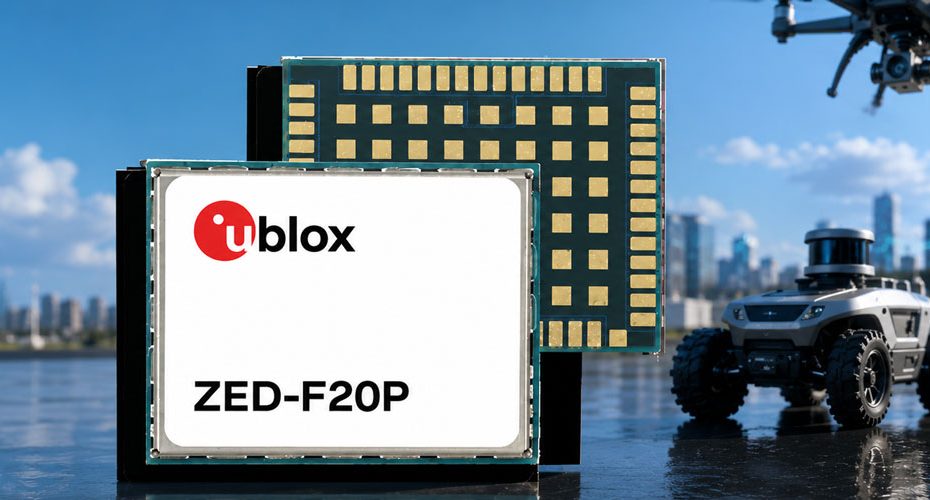
Mouser Electronics has expanded its high-precision positioning portfolio with the availability of the new ZED-F20P multi-band GNSS module from u-blox. The module is designed for autonomous robotics and UAV applications where accuracy, signal resilience, and fast convergence are critical for real-world deployment.
Triple-band GNSS improves signal reliability in complex environments
The ZED-F20P operates across three frequency bands L1, L2, and L5, enabling simultaneous reception from major global and regional constellations including GPS, Galileo, BeiDou, QZSS, and NavIC. This multi-frequency architecture is not just about redundancy. It directly improves ambiguity resolution and reduces convergence time, particularly in environments where signal reflection and obstruction are common.
From a technical standpoint, triple-band capability allows the receiver to better mitigate ionospheric errors and multipath effects, which remain two of the biggest limiting factors in GNSS accuracy for robotics operating in urban corridors, near tree cover, or around industrial infrastructure.
RTK and PPP RTK enable fast centimeter-level positioning
The module supports both RTK and PPP RTK positioning methods, giving integrators flexibility depending on infrastructure availability. RTK is typically used with local base stations or network RTK services, while PPP RTK extends high-precision positioning over wider geographic areas using satellite-delivered corrections.
Support for RTCM and SPARTN correction formats allows compatibility with a wide range of correction delivery methods, including virtual reference station networks and state space representation services. In practice, this means the same hardware platform can scale from local robotic deployments to regional or even continental operations without redesigning the positioning stack.
Built-in security features address real-world GNSS threats
A notable aspect of the ZED-F20P is its integrated security layer, which reflects a broader industry shift toward hardened positioning systems. The module includes anti-jamming and anti-spoofing capabilities, along with secure boot to prevent unauthorized firmware execution.
It also supports OSNMA, a Galileo-based authentication mechanism that verifies the integrity of navigation messages. For autonomous systems operating in safety-critical environments, this is becoming less of a premium feature and more of a baseline requirement.
Optimized for UAVs and low-power robotic platforms
The hardware is designed with integration constraints in mind. The compact form factor and low power consumption make it suitable for battery-powered systems such as drones, mobile robots, and compact industrial automation platforms.
While detailed electrical specifications such as exact power draw or update rates are not publicly highlighted in this release, modules in this class typically prioritize efficient processing and thermal stability to maintain consistent positioning performance during long operational cycles.
Evaluation kit simplifies development and testing
Alongside the module, Mouser is offering the EVK-X20P evaluation kit, built to demonstrate full multi-band performance in a controlled environment. The kit supports multiple constellations and provides a straightforward interface for testing positioning accuracy, convergence time, and correction workflows.
Compatibility with u-blox ANN-MB2 and ANN-MB3 antennas ensures that the full benefit of triple-band reception can be realized without additional RF tuning challenges during integration.
About u-blox
u-blox is a Switzerland-based provider of positioning and wireless communication technologies. The company employs over 1,300 people globally and serves markets including automotive, industrial automation, and IoT. u-blox GNSS modules are widely deployed in high-precision applications ranging from surveying equipment to autonomous systems, with a strong focus on multi-band positioning and secure navigation solutions.