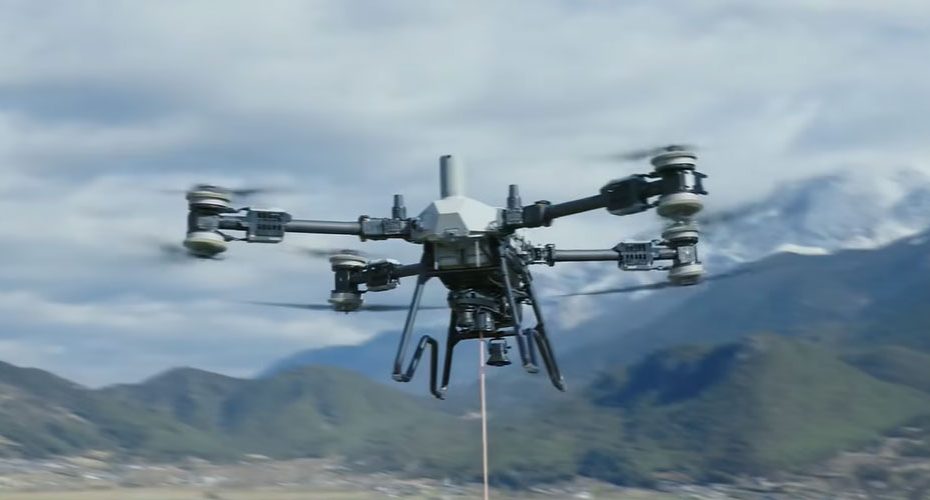
DJI has unveiled a new concept in aerial logistics with the introduction of the FC200 transport drone, a system designed to operate not as a standalone aircraft but as part of a coordinated multi drone lifting platform. The core idea is simple but technically demanding: multiple drones working in synchronized flight to carry a single payload that exceeds the capability of any individual unit.
According to initial information, the system supports a four drone formation capable of lifting up to 600 kg, or approximately 1,300 lbs. Each drone shares load distribution through a tethered rig, requiring precise real time coordination, stable positioning, and continuous communication between units.
This approach signals a shift away from the traditional model of scaling payload through larger single aircraft. Instead, DJI is exploring distributed lift systems where redundancy, flexibility, and modular deployment become key advantages.
Multi Drone Load Sharing Architecture Redefines Payload Scaling in UAV Systems
The FC200 platform appears to rely on synchronized flight control algorithms that manage thrust, position, and load balancing across multiple UAVs simultaneously. In practical terms, this means:
- Dynamic load stabilization across multiple anchor points.
- Real time communication between drones to prevent oscillation or imbalance.
- Redundant lift capability in case of partial system failure.
- Modular scaling depending on payload requirements.
This type of architecture is particularly relevant in environments where traditional heavy lift helicopters are either too expensive or operationally constrained.
While DJI has not released detailed technical specifications such as individual motor output, battery capacity, or endurance figures, the system clearly targets industrial logistics rather than consumer or prosumer markets.
Industrial Use Cases for Coordinated Drone Transport Systems
The FC200 concept aligns with several emerging use cases where aerial logistics can provide measurable efficiency gains.
- Construction sites where heavy components must be delivered vertically.
- Remote infrastructure projects with limited road access
- Emergency response scenarios requiring rapid deployment of equipment
- Agricultural operations for transporting materials across difficult terrain
Compared to single heavy lift drones, a coordinated system offers more flexibility. Units can be deployed independently when needed or combined for larger payload missions.
Engineering Challenges Behind Stable Multi UAV Transport
Achieving stable multi drone lifting is significantly more complex than standard UAV operation.
Key challenges include:
- Synchronizing flight controllers with near zero latency.
- Maintaining consistent tension across multiple cables.
- Managing wind interference that affects each drone differently.
- Preventing cascading instability if one unit deviates.
The visual concept suggests DJI is addressing these issues with advanced flight control software, likely building on its existing expertise in swarm coordination and enterprise drone systems.
What Is Known and What Remains Unconfirmed About DJI FC200 Specifications
At this stage, DJI has not publicly confirmed:
- Maximum flight time under full load.
- Range and communication system architecture.
- Power system configuration or battery redundancy.
- Individual drone payload capacity within the formation.
Without these details, it is not yet possible to fully evaluate operational efficiency or compare it directly with existing heavy lift UAV platforms.
About DJI
DJI is the global leader in civilian drone technology, founded in 2006 and headquartered in Shenzhen, China. The company is estimated to control over 70 percent of the global consumer drone market and maintains a strong presence in enterprise segments including agriculture, inspection, and public safety.
DJI’s product ecosystem spans aerial imaging, agricultural spraying systems, industrial inspection drones, and software platforms. Its enterprise solutions such as the Matrice and Agras series are widely used across more than 100 countries. The company continues to invest heavily in automation, AI driven flight systems, and advanced sensor integration.