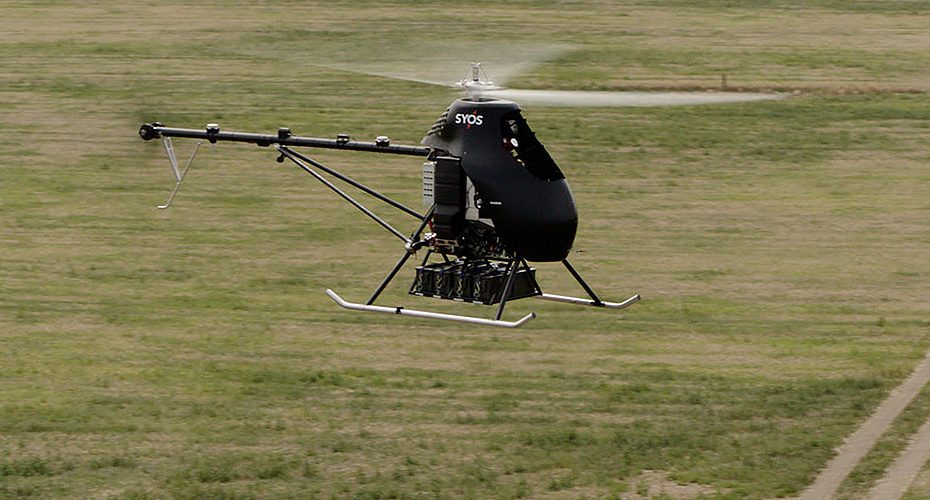
UK based autonomous aviation developer SYOS Aerospace has officially cleared its SA200 autonomous heavy lift helicopter for serial production following the completion of a multi year autonomous flight testing campaign.
The milestone positions the SA200 as one of the more serious Western rotary wing uncrewed logistics and reconnaissance platforms currently targeting military operations in contested environments, particularly where GPS denial, electronic warfare, and high risk resupply missions are becoming central battlefield challenges.
Unlike many experimental UAV concepts that remain limited to controlled demonstrations, the SA200 has now reportedly completed fully autonomous operational scenarios including takeoff and landing on moving platforms, one of the hardest technical problems in autonomous aviation.
Autonomous Shipborne Operations
According to SYOS, the latest trials validated the helicopter’s ability to independently execute:
- fully autonomous takeoff and landing;
- moving vehicle deck operations;
- shipborne style landing scenarios;
- navigation in degraded GNSS conditions;
- autonomous mission execution without direct pilot input.
From a technical perspective, autonomous landing on moving platforms is significantly more complex than conventional waypoint navigation. The aircraft must continuously calculate relative motion, compensate for turbulence and deck movement, and maintain stable positioning during descent while simultaneously handling latency, sensor fusion, and environmental disturbances.
This capability is particularly relevant for future naval logistics, distributed battlefield operations, and autonomous support missions alongside crewed helicopters.
SA200 Payload and Range Specs
The SA200 enters the increasingly crowded military autonomous helicopter segment with specifications focused more on operational flexibility and survivability than outright payload dominance.
Key reported specifications include:
- maximum payload capacity up to 200 kg;
- range exceeding 180 km with standard fuel configuration;
- extended range up to 300 km carrying 150 kg payload;
- optional endurance reportedly reaching 8 hours with external fuel tanks;
- modular airframe for rapid assembly and deployment;
While some commenters have criticized the “heavy lift” classification due to the 200 kg payload ceiling, that criticism somewhat misses the operational niche these aircraft target.
In military autonomous aviation, survivability, deployability, autonomy stack maturity, and logistics simplicity often matter more than pure payload numbers. A 200 kg autonomous helicopter capable of operating without runway infrastructure and surviving degraded electronic warfare conditions can still dramatically reduce risk for manned crews during resupply or reconnaissance operations.
AAIMS Autonomy Software
One of the more strategically important elements of the SA200 may actually be the software layer rather than the aircraft itself.
The platform uses SYOS’s AAIMS autonomy architecture, described as an open architecture autonomy management layer designed to operate across air, land, and maritime systems.
SYOS claims the system supports:
- multi vehicle coordination;
- swarming operations;
- reduced operator workload;
- continued operation during communications disruption;
- navigation during GNSS denial.
The aircraft also integrates:
- anti jam GNSS technology;
- encrypted data links;
- self healing mesh networking;
- vision based navigation systems;
The shift toward vision aided navigation is particularly notable. Modern battlefield environments increasingly assume GNSS degradation or spoofing as a baseline threat rather than an exception. That is forcing autonomous system developers to combine inertial navigation, computer vision, terrain matching, and alternative positioning methods into hybrid navigation architectures.
Project NYX Competition
The SA200 is tied closely to the UK Ministry of Defence’s Project NYX initiative, which seeks autonomous systems capable of operating alongside platforms such as the Boeing AH-64 Apache.
Project NYX represents part of a broader UK defense strategy aimed at accelerating deployment of autonomous support aircraft for:
- resupply missions;
- battlefield reconnaissance;
- high risk logistics;
- loyal wingman operations;
- contested environment support.
However, the competitive landscape appears extremely aggressive.
Other reported NYX contenders include systems associated with BAE Systems, Anduril Industries, Tekever, and Thales Group working with Schiebel Aircraft.
Some competing platforms reportedly exceed the SA200 in payload capacity and endurance on paper. That means SYOS may ultimately compete more aggressively on affordability, deployment simplicity, autonomy maturity, and operational flexibility rather than raw performance metrics alone.
Market Analysis
The broader significance of the SA200 is not necessarily that it carries the largest payload in its category. The more important development is that autonomous rotary wing logistics systems are now moving from experimental defense projects toward actual production readiness.
Fixed wing drones already dominate long endurance ISR missions, but rotary wing autonomous systems solve a different battlefield problem:
- vertical takeoff without infrastructure;
- precision delivery in confined areas;
- shipboard deployment;
- operations in mountainous or urban terrain;
- low footprint logistics support.
That market is likely to expand rapidly as NATO militaries and allied forces continue adapting to lessons from Ukraine and other modern conflict zones where distributed operations and survivable logistics have become critical priorities.
About SYOS Aerospace
SYOS Aerospace is a UK based autonomous systems developer focused on multi domain autonomy technologies spanning air, land, and maritime platforms. The company’s portfolio centers around its AAIMS autonomy software ecosystem and modular autonomous vehicle development.
The SA200 represents one of the company’s flagship defense programs and has been under development for approximately five years prior to entering serial production readiness. SYOS is also actively participating in UK defense autonomy initiatives including Project NYX, which aims to integrate autonomous systems alongside crewed military aviation platforms.