Dirac Labs has raised $1.8 million in pre-seed funding to advance a quantum navigation system designed to operate where conventional GNSS positioning becomes unavailable, including underwater, underground and other GPS-denied environments.
The Madison, Wisconsin-based startup plans to use the funding to build prototypes of its diamond-based quantum sensors and move the technology into field trials. The round included TitletownTech, Automotive Ventures, Riceberg Ventures, quantumEDGE Ventures, Jude Gomila and Balaji Srinivasan.
The underlying idea is ambitious but increasingly relevant. Instead of depending on satellite signals, Dirac Labs intends to determine position by measuring variations in Earth’s magnetic field with highly sensitive quantum magnetometers.
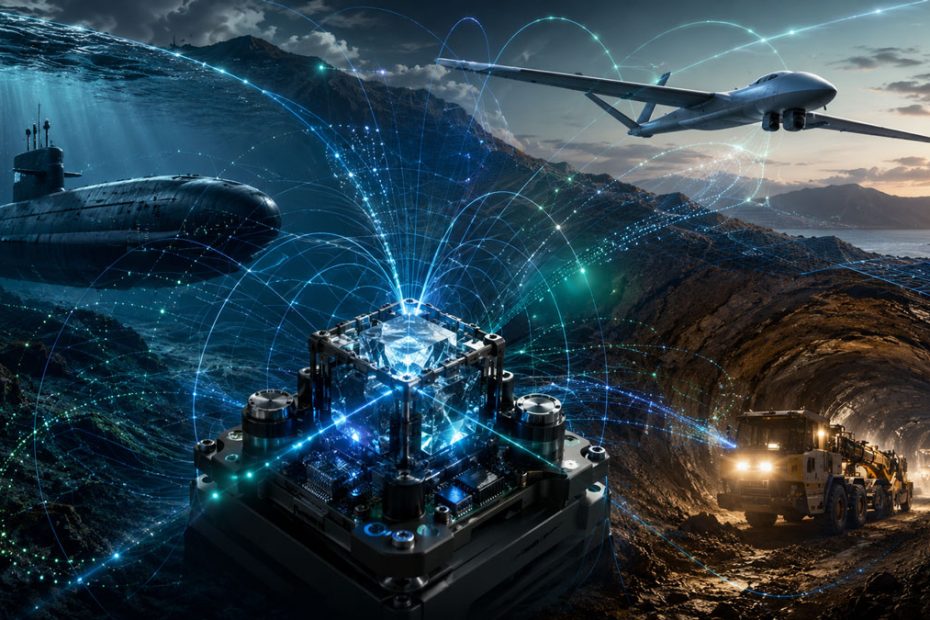
If the company can make those sensors sufficiently compact, stable and inexpensive, the technology could provide another positioning layer for submarines, mining equipment, autonomous vehicles, aircraft, drones and defense platforms operating beyond reliable GNSS coverage.
Quantum Navigation Without GPS
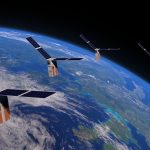
GNSS has become the default positioning infrastructure for modern transportation and autonomous systems, but its fundamental limitation has never disappeared: satellite radio signals need to reach the receiver.
That makes conventional GNSS ineffective underwater and deep underground, while urban structures, terrain, interference and intentional jamming can also degrade positioning in other environments.
Dirac Labs is targeting this problem using diamond-based quantum sensing.
The company’s platform measures subtle characteristics of Earth’s magnetic field and combines those measurements with AI-based signal processing and sensor fusion. Rather than treating magnetic measurements as a standalone compass, the goal is to extract enough spatial information from the field to help determine where a platform is located.
Quantum sensing research at the University of Wisconsin-Madison already includes diamond-based solid-state systems capable of detecting extremely small changes in magnetic fields and other physical quantities. The university describes quantum sensing for navigation and inertial guidance as one of the Wisconsin Quantum Institute’s core research areas.
That scientific foundation is important because the difficult part is not simply demonstrating that quantum magnetometry works. It is making it reliable outside controlled laboratory conditions.
Diamond Sensors Target Scale
Dirac Labs’ most important claim may therefore be less about quantum sensitivity and more about manufacturing.
The company says its sensors are being designed around semiconductor-compatible production methods, with the goal of using existing foundry infrastructure rather than relying on highly specialized, low-volume manufacturing.
This directly addresses one of the biggest obstacles facing quantum sensing.
Extremely sensitive quantum instruments already exist, but many remain too large, expensive or environmentally sensitive for widespread integration into commercial equipment.
Diamond offers an attractive solid-state platform because engineered defects in the crystal structure can behave as quantum sensing elements. Research groups at UW-Madison are already studying optically active spin defects in diamond for precision sensing applications.
A broader Midwestern supply chain is also emerging around quantum-grade diamond materials and semiconductor processing. University of Chicago researchers recently highlighted companies across Illinois, Wisconsin and Indiana working on diamond growth, wafer preparation, thin-film integration and quantum sensor applications, including Dirac Labs.
That industrial ecosystem could become just as significant as the underlying physics if quantum sensors are ever going to transition from laboratory instruments into vehicle components.
Plug-In Navigation Architecture
Dirac Labs is also taking a pragmatic approach to integration.
Rather than requiring vehicle manufacturers to redesign an entire navigation architecture, the company wants its positioning system to interface with existing GPS inputs on aircraft, submarines and other platforms.
That concept could considerably lower the barrier to adoption.
Defense and industrial equipment often remains in service for decades. A navigation technology that can be introduced as a retrofit or complementary positioning source has a much easier route into existing fleets than one requiring a completely new vehicle architecture.
It also reflects the direction positioning technology is already taking.
Future resilient navigation systems are unlikely to depend on a single sensor. GNSS, inertial measurement units, vision, lidar, radar, terrain databases and magnetic sensing can all contribute information depending on the operating environment.
Quantum magnetometry could become another input within that broader sensor-fusion stack.
Defense and Subsurface Markets
The immediate commercial opportunities are likely to be found in environments where the cost of losing positioning is already high.
Underwater navigation is an obvious example.
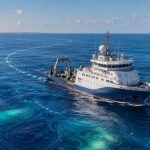
Submarines, autonomous underwater vehicles and remotely operated systems cannot continuously use GNSS while submerged and therefore depend heavily on inertial navigation, acoustic systems and periodic position updates.
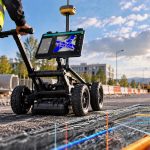
Mining represents another potentially attractive market. Autonomous equipment operating deep underground faces similar limitations, while accurate positioning is increasingly important as mines adopt automation and remotely operated machinery.
Defense applications add a second category of demand. Even above ground, military platforms must increasingly assume that GNSS signals could be jammed, spoofed or unavailable.
Dirac Labs has previously said it is developing positioning technologies for autonomous vehicles, unmanned aircraft, shipping, robotics and asset tracking across both commercial and defense markets. The company joined the Chicago Quantum Exchange as a corporate partner in March 2025.
Field Trials Are the Real Test
The $1.8 million round is significant for an early-stage quantum startup, but it does not mean universal positioning has been solved.
The next stage will be considerably more revealing.
Magnetic navigation depends not only on sensor sensitivity but also on the ability to distinguish useful geographic signatures from local magnetic disturbances generated by vehicles, infrastructure, electrical systems and changing environmental conditions.
A sensor may demonstrate exceptional sensitivity in a laboratory and still face major challenges when mounted inside a vibrating vehicle surrounded by motors, steel structures and electrical currents.
That is why Dirac Labs’ planned field trials matter more than another improvement in laboratory sensitivity.
The central engineering question is whether the company can preserve positioning performance when the sensor leaves the lab.
Why This Approach Matters
The most interesting part of Dirac Labs’ strategy is its attempt to treat quantum navigation as a manufacturable component rather than an exotic instrument.
Many quantum sensing projects begin with exceptional measurement performance and only later confront size, cost and production constraints.
Dirac Labs appears to be attacking the problem from the opposite direction by combining quantum physics with semiconductor-style manufacturing and a vehicle-compatible integration strategy.
That does not guarantee that magnetic navigation will become a universal substitute for GPS. It probably will not.
A more realistic and potentially more valuable outcome is for quantum magnetometry to become one component of resilient multi-sensor navigation systems.
GNSS works extraordinarily well when satellite signals are available. Replacing it simply for the sake of replacement would make little sense.
The opportunity is in maintaining trustworthy positioning when GNSS disappears.
If Dirac Labs can produce quantum magnetometers that are small, affordable and stable enough for mass deployment, the technology could extend precision positioning into operating environments that satellite navigation fundamentally cannot serve.
That would be far more consequential than building another higher-accuracy GNSS receiver.
About Dirac Labs
Dirac Labs is a privately held quantum navigation startup headquartered in Madison, Wisconsin. The company was founded in 2023 and currently lists a team size of 2 to 10 employees.
It was co-founded by Sanket Deshpande and Aishwarya Das following research connected with the University of Wisconsin-Madison. Deshpande’s background includes approximately six years of quantum sensing experience and two quantum technology patents, according to the company’s team profile.
Dirac Labs became a Chicago Quantum Exchange corporate partner in 2025 and has worked on quantum magnetometry and high-accuracy magnetic field datasets.
Before the latest private round, the company had also secured public and non-dilutive support. In 2025, it was selected for the Great Lakes Innovation Accelerator with $100,000 in non-dilutive funding for work involving navigation in GPS-denied waters and underwater infrastructure monitoring.
Its newly announced $1.8 million pre-seed round will primarily support sensor prototyping and field testing as the company attempts to move its quantum navigation platform toward commercial and defense deployment.