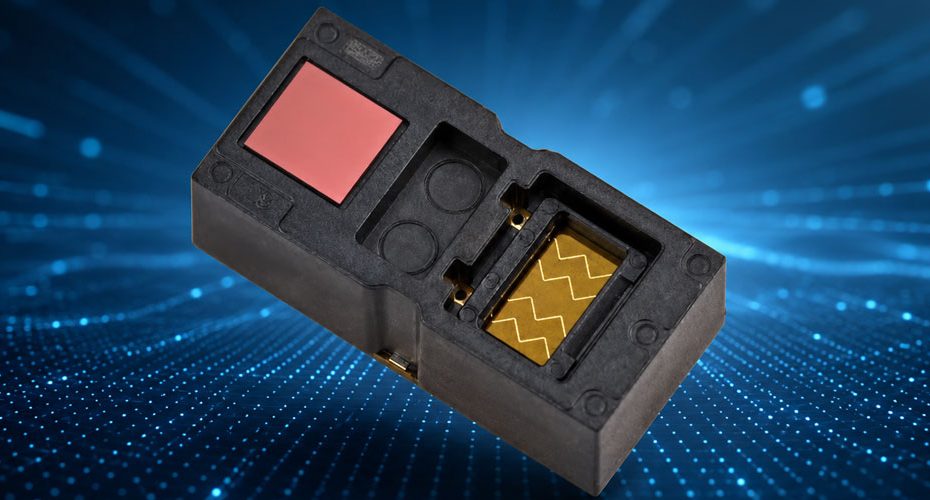
STMicroelectronics has introduced the VL53L9, a new direct Time of Flight (dToF) 3D LiDAR module that significantly raises the performance of compact depth sensing systems. Designed for edge AI applications, the new sensor combines high resolution 3D mapping, infrared imaging, onboard processing, and laser illumination inside a miniature package, allowing developers to build smarter products without relying on powerful external processors.
The announcement reflects a broader trend across the embedded AI industry. As robots, smart cameras, industrial automation, and wearable devices become more autonomous, manufacturers increasingly need sensors capable of producing richer spatial data while minimizing system complexity and power consumption. The VL53L9 is clearly aimed at that growing market.
High Resolution 3D Depth Mapping
The biggest improvement is the sensor’s 2,268 measurement zones, arranged in a 54 × 42 depth array. That represents a significant increase in spatial detail compared to previous generations of compact Time of Flight sensors and allows much more precise detection of object edges, contours, and small obstacles.
The module measures distances from less than 5 centimeters up to approximately 9 meters with accuracy of up to 1%, while operating at frame rates reaching 100 fps. Such performance enables smooth real time depth mapping for fast moving robots and interactive AI applications.
ST also combines its latest stacked BSI SPAD technology with metasurface optical elements and dual VCSEL flood illumination, eliminating the need for traditional scanning mechanisms while reducing motion artifacts and dead zones.
Key Specs
Technology
- Direct Time of Flight (dToF) 3D LiDAR
Resolution
- 54 × 42 zones (2,268 depth points)
Measurement Range
- Less than 5 cm to approximately 8.8 to 9 meters
Frame Rate
- Up to 100 fps
Field of View
- 55° × 42° (71° diagonal)
Output Data
- 3D depth map.
- Active infrared image.
- Passive infrared image.
- Reflectance map.
- Confidence map.
Interfaces
- I3C
- MIPI CSI
Power Supply
- 1.2 V and 3.3 V
Dimensions
- 12.8 × 6.1 × 4.6 mm
Laser
- Dual 940 nm VCSEL flood illumination
Safety
- Class 1 laser certified.
- Designed for Edge AI Systems.
Unlike many LiDAR solutions that require extensive post processing, the VL53L9 performs much of the computation internally. The module integrates onboard dToF processing, power management, optical filtering, and calibration, allowing even relatively small microcontrollers to work with high quality depth information.
That makes it suitable for battery powered and embedded systems where processor resources are limited but reliable environmental awareness is essential.
Potential applications include:
- Autonomous mobile robots and SLAM navigation.
- Industrial automation and volume measurement.
- Human presence detection and people counting.
- Gesture recognition and body tracking.
- AR and VR interaction.
- Healthcare monitoring and fall detection.
Why This Sensor Matters
The most interesting aspect of the VL53L9 is not simply its higher resolution. Many compact LiDAR sensors already offer respectable ranging performance. What STMicroelectronics has done differently is package an unusually complete sensing system into an extremely small module while offloading much of the computational work from the host processor.
That combination is likely to be especially attractive as edge AI continues moving toward smaller, lower power devices. Instead of requiring expensive application processors, future robots, smart appliances, and industrial sensors may be able to achieve sophisticated 3D perception using relatively inexpensive MCUs. If the module performs as advertised in real world deployments, it could become one of the strongest reference designs for next generation embedded vision systems.
About STMicroelectronics
Founded in 1987, STMicroelectronics is one of the world’s largest semiconductor manufacturers. The company develops microcontrollers, sensors, analog ICs, power electronics, automotive semiconductors, MEMS devices, and embedded processors for customers across industrial, automotive, consumer electronics, and IoT markets. ST employs more than 50,000 people worldwide, operates manufacturing and R&D facilities across Europe, Asia, and the Americas, and reported $13.3 billion in revenue in 2025, making it one of the global leaders in advanced sensing and embedded semiconductor technologies.