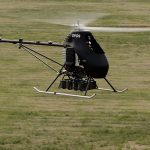
Canadian defense software developer SPARC AI has entered a strategic partnership with U.S. drone manufacturer Rate Manufacturing to integrate AI driven navigation and targeting software into next generation attritable unmanned aerial systems. The collaboration was officially presented during SOF Week 2026 in Tampa, Florida, where both companies positioned the new integration as a response to one of the fastest growing battlefield problems: drone survivability and targeting accuracy under GNSS jamming and spoofing conditions.
The agreement will bring SPARC AI’s Overwatch software platform into Rate Manufacturing’s Model F multi mission drone family, with the goal of maintaining stable navigation and precision target coordinate generation even after complete GPS signal loss.
GPS Denied Warfare Is Reshaping Drone Design
Electronic warfare has rapidly become one of the defining factors of modern drone combat. Small tactical drones that once relied heavily on commercial GPS navigation are increasingly vulnerable to jamming systems, spoofing attacks, and localized electronic suppression.
In most conventional low cost drones, once satellite positioning is disrupted, the aircraft must depend entirely on onboard inertial measurement systems. The problem is that inexpensive commercial IMUs accumulate positional errors extremely quickly. Within a short period, drift becomes so severe that the drone can no longer reliably determine its own location or generate usable targeting data.
SPARC AI claims its Overwatch platform addresses this weakness without adding expensive hardware payloads or increasing aircraft complexity.
Software Based Navigation Instead of Heavy Hardware
Rather than depending on laser rangefinders, radar systems, or complex external navigation modules, Overwatch uses a software defined architecture built around machine learning assisted sensor correction and geometric calculations.
According to the companies, the system continuously analyzes internal IMU behavior in real time, identifying sensor bias and reducing accumulated navigation errors before they destabilize the aircraft’s positioning model.
The platform then combines corrected camera orientation, heading data, pitch angles, and geometric line of sight calculations to estimate precise ground target coordinates directly from the drone’s onboard optics.
One of the more technically important aspects is that the system reportedly does not rely on traditional object recognition databases or pre mapped terrain references. Instead, the targeting model is based on geometric coordinate extraction, allowing operation in degraded visual environments such as smoke, damaged urban zones, or rapidly changing front line conditions.
Low Cost Attritable Drones Need Better Software
The partnership also reflects a broader shift taking place across Western defense procurement programs. Military planners increasingly prioritize mass produced, low cost drone fleets capable of operating as expendable battlefield assets rather than relying exclusively on small numbers of highly expensive platforms.
That strategy creates pressure for manufacturers to improve survivability through software rather than expensive hardware additions.
Rate Manufacturing stated that integrating Overwatch allows GPS denied capabilities to scale alongside production volume without significantly increasing drone weight, operator workload, or manufacturing cost.
From a technical perspective, this may become one of the more important trends in the drone industry over the next several years. The market is moving toward software defined battlefield resilience, where survivability depends less on expensive military grade components and more on advanced sensor fusion, AI assisted stabilization, and real time mathematical correction models.
The most interesting part is that these systems are increasingly being designed around commercial grade hardware architectures. That dramatically lowers barriers for mass deployment while accelerating battlefield iteration cycles.
Ukraine Continues to Shape Drone Innovation
The announcement also follows SPARC AI’s recent expansion into Ukraine, where the company established a permanent engineering presence to work directly with local drone manufacturers and operators.
Ukraine has effectively become one of the world’s largest real world laboratories for electronic warfare resistant drone development. Technologies that can survive GPS disruption there are likely to influence procurement strategies across NATO and allied defense industries far beyond Eastern Europe.
If software only targeting stabilization proves reliable at scale, it could significantly change how future tactical drone fleets are designed, especially for lower cost FPV and reconnaissance systems where size, weight, and affordability remain critical constraints.
About SPARC AI
SPARC AI is a Vancouver based defense software company focused on AI driven positioning, navigation, and targeting technologies for contested environments. The company’s Overwatch platform is designed to improve navigation resilience for drones operating in GNSS degraded conditions using software based sensor optimization and geometric targeting models. In 2026, SPARC AI expanded operations into Ukraine to support direct integration with frontline drone manufacturers and tactical systems developers.
About Rate Manufacturing
Rate Manufacturing is a U.S. defense contractor specializing in scalable unmanned systems and advanced manufacturing for military applications. The company develops multi mission attritable drone platforms intended for domestic production and rapid deployment. Its Model F UAS family targets defense customers seeking low cost, adaptable systems capable of operating in electronically contested environments.