Taoglas has introduced a new generation of embedded combination antennas aimed at solving one of the most persistent engineering challenges in connected device design: how to support multiple wireless standards within increasingly limited internal space. The new FXP30x and PC30x series bring cellular, GNSS, and Wi Fi capabilities into a single compact antenna platform, reducing component count and simplifying integration for OEMs.
FXP30x and PC30x antenna design enables multi radio integration in compact devices
The new portfolio includes six antenna variants split across two physical formats. The FXP30x series uses a flexible PCB structure, while the PC30x series is built on a rigid FR4 substrate. Both families are designed to operate across a wide frequency range from 600 MHz to 8000 MHz, covering global cellular bands along with GNSS and modern Wi Fi standards.
From an engineering standpoint, the key value lies in consolidation. Instead of deploying separate antennas for LTE, GNSS, and Wi Fi, designers can now integrate all required radios through a single embedded unit. This reduces RF complexity, minimizes interference risks between closely spaced antennas, and shortens development cycles.
Flexible vs rigid PCB antenna architecture for different integration scenarios
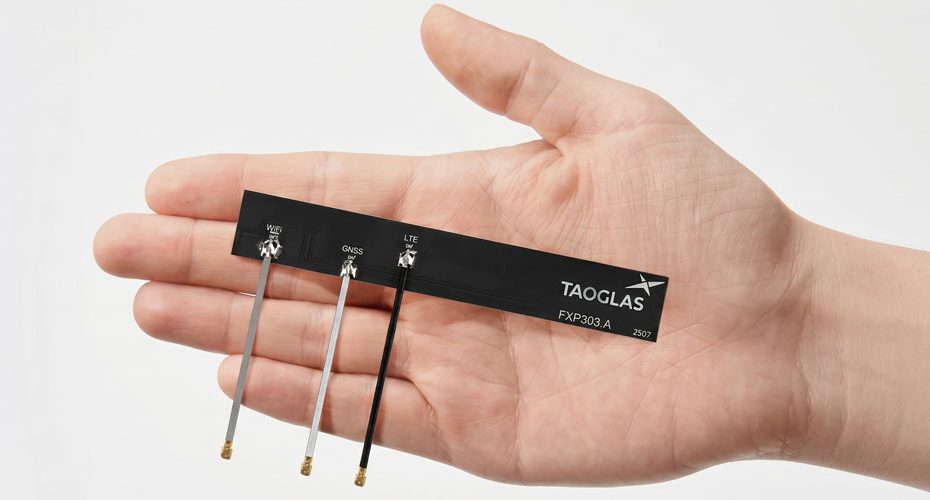
The FXP30x series is based on flexible polymer antenna technology, allowing installation in curved or space constrained enclosures. This makes it particularly suitable for compact electronics such as wearables, telematics modules, and IoT sensors where internal layout flexibility is critical. The peel and stick mounting system simplifies installation on non metallic surfaces including plastic and glass.
The PC30x series provides a rigid alternative using FR4 material, offering better mechanical stability in devices where the antenna can be securely mounted inside the housing. This is typically preferred in industrial equipment or larger enclosures where structural rigidity and repeatable placement are priorities.
Both series are delivered with pre integrated cables and I-PEX MHF I connectors, a standard widely used in compact RF modules. Color coded cables further reduce integration errors during assembly, which becomes important in multi antenna configurations.
FXP301 to FXP303 and PC301 to PC303 variants define connectivity combinations
Taoglas structured the lineup into three functional configurations, each targeting a specific connectivity requirement:
- FXP301 and PC301 combine cellular and GNSS, supporting positioning signals across L1, B1I, G1, and L Band alongside wideband cellular coverage.
- FXP302 and PC302 integrate cellular with Wi Fi, covering 2.4 GHz, 5.8 GHz, and 7.125 GHz bands aligned with modern Wi Fi standards.
- FXP303 and PC303 provide full tri band integration with GNSS, cellular, and Wi Fi in a single antenna for advanced connected devices.
This modular approach allows OEMs to select only the required functionality without over engineering the RF system.
High efficiency antenna performance supports IoT, telematics, and smart agriculture systems
While detailed gain figures and efficiency curves are not publicly specified for each variant, Taoglas positions the series as high efficiency antennas with strong peak gain relative to their compact size. The combination of ground plane independence and wideband operation suggests these antennas are optimized for real world embedded environments rather than ideal lab conditions.
The target applications reflect this positioning. The series is aimed at asset tracking systems, fleet telematics, e mobility platforms, precision agriculture equipment, healthcare devices, and industrial IoT deployments. In these segments, reliable multi radio connectivity and compact integration are often more critical than maximum theoretical performance.
Why combination antennas are becoming essential in modern device design
The shift toward multi radio systems is accelerating across industries. A single device may require GNSS for positioning, cellular for wide area connectivity, and Wi Fi for local data transfer or configuration. Traditionally, this meant multiple antennas competing for space and introducing RF interference challenges.
Combination antennas like the FXP30x and PC30x series address this by integrating multiple radiating elements into a unified design that is pre tuned for coexistence. This reduces design risk and shortens certification timelines, particularly for globally deployed devices.
About Taoglas
Taoglas is a global provider of advanced RF and antenna solutions headquartered in Ireland. The company operates across more than 30 locations worldwide and supports industries including automotive, industrial IoT, medical, and smart infrastructure. Its portfolio includes antennas, RF components, cable assemblies, and full connectivity solutions, with a strong focus on GNSS and cellular technologies. Taoglas products are widely used in high volume embedded systems where reliability and global compatibility are critical.