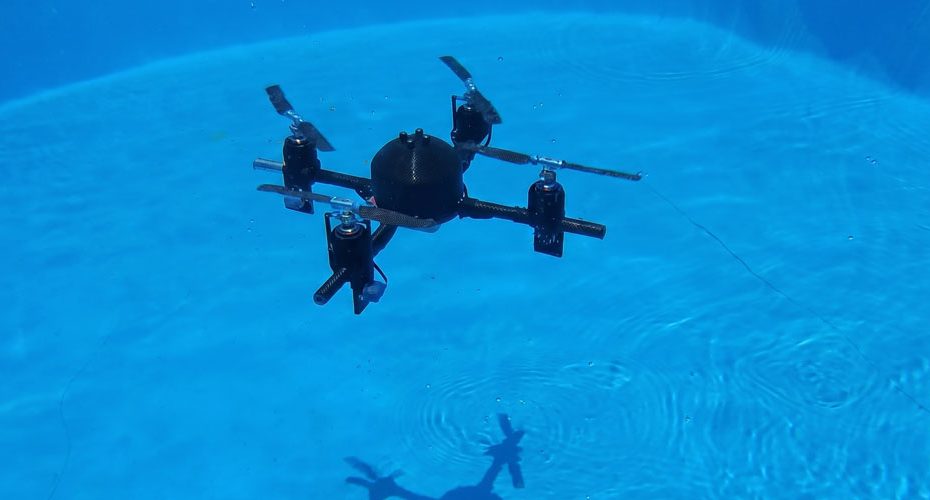
A team of engineering students from Aalborg University has developed an experimental hybrid drone capable of operating both in the air and underwater, demonstrating a concept that could eventually influence the future of compact unmanned systems.
The prototype, created as part of a bachelor’s thesis project, can take off like a traditional drone, dive directly into the water, maneuver beneath the surface, and then relaunch back into flight within seconds. What makes the project particularly interesting from an engineering perspective is the simplicity of the transition process.
Unlike many previous amphibious drone concepts that rely on complicated folding arms, sealed propulsion swaps, or mechanically reconfigurable structures, the Danish students focused on minimizing moving components and simplifying the architecture as much as possible.
At the center of the design is a variable pitch propeller system capable of adjusting thrust characteristics depending on whether the vehicle is operating in air or underwater. That allows the same propulsion setup to function in two completely different environments without requiring major physical transformation of the drone itself.
Variable Pitch Propulsion
Technically, this is a far more difficult problem than it may initially appear.
Air and water create dramatically different resistance loads on propellers. A propeller optimized for flight typically becomes highly inefficient underwater, while marine propellers generally cannot generate stable aerodynamic lift for airborne operation.
The Aalborg University prototype appears to bridge that gap by dynamically altering blade pitch and thrust behavior in real time, allowing smoother transitions between both mediums.
The project also demonstrates how accessible modern prototyping tools have become. According to the team, the drone was built using relatively affordable manufacturing methods including 3D printing, CNC machining, and custom developed control software.
That is important because it lowers the barrier for future research and development in hybrid unmanned systems. In the past, projects involving dual environment drones were usually limited to large defense contractors or advanced research laboratories with substantial budgets.
Military And Marine Potential
From an industry perspective, hybrid aerial underwater drones remain a niche category, but interest is steadily growing.
Military organizations have been exploring similar concepts for years because vehicles capable of moving seamlessly between air and water could create new tactical options for reconnaissance, harbor surveillance, covert delivery missions, mine inspection, and maritime security operations.
The commercial sector could also benefit from compact dual environment drones for ship hull inspections, offshore infrastructure monitoring, marine biology research, underwater mapping, and search and rescue operations in difficult coastal environments.
One of the biggest limitations in current marine robotics is deployment speed. Traditional underwater ROVs often require boats, cables, support crews, or launch systems. A compact drone that can simply fly to a target location, enter the water independently, and begin underwater operations could significantly reduce operational complexity.
Proof Of Concept Still Faces Challenges
Despite the attention generated by the viral demonstration video, the system remains an early proof of concept.
Battery efficiency, waterproofing durability, underwater communications, sensor integration, navigation accuracy, and long term reliability will all become major engineering challenges if the concept moves toward commercial deployment.
Underwater operation is especially demanding because radio communication behaves very differently beneath the surface. Many autonomous systems rely on acoustic communication, inertial navigation, or tethered operation once submerged.
The drone also appears relatively small, which limits payload capacity and operational endurance. Scaling the concept into a field ready platform would require major advances in energy management and structural optimization.
Still, the achievement is impressive for a student led engineering project.
The most important aspect may not be the drone itself, but the broader signal it sends about where robotics development is heading. Affordable rapid prototyping tools are now allowing smaller teams and universities to experiment with concepts that previously required the resources of major aerospace or defense companies.
As autonomous systems continue evolving, hybrid drones capable of operating across multiple environments may eventually become an important category within both commercial and military robotics.