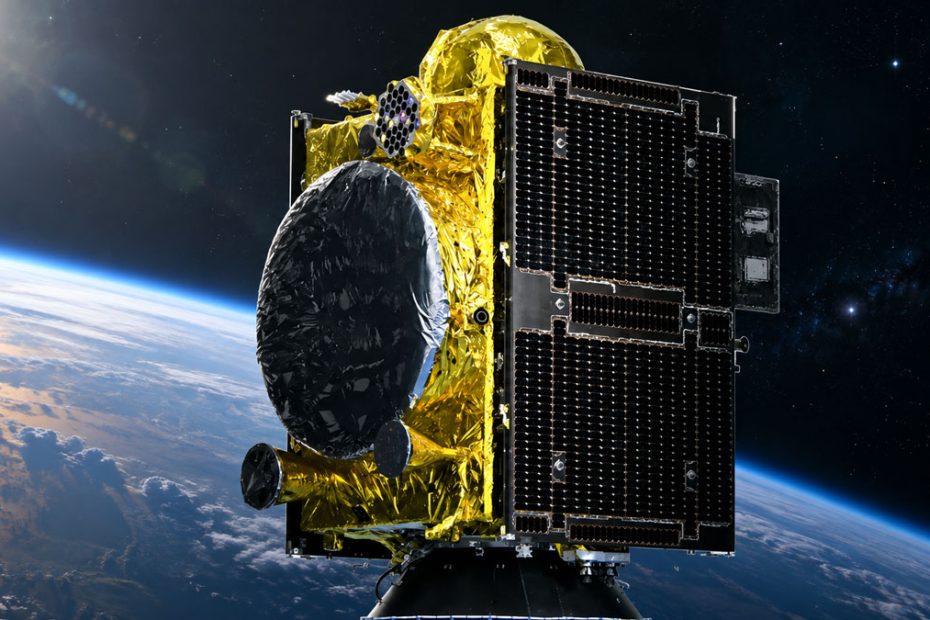
India is preparing another major step in the recovery of its independent satellite navigation system, with the Indian Space Research Organisation targeting September 2026 for the launch of the NVS-03 navigation satellite.
NVS-03 is the third spacecraft in the five-satellite second-generation NVS series developed to replace and augment aging satellites in the Navigation with Indian Constellation, better known as NavIC. Recent reports citing a senior ISRO official indicate that the spacecraft is already at the Satish Dhawan Space Centre in Sriharikota and is being prepared for launch, with an early September window under consideration. ISRO has not yet published a final launch date on its mission schedule.
The mission carries considerably more weight than a routine constellation replenishment. NavIC has suffered from aging spacecraft, atomic clock problems and the failure of NVS-02 to reach its intended operational orbit. A successful NVS-03 deployment would restore critical capacity while advancing India’s transition toward a newer generation of navigation satellites.
NVS-03 Strengthens NavIC
NavIC was developed as India’s independent positioning, navigation and timing system. Unlike GPS, Galileo, GLONASS and BeiDou, which provide global coverage, NavIC was designed primarily as a regional system covering India and an area extending approximately 1,500 kilometers beyond the country’s landmass.
Its reference architecture consists of seven satellites. Three are positioned in geostationary orbit, while four operate in inclined geosynchronous orbits. ISRO designed the system to provide Standard Positioning Service for civilian users and a Restricted Service for authorized applications.
ISRO specifies NavIC positioning performance of better than 20 meters at the 2 sigma level across its primary service area, along with timing performance measured in tens of nanoseconds. Its civilian signals are also designed for interoperability with other major GNSS constellations.
NVS-03 is therefore not intended to create a new navigation architecture. Its role is to restore capacity within an existing one while introducing the upgraded technology developed for the second-generation NVS spacecraft.
New L1 NavIC Signal
One of the most important changes introduced with the NVS generation is the addition of the L1 navigation signal.
First-generation NavIC satellites primarily transmitted navigation services through L5 and S band frequencies. The NVS generation adds L1 alongside L5 and S band navigation payloads, a significant development because L1 is widely supported across the global GNSS receiver ecosystem.
ISRO explicitly identified the additional L1 signal as a way to broaden adoption of NavIC services. NVS-01, launched in May 2023, became the first spacecraft in the new generation and also carried an indigenous atomic clock.
This matters beyond the satellite itself. Adding an L1 service makes NavIC more practical for integration into mass-market multi-constellation receivers used in smartphones, vehicles, timing equipment, surveying systems, transportation and Internet of Things applications.
For NavIC to become commercially relevant, satellite availability and receiver availability have to develop together. A technically capable constellation has limited value if manufacturers cannot economically integrate its signals into mainstream hardware.
NVS-02 Orbit Failure
NVS-03 will also be closely watched because of what happened to its predecessor.
NVS-02 was successfully launched aboard GSLV-F15 on January 29, 2025 and was accurately injected into an elliptical transfer orbit of approximately 170 by 37,785 kilometers. The launch vehicle itself performed as intended, but the spacecraft was unable to complete the orbit-raising sequence required to reach its planned operational orbit.
ISRO’s investigation subsequently identified the likely cause in the spacecraft propulsion system.
According to the agency’s February 2026 technical update, the drive signal required to operate the oxidizer-line pyro valve did not reach the valve. An investigation concluded that the most likely cause involved disengagement of connector contacts in both the main and redundant electrical paths.
That distinction is important. NVS-02 was not primarily a GSLV launch failure. The satellite reached the transfer orbit delivered by the rocket, but its onboard propulsion system could not perform the maneuver needed to circularize and position the spacecraft.
ISRO says recommendations from the investigation were incorporated into subsequent spacecraft, including changes intended to improve redundancy and reliability of pyro system operations. The corrective measures were used on the CMS-03 spacecraft launched in November 2025, where the relevant systems operated successfully.
NVS-03 will consequently provide another real-world test of those corrective measures.
Five New NavIC Satellites
The broader modernization program calls for five second-generation navigation spacecraft designated NVS-01 through NVS-05. ISRO describes them as replacements and augmentation satellites for the aging NavIC base constellation.
NVS-01 began the transition in May 2023. NVS-02 followed in January 2025 but remained in an unintended orbit. NVS-03 is next, with NVS-04 and NVS-05 expected to continue the replenishment program.
The Department of Space’s 2025 to 2026 annual report identified NVS-03 as the third spacecraft in this five-satellite series and assigned it to the GSLV program.
The objective is not simply to increase the number of spacecraft in orbit. Navigation systems depend heavily on geometry, signal continuity, clock stability and satellite availability. Losing even a small number of operational spacecraft can have a disproportionate effect on the usefulness of a relatively compact regional constellation.
Why NavIC Independence Matters
NavIC’s strategic value comes from something that raw positioning accuracy figures do not fully describe: control.
GPS is operated by the United States, Galileo by the European Union, GLONASS by Russia and BeiDou by China. NavIC gives India an independently controlled source of positioning, navigation and timing data.
That capability can support transportation, telecommunications synchronization, mapping, maritime operations, location services, emergency response, infrastructure timing and other civilian applications. It also has obvious strategic relevance for government and defense users.
In practice, modern receivers will continue combining signals from several GNSS constellations whenever possible. NavIC does not need to replace GPS to be valuable. Its strongest role may instead be as an additional independent source of navigation and timing that improves both availability and national resilience.
NVS-03 Is About More Than One Satellite
The significance of NVS-03 should not be measured solely by whether one additional spacecraft becomes operational.
India already demonstrated that it could design and deploy a regional navigation system. The harder challenge now is maintaining it continuously while expanding adoption among receiver and chipset manufacturers.
That is where the NVS series becomes particularly important.
The additional L1 signal addresses part of the commercial adoption problem. New atomic clock technology addresses another critical area. Replenishing aging satellites addresses constellation availability. But all three elements must work reliably at the same time for NavIC to mature from a strategically important national system into a routinely used navigation layer.
From a GNSS industry perspective, NVS-03 is therefore best viewed as a reliability mission rather than simply a replacement mission.
A successful launch and orbit-raising campaign would demonstrate that ISRO has moved beyond the specific NVS-02 propulsion anomaly while adding another modern satellite to the constellation. More importantly, successful deployment of NVS-03, NVS-04 and NVS-05 could give receiver manufacturers a much stronger reason to treat NavIC support as a standard capability rather than an optional regional feature.
That could ultimately matter more for NavIC’s future than the launch itself.
About ISRO
The Indian Space Research Organisation was established in 1969 and operates under India’s Department of Space. Its programs span satellite communications, Earth observation, navigation, planetary exploration, launch vehicles, human spaceflight technologies and space science.
ISRO operates several launch vehicle families, including PSLV, GSLV Mk II, LVM3 and SSLV. The NVS navigation satellites use the GSLV family, which employs a three-stage architecture and an indigenous cryogenic upper stage for missions requiring delivery toward geosynchronous orbit.
India’s Department of Space reported a total workforce of 14,637 people across its listed centers and organizations in 2025 to 2026. The approved Department of Space budget for fiscal year 2026 to 2027 is ₹13,705.63 crore, compared with a revised estimate of ₹12,448.60 crore for 2025 to 2026.
NVS-02, launched in January 2025, was also historically significant as the 100th launch from Sriharikota, illustrating the scale reached by India’s domestic launch program since the spaceport began operations.