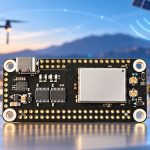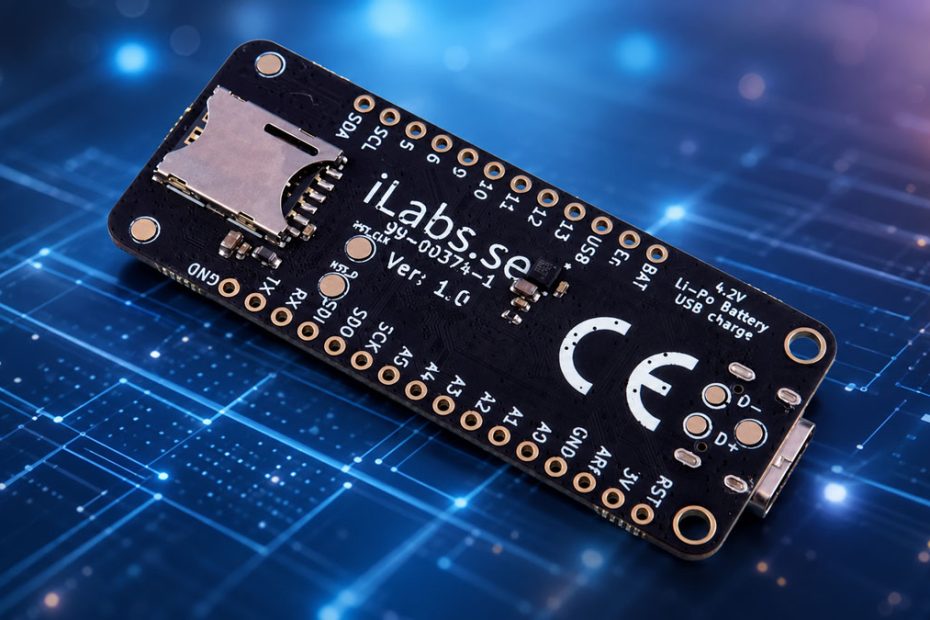
iLabs has introduced the Challenger+ RP2350 NB-IoT, a compact development board that combines Raspberry Pi’s RP2350 microcontroller with STMicroelectronics’ ST87M01-1301 cellular module. The result is a Feather-compatible platform aimed at developers building battery-powered IoT devices that need long-range cellular communication and positioning without relying on Wi-Fi.
The board targets applications such as remote sensing, asset tracking, smart metering, infrastructure monitoring and other systems that may transmit relatively small amounts of data over long deployment periods. iLabs has also retained breadboard-friendly dimensions and support for familiar embedded development environments, making the cellular hardware accessible without requiring a custom carrier board at the prototype stage.
RP2350 Dual Architecture MCU
At the center of the Challenger+ is Raspberry Pi’s RP2350, the second-generation microcontroller introduced as the successor to the RP2040.
The chip can operate with two Arm Cortex-M33 cores or two open-hardware Hazard3 RISC-V cores, with clock speeds of up to 150 MHz. It provides 520 KB of on-chip SRAM, while iLabs equips its board with 8 MB of external flash storage. Raspberry Pi also gives the RP2350 12 Programmable I/O state machines, providing considerable flexibility for implementing specialized digital interfaces and time-sensitive peripheral control.
Security capabilities include Arm TrustZone when running the Cortex-M33 architecture, along with hardware features intended for secure embedded applications.
For developers, the unusual attraction of the RP2350 remains its architecture flexibility. A product can stay within the established Arm ecosystem or provide developers with a relatively approachable route into RISC-V while retaining the same underlying microcontroller platform.
ST87M01 NB-IoT Connectivity
Cellular communication comes from the STMicroelectronics ST87M01-1301, an industrial LTE Cat NB2 module implementing 3GPP Release 15.
The version used by iLabs is certified for LTE bands B1, B3, B5, B8, B20 and B28. Peak transfer rates are rated at up to 159 kbps uplink and 127 kbps downlink. Those numbers are modest compared with conventional LTE, but high throughput is not the objective of NB-IoT. The technology is optimized for devices transmitting comparatively small data packets while prioritizing coverage and power efficiency.
ST specifies power-saving-mode consumption below 1.2 µA and power-off current below 0.5 µA for the ST87M01. The module also supports PSM and eDRX mechanisms designed to extend operating life in devices that spend much of their time asleep.
The ST module measures only 10.6 x 12.8 mm and is rated for operation from -40°F to 185°F (-40°C to 85°C), which makes it considerably more relevant to industrial and remote-monitoring projects than a typical hobby-focused cellular add-on. ST also states a 15-year longevity commitment for the module family.
GPS and Galileo Positioning
The ST87M01-1301 adds positioning capabilities directly to the communications subsystem.
It supports concurrent GPS L1 and Galileo reception, while Assisted GNSS can obtain ephemeris information over the NB-IoT connection to reduce the time required to establish a position. iLabs provides a dedicated U.FL connector for the GNSS antenna.
The module can also scan nearby 2.4 GHz 802.11b access points and collect information that can be used by an external geolocation service for indoor positioning. Importantly, the device does not need to associate with those Wi-Fi networks.
This combination makes the board particularly interesting for asset and equipment monitoring because outdoor GNSS positioning and indoor Wi-Fi-assisted location can be handled through the same communications module.
Embedded IoT Protocols
ST has integrated much more than the cellular modem into the ST87M01.
Its embedded networking stack includes TCP/IP, TLS and DTLS, CoAP, LwM2M, MQTT, HTTP/HTTPS and PDU SMS support. The modem is controlled through AT commands, reducing the amount of networking functionality developers need to implement directly on the RP2350.
Firmware maintenance is also supported through differential firmware-over-the-air updates using LwM2M, as well as local updating through UART.
For commercial development, certification is another notable feature. ST lists GCF, RED and RED-DA certification for the module, which can help reduce some of the regulatory work involved when moving from a prototype toward a finished connected product.
USB-C and LiPo Support
The development board measures approximately 50.7 x 22.8 mm and follows the compact Challenger and Adafruit Feather-style form factor. Its edge headers expose interfaces including GPIO, SPI, I2C, UART, PWM and analog functionality, while the RP2350’s programmable I/O remains available for more specialized interfaces.
USB-C provides power and data connectivity, and iLabs has integrated a lithium-polymer battery charging circuit. Charging can be supplied through USB-C or through the VUSB input.
A nano-SIM slot handles cellular service, and iLabs also offers evaluation-oriented connectivity options.
Software support includes Arduino, MicroPython and CircuitPython, an important consideration because cellular boards can otherwise impose a substantial software-learning overhead before developers reach the application itself.
Why This Board Matters
The most interesting part of the Challenger+ RP2350 NB-IoT is not any individual component. Both capable microcontrollers and NB-IoT modules are already widely available. The strength is how iLabs has combined them.
Many cellular IoT prototypes begin with a microcontroller board, a separate modem board, an antenna interface, battery-management hardware and considerable wiring between them. That is manageable on a workbench but becomes inconvenient for portable prototypes and early field testing.
Challenger+ packages much of that infrastructure onto one breadboard-compatible board while still exposing enough RP2350 I/O for sensors and control hardware.
The ST87M01 is also a sensible partner for the RP2350. A high-bandwidth 4G or 5G modem would be unnecessary for applications that send a few sensor values, alarms or location reports periodically. NB-IoT trades bandwidth for characteristics that matter more in these deployments, including low idle consumption and cellular network reach.
The addition of GNSS makes the proposition stronger. A developer working on equipment trackers, agricultural sensors, utility monitoring, environmental stations or infrastructure telemetry can potentially build the communications, location and application-processing layers around one compact platform.
Its biggest limitation is inherent to NB-IoT itself: this is not a general-purpose cellular development board for streaming video, transferring large files or applications demanding broadband connectivity. For telemetry-oriented IoT, however, that specialization is precisely the point.
Challenger+ RP2350 NB-IoT Availability
iLabs currently lists the Challenger+ RP2350 NB-IoT in its product catalog, with the company’s site showing inventory available at the time of writing. The listed price has been SEK 549.
There is an important change for European buyers. As of August 9, 2026, iLabs says its own webshop no longer accepts direct orders from EU countries because of the administrative burden associated with new packaging and producer-responsibility requirements. The company says the Challenger range remains available internationally through distributor The Pi Hut.
About iLabs
iLabs Electronics is a European embedded-electronics developer focused on development boards, microcontrollers, sensors and related hardware for engineers, small businesses and electronics enthusiasts. Its product portfolio centers heavily on the Challenger family, which uses a compact Feather-compatible format across multiple processor and connectivity combinations.
The company currently offers RP2350-based Challenger products alongside RP2040 boards and connectivity options including Wi-Fi 6, Bluetooth, LoRa and now LTE Cat NB2. The Challenger+ RP2350 NB-IoT uses an 8 MB flash configuration, a 520 KB SRAM RP2350 and the ST87M01-1301 module, creating one of the company’s most connectivity-focused development platforms to date.