Septentrio is expanding the ecosystem around its ultra-compact mosaic-G5 GNSS receiver family, adding new hardware partners and open-source reference designs aimed at accelerating integration into drones, robotics and autonomous navigation platforms.
The Belgian GNSS specialist, now part of Hexagon, says the expanded ecosystem combines commercial carrier boards with openly available hardware designs that connect mosaic-G5 receivers to widely used development platforms. New partners Hoverfly and CUAV are joining an existing group that includes SparkFun, ArduSimple, GNSS Store, ARK Electronics, ANavS, Holybro, MikroElektronika, Systork, Gateworks and 3DR.
The strategy moves mosaic-G5 beyond being simply an OEM GNSS module. Septentrio is effectively building a hardware integration layer around the receiver, allowing developers to choose between custom designs, ready-made boards and reference platforms depending on production volume and application requirements.
New mosaic-G5 Hardware Options
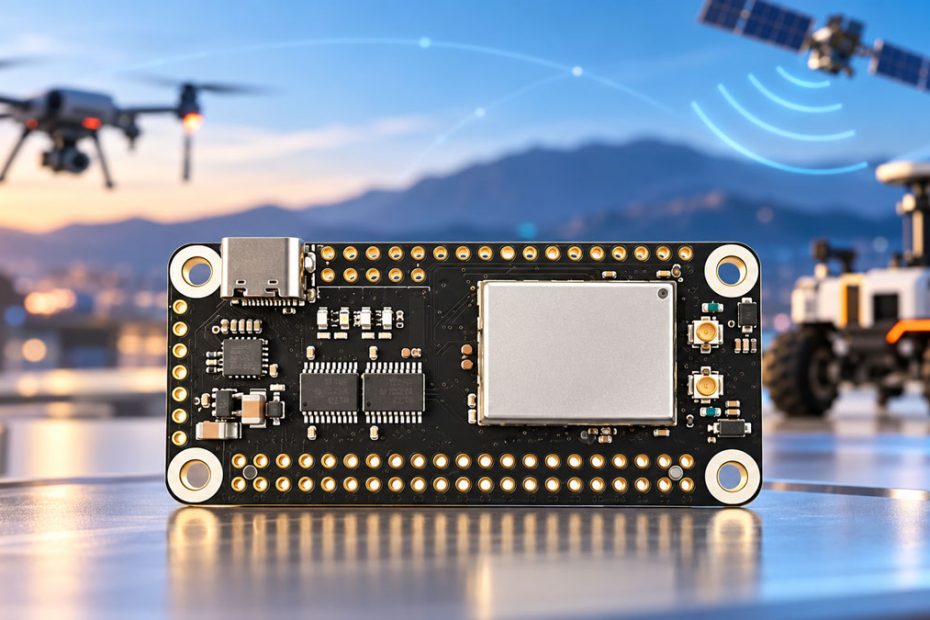
Septentrio has released four open-source hardware reference designs called mosaicG5-HAT, TeenG5, moTi and G5Dot. They provide integration paths for platforms including Raspberry Pi, NVIDIA-based computers, Arduino, Teensy and M.2 systems.
For robotics and UAV developers, that can remove a significant portion of the engineering work normally required between evaluating a GNSS receiver and deploying it inside a working navigation system.
A GNSS module may provide centimeter-level positioning, but it still requires power management, communication interfaces, antenna connections, PCB layout, mechanical packaging and integration with the host computer or autopilot. Reference hardware gives engineering teams a known starting point instead of forcing each project to solve those problems independently.
That approach is particularly relevant for smaller robotics companies and research teams that want high-end GNSS performance without designing a completely custom carrier board during the prototype stage.
23 x 16 mm GNSS Platform
The mosaic-G5 family is built around an exceptionally small surface-mount package. The modules measure approximately 22.8 x 16.4 mm, commonly rounded to 23 x 16 mm, and weigh as little as 2.2 grams.
Septentrio started volume production of the mosaic-G5 family in October 2025 after introducing the platform earlier that year. The design specifically targets systems where size, weight and power consumption are major constraints, including UAVs, mobile robots, GIS equipment and autonomous machines.
The current family includes several variants optimized for different positioning requirements.
The mosaic-G5 P1 provides essential triple-band, multi-constellation positioning and RTK capability. The P3 increases functionality with quad-band reception and full raw GNSS measurements, while the P3H adds dual-antenna heading.
Higher-end P6 and P8 versions target applications requiring greater positioning resilience and additional navigation capabilities. Septentrio also offers the mosaic-G5 T for precision timing applications.
Multi-Constellation GNSS Tracking
Depending on the version, mosaic-G5 receivers can track signals from GPS, Galileo, GLONASS, BeiDou and QZSS, with additional support for regional systems and augmentation services available on specific models.
The mosaic-G5 P3, for example, operates as a quad-band receiver and uses multiple frequencies across available satellite constellations. This improves satellite availability while reducing dependence on any single GNSS constellation.
That matters for autonomous systems operating around buildings, vegetation, machinery or other obstacles where part of the sky may frequently be blocked.
Multi-frequency reception also helps the receiver compensate for atmospheric errors more effectively and recover RTK solutions faster than basic single-frequency GNSS hardware.
Several mosaic-G5 receivers deliver positioning output at rates up to 20 Hz, which is useful for dynamic applications where the navigation controller requires frequent updates. The P3H, for example, supports positioning rates up to 20 Hz.
Dual-Antenna Heading
Some mosaic-G5 variants also support dual-antenna GNSS heading.
The P3H can calculate heading without relying on vehicle motion, unlike a single-antenna GNSS receiver that typically derives course from movement. Septentrio specifies heading accuracy of approximately 0.15 degrees with a 1-meter antenna baseline and about 0.03 degrees with a 5-meter baseline under specified conditions.
This can be particularly valuable for slow-moving robots, agricultural machines, unmanned boats and UAV platforms where knowing orientation while stationary or at very low speed is important.
GNSS heading can also complement an inertial measurement unit by providing an absolute heading reference that does not accumulate drift over time.
Anti-Jamming and Spoofing
Septentrio is also positioning the mosaic-G5 family around GNSS resilience rather than accuracy alone.
Its GNSS+ technology suite includes several signal-processing systems developed to address real-world GNSS degradation.
AIM+ detects and mitigates radio-frequency interference, including jamming and spoofing. APME+ is designed to reduce multipath errors caused by reflected satellite signals. RAIM+ performs integrity monitoring and can reject measurements judged unreliable, while IONO+ targets positioning problems caused by ionospheric disturbances. LOCK+ is designed to maintain satellite tracking under vibration and shock.
Not every mosaic-G5 model receives the same AIM+ capability. Septentrio differentiates between basic, advanced and higher-level resilience depending on the product.
The P1, for example, provides AIM+ Basic interference detection with manual mitigation, while higher-end models such as the P3 offer more advanced automatic interference mitigation.
The mosaic-G5 P8 goes further and is positioned for mission-critical applications where strong protection against sophisticated jamming and spoofing is required. Septentrio introduced the P8 in May 2026 with its AIM+ Ultimate protection package.
Why the Ecosystem Matters
The most important part of Septentrio’s announcement may not be another GNSS specification.
It is the decision to reduce the engineering distance between a high-performance GNSS module and a finished autonomous machine.
High-end GNSS receivers have traditionally been adopted first by companies with dedicated navigation engineers and sufficient production volume to justify custom electronics. Robotics is changing that market. Thousands of companies are now developing autonomous vehicles, inspection robots, drones and specialized machines in much smaller production runs.
For those developers, integration time can matter almost as much as positioning accuracy.
Supporting Raspberry Pi, NVIDIA platforms, Arduino, M.2 hardware and major autopilot ecosystems makes mosaic-G5 considerably easier to evaluate and prototype. A company can initially develop around a commercially available carrier board, verify navigation performance and later move to a custom surface-mount implementation for production.
That is a powerful model because it allows Septentrio to maintain its position as an OEM GNSS supplier while making its technology accessible to developers who previously might have selected simpler plug-and-play receivers.
It also reflects a broader change in autonomous navigation. GNSS is increasingly becoming one component of a larger compute architecture that combines positioning, inertial sensors, cameras, LiDAR, radar and machine perception. Compatibility with mainstream embedded computing platforms can therefore become almost as important as the receiver itself.
From GNSS Module to Navigation Platform
Septentrio appears to be following a strategy already familiar in other parts of the semiconductor industry.
Instead of selling only a component, the company is creating development boards, reference designs, software tools and partner hardware around that component.
That lowers the technical barrier to adoption while still allowing high-volume manufacturers to design the mosaic-G5 directly onto their own PCBs.
The result could be especially significant in commercial drones and compact autonomous machines, where every gram and every square centimeter of PCB area matters. A 2.2-gram GNSS module with multi-band RTK and interference mitigation offers capabilities that previously required substantially larger receiver hardware.
The real competitive advantage, however, may come from making those capabilities easier to integrate.
GNSS specifications between high-end receivers are becoming increasingly sophisticated. Development effort, documentation, autopilot compatibility and availability of proven reference hardware are therefore becoming important differentiators.
By expanding the mosaic-G5 ecosystem, Septentrio is clearly trying to compete on all of those fronts at once.
About Septentrio
Septentrio was founded in 2000 as a spin-off from Belgian semiconductor research institute imec. The company specializes in high-precision, multi-frequency and multi-constellation GNSS receivers for industrial, scientific and mission-critical applications.
Its headquarters are in Leuven, Belgium, with offices in the United States, Finland, China, Japan and South Korea. Septentrio’s technology is used across UAVs, robotics, surveying, construction, maritime, reference networks, logistics and autonomous systems.
Hexagon announced the acquisition of Septentrio in January 2025 and completed the transaction in March 2025. At the time of the acquisition announcement, Septentrio had approximately 150 employees and was expected to generate more than €50 million in 2024 revenue. The company now operates within Hexagon’s Autonomous Solutions division.
Hexagon itself reported approximately 24,800 employees across 50 countries and annual net sales of about €5.4 billion in recent company disclosures.