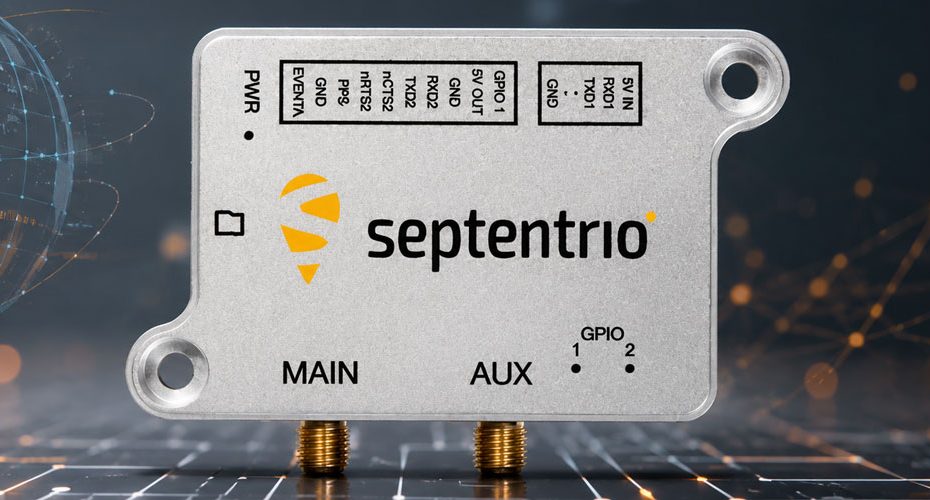
Septentrio, part of Hexagon, has expanded its precision positioning portfolio with the new mosaic G5 P6 GNSS module, targeting commercial drones, autonomous robots, industrial automation systems, and other applications where size, weight, and power efficiency are critical.
The new receiver is extremely compact at just 23 x 16 mm and weighs approximately 2.2 grams, placing it among the smallest high precision multi frequency GNSS modules currently aimed at professional industrial integration rather than hobby grade navigation.
What makes this launch particularly important is that Septentrio is clearly pushing the market toward smaller embedded positioning systems that still retain enterprise level resilience features. In many UAV and robotic applications, compact size traditionally forced manufacturers to compromise on interference resistance, update speed, or positioning quality. Mosaic G5 P6 appears designed specifically to avoid those compromises.
Anti Jamming Features
One of the key technologies integrated into the module is Septentrio’s AIM+ interference mitigation platform, which is intended to protect the receiver from GNSS jamming and spoofing attacks.
That matters more today than it did even a few years ago. GNSS interference has become increasingly common around ports, industrial zones, military conflict regions, and even large urban environments with heavy radio congestion. For autonomous machines operating near critical infrastructure or in commercial agricultural applications, maintaining stable positioning during signal degradation is becoming a serious operational requirement rather than just a premium feature.
Septentrio has long been known inside the professional GNSS sector for strong RF interference mitigation performance, especially in demanding applications like unmanned systems, marine navigation, surveying, mining, and industrial automation.
High Update Rates for Automation
According to the company, the mosaic G5 P6 delivers one of the higher GNSS update rates currently available in this size category while maintaining low latency performance.
Although Septentrio has not publicly disclosed every detailed specification yet, the module supports multi constellation GNSS reception, including GPS, Galileo, GLONASS, BeiDou, NavIC, and QZSS compatibility through modern multi frequency tracking architecture.
The receiver also supports:
- Galileo High Accuracy Service for decimeter level positioning.
- Single and dual antenna configurations.
- GNSS heading capabilities.
- Raw measurement output for sensor fusion.
- Compatibility with PX4 and ArduPilot ecosystems.
- ROS integration support for robotics developers.
These features position the module well for advanced autonomy stacks where GNSS data must work together with IMUs, LiDAR, cameras, and wheel odometry systems.
Dual antenna support is especially valuable for autonomous machines because it enables true heading determination even at very low speeds or during stationary operation, something standard single antenna GNSS systems cannot reliably achieve without vehicle movement.
Robotics and Precision Guidance Focus
The strongest commercial opportunities for the mosaic G5 P6 will likely come from sectors where integrators need compact OEM level positioning without moving to larger survey grade receivers.
That includes:
- Agricultural robotics.
- Autonomous tractors.
- UAV mapping platforms.
- Warehouse robotics.
- Mobile industrial inspection systems.
- Precision guidance machinery.
- Marine robotics.
The inclusion of open ecosystem compatibility is another important strategic move. Support for PX4, ArduPilot, and ROS significantly reduces integration barriers for developers already working within established autonomous system frameworks.
Septentrio also introduced the mosaic go G5 P6 evaluation kit, allowing developers to rapidly prototype and validate integrations before full production deployment.
GNSS Market Competition Intensifies
The launch also reflects a broader trend across the precision positioning industry. GNSS vendors are increasingly competing not only on accuracy, but also on resilience, integration simplicity, latency, power consumption, and anti spoofing performance.
Compact high precision positioning modules are becoming critical components for the next generation of autonomous equipment, especially as robotics and precision agriculture continue scaling globally.
In the agricultural sector specifically, compact RTK capable modules are increasingly being integrated into autonomous implements, retrofit guidance systems, robotic sprayers, and small unmanned field platforms where traditional large receivers are impractical.
About Septentrio
Septentrio was founded in Belgium in 2000 and has become one of Europe’s most recognized high precision GNSS receiver manufacturers. The company develops positioning technologies for industrial, surveying, marine, UAV, mining, and autonomous system applications worldwide. Septentrio became part of Hexagon in 2021, strengthening Hexagon’s positioning technology portfolio across industrial automation and geospatial markets. Hexagon operates in more than 50 countries and generates annual revenues exceeding €5 billion across its industrial technology businesses.