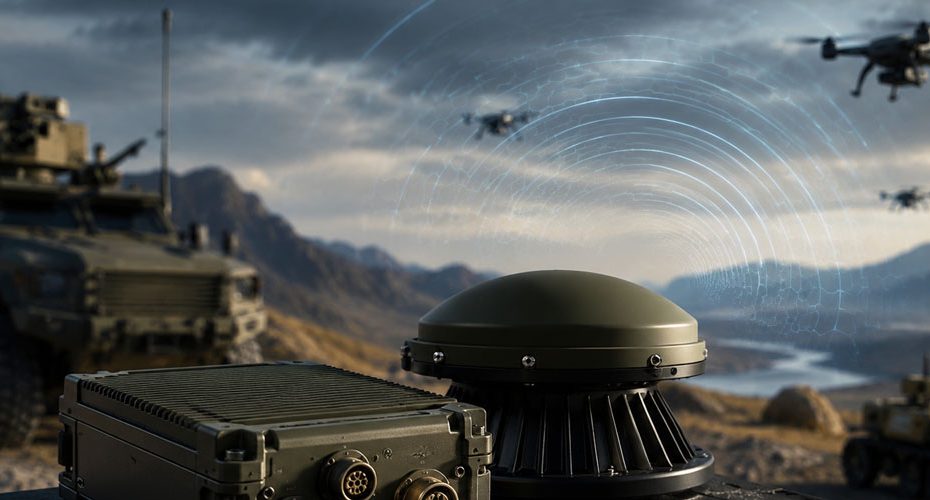
Thales has officially introduced a new compact positioning, navigation, and timing receiver designed specifically for military platforms operating in heavily contested electromagnetic environments. Called the TopStar Smart Receiver, the new system combines anti jam protection, multi constellation military GNSS support, and long duration timing holdover inside a significantly smaller package than traditional battlefield navigation systems.
The launch reflects a broader shift currently happening across defense electronics. Reliable satellite positioning is no longer assumed in modern conflict zones. Instead, manufacturers are now designing systems around the expectation of constant jamming, spoofing attempts, and intermittent GNSS denial.
TopStar Smart Receiver specifications
According to Thales, the TopStar Smart Receiver integrates three major capabilities into a single compact unit:
- Dual constellation military GNSS receiver.
- Adaptive CRPA anti jam antenna technology.
- High stability onboard timing clock.
The receiver supports military satellite navigation signals alongside civilian GPS and Europe’s Galileo Public Regulated Service. This combination improves redundancy and operational resilience when signal conditions deteriorate.
One of the most important technical elements is the integrated Controlled Radiation Pattern Antenna system. CRPA technology dynamically suppresses interference sources by electronically shaping antenna reception patterns in real time.
Thales claims the system can continue operating up to 30 times closer to an active jamming source compared to a conventional GPS receiver. In practical battlefield conditions, that is a major operational difference. Modern electronic warfare systems are now widely deployed not only by advanced military powers but also across lower cost tactical environments, making hardened navigation increasingly essential even for smaller unmanned systems.
Electronic warfare pressure is reshaping GNSS hardware
From a technical and strategic perspective, this launch highlights how rapidly the defense GNSS sector is evolving.
A decade ago, anti jam technology was largely reserved for high value aircraft, naval platforms, or strategic systems. Today, electronic warfare threats affect almost every category of military hardware including:
- Ground vehicles.
- Tactical drones.
- Loitering munitions.
- Precision artillery systems.
- Battlefield communications networks.
The compact size of the TopStar Smart Receiver may ultimately become just as important as its anti jam performance. Smaller receivers are increasingly critical for modern drone ecosystems where payload space, weight, and power consumption directly affect endurance and mission flexibility.
Timing holdover improves operational resilience
Another major capability is the onboard high performance clock designed for timing continuity during GNSS outages.
According to Thales, the receiver can maintain synchronization for tactical radio systems for up to 48 hours after complete satellite signal loss. Conventional systems often sustain synchronization for roughly 30 minutes under similar conditions.
That difference matters because modern military communications increasingly rely on precise timing coordination for encrypted networking, data exchange, and synchronized operations. A longer holdover window allows forces to continue operating even when satellite access is temporarily degraded or denied.
French production expansion supports demand growth
The system is assembled at Thales facilities in Valence, France, and is already available for operational testing.
The launch also ties into the company’s broader production expansion strategy under the OMEGA industrial program. Thales previously announced a €55 million investment focused on scaling manufacturing capacity across its Valence and Châtellerault operations.
Mass production of TopStar M receivers and TopShield anti jam systems is expected to ramp up this year as European and NATO aligned defense procurement increasingly prioritizes resilient navigation infrastructure.
Why this launch matters now
From an industry perspective, the timing of this release is significant.
The global defense market is entering a phase where anti jam resilience is no longer considered a premium feature. It is rapidly becoming a baseline requirement. Recent battlefield conditions have demonstrated that even advanced platforms can lose effectiveness quickly when navigation and timing systems become unreliable.
In that context, compact integrated PNT systems with hardened anti jam capability are likely to become one of the fastest growing segments of the military electronics market over the next several years.
About Thales
Thales Group is one of Europe’s largest aerospace, defense, cybersecurity, and digital technology companies. Headquartered in France, the company operates in more than 65 countries and employs over 80,000 people globally. Thales reported annual revenue exceeding €18 billion and remains heavily involved in military avionics, secure communications, radar systems, satellite technologies, air traffic management, and electronic warfare infrastructure. The company is also a major supplier of navigation and anti jam technologies for NATO aligned defense programs.