InfraDigital is scaling its role in infrastructure digitalization by delivering a series of advanced as built and digital twin projects across rail, road, and energy sectors. The company’s latest work highlights how point clouds, mobile mapping, and BIM workflows are converging into fully traceable, data rich models inside Trimble Connect.
Rather than treating 3D models as static deliverables, InfraDigital is positioning them as operational assets that integrate geometry, metadata, and lifecycle intelligence into a single environment.
Digital twin workflows powered by point clouds and mobile mapping data
A consistent pattern across all showcased projects is the heavy reliance on high density 3D point clouds as the primary data source. These datasets are enriched with legacy plans, GIS layers, CAD inputs, and alignment data to produce engineering grade as built models.
For example, the Europabrücke Zurich project demonstrates the scale at which automation is now applied. Using Trimble MX9 mobile mapping data, InfraDigital generated a detailed bridge model where automated edge extraction alone accounted for 79,292 linear meters. This level of automation significantly reduces manual modeling time while improving geometric consistency across large structures.
Similarly, the RhB Farschbrücke bridge model integrates multiple data layers including current point cloud scans and historical construction documentation. This hybrid approach ensures both geometric accuracy and engineering context, which is critical for renovation and structural assessment workflows.
Automated BIM modeling for highways and multi asset infrastructure
InfraDigital’s work on the N12 Flamatt to Weyermannshaus motorway section highlights how BIM is evolving from design support into a central data backbone for infrastructure renewal.
The project spans approximately 8 kilometers and combines:
- mobile mapping datasets;
- GIS infrastructure layers;
- object inventories;
- legacy engineering plans;
- CAD models.
All elements are linked to model components with traceable attribution, enabling engineers to track data origin and reliability. A key innovation here is the automatic extraction of discipline specific models directly from point clouds, reducing the need for manual segmentation and accelerating project timelines.
This approach is particularly relevant for national infrastructure operators such as ASTRA, where asset traceability and data consistency are critical for long term maintenance planning.
Parametric tunnel modeling enables full automation in renovation projects
In the Toua Tunnel renovation, InfraDigital moves beyond static modeling into parametric infrastructure generation.
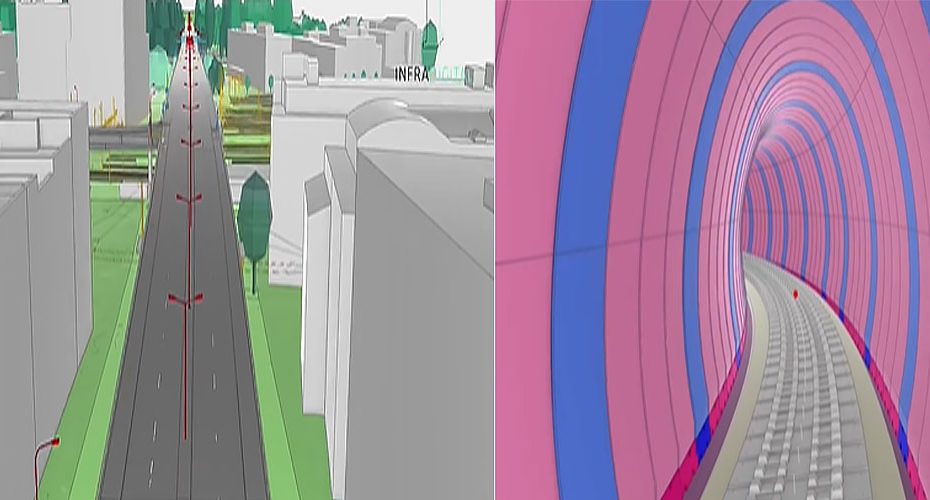
For this 100 year old railway tunnel, the company developed a fully parameterized lining segment distribution system. Based on inputs such as clearance profiles and track alignment, segment placement along the tunnel axis is now automated.
This is not just a design tool. The model functions as a digital twin during construction, supporting sequencing, validation, and potentially machine guidance workflows.
Such parametric approaches signal a shift toward rule based infrastructure modeling, where geometry is generated dynamically rather than manually drafted.
Digital twin approach extends into alpine solar energy projects
InfraDigital is also applying its methodology outside traditional transport infrastructure. In the Sedrun Solar project, part of the ZENDRA initiative, the company implemented a fully digital workflow for planning alpine solar installations.
The system enables:
- terrain based positioning of solar tables;
- integration of production and construction planning;
- lifecycle support from design to operation.
Operating in high alpine environments introduces additional complexity such as terrain variability and logistics constraints. The use of a centralized digital twin within Trimble Connect helps coordinate these factors in a single model driven workflow.
Multi corridor infrastructure modeling supports complex planning scenarios
One of the most complex projects in the portfolio is the Fideris to Küblis new alignment, covering nearly 5 kilometers of multi modal infrastructure.
The BIM as built model supports:
- a national highway;
- a cantonal road;
- a new railway line;
- utility networks;
- bridges and retaining structures;
- a new railway tunnel.
By consolidating all disciplines into a unified model, InfraDigital enables cross domain coordination at an early stage, reducing design conflicts and improving planning efficiency for large scale infrastructure programs.
Industry shift toward data driven infrastructure models accelerates
Across all projects, a clear trend emerges. Infrastructure modeling is moving from geometry creation toward data orchestration.
InfraDigital’s workflows demonstrate:
- automation replacing manual CAD modeling;
- point clouds becoming the primary source of truth;
- BIM models acting as data containers rather than just visualizations;
- digital twins extending into construction and operations.
This aligns with broader industry movement where platforms like Trimble Connect are evolving into collaboration hubs that connect field data, design models, and asset management systems.
About InfraDigital
InfraDigital is a Switzerland based engineering and digital infrastructure company specializing in BIM modeling, digital twins, and point cloud processing for transport and energy projects. The company focuses on integrating mobile mapping, laser scanning, and GIS data into structured, traceable infrastructure models.
While exact company size and revenue figures are not publicly disclosed, InfraDigital operates across multiple large scale national and regional projects, including collaborations with railway operators, highway authorities, and energy initiatives in Switzerland. Its portfolio spans bridges, tunnels, highways, and renewable energy infrastructure, positioning it as a niche player in high precision infrastructure digitization.