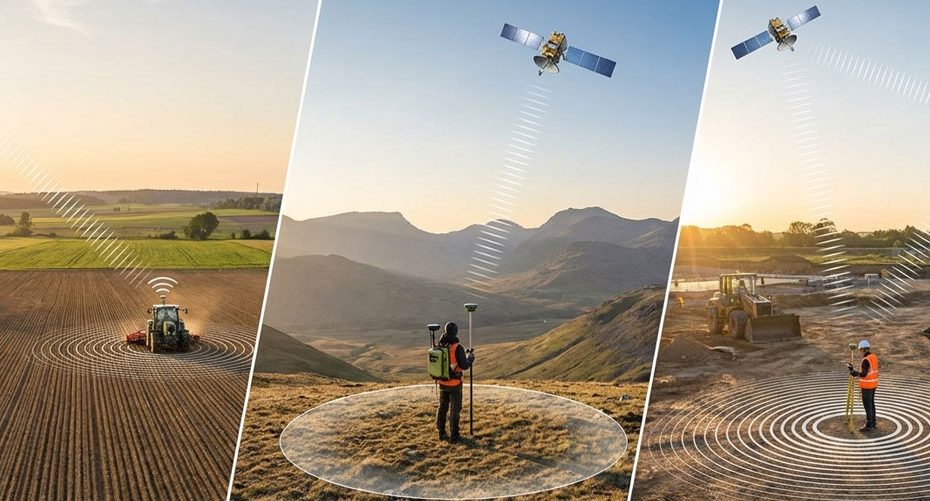
GNSS positioning technology has reached a turning point. With four main operational satellite constellations (GPS, GLONASS, Galileo, BeiDou) now fully deployed and dual-frequency capability spreading across consumer devices, the methods used to calculate position have fragmented into distinct approaches. Each method trades different variables: accuracy against infrastructure, speed against coverage, cost against reliability.
The question isn’t which method is objectively superior. The question is which method fits your operational constraints.
How GNSS Positioning Works
Every GNSS receiver measures the time it takes for signals to travel from satellites to the receiver. Multiply that time by the speed of light, and you get distance. Triangulate from enough satellites, and you get position.
The problem: multiple error sources corrupt these measurements. Satellite clocks drift. Signals refract through the ionosphere and troposphere. Receiver hardware introduces noise. Multipath reflections add false readings.
Different positioning methods handle these errors differently.
The 3 GNSS Signal Components
GNSS signals contain three components that receivers can measure.
Carrier wave. The electromagnetic wave oscillates at 1100-1600 MHz. Measuring the phase of this carrier gives you fractional wavelength precision—roughly 1000 times more accurate than code measurements. The carrier phase determines highly precise fractional ranges, but you don’t know how many complete wavelengths (cycles) have elapsed. This ambiguity must be resolved through processing.
Spreading codes. Binary sequences modulated onto the carrier at 1-10 MHz. These codes provide absolute range measurements with meter-level accuracy. They’re immune to the cycle ambiguity problem but sacrifice precision.
Data component. Low-frequency stream (125 Hz for Galileo I/NAV) containing satellite ephemeris, clock corrections, and integrity indicators.
The positioning method you choose determines which signal components you use and how you process them.
Method Comparison Overview
| Method | Observable | Positioning Type | Communication Link | Horizontal Accuracy | Coverage | Time To First Fix |
|---|---|---|---|---|---|---|
| SPP | Code | Absolute (GNSS reference frame) | No | 5-10 m (dual-freq) / 15-30 m (single-freq) | Worldwide | Rx TTFF |
| DGNSS | Code | Relative | Yes | < 1 m to < 5 m | Up to 100s km | As SPP + time to receive corrections |
| SBAS | Code | Relative | Yes (GNSS-like) | Up to 1 m | Up to 1000s km | As DGNSS |
| RTK | Carrier | Relative | Yes | 1 cm + 1 ppm baseline | Up to 10s km | As DGNSS + time to resolve ambiguities |
| PPP-RTK | Carrier | Absolute (tracking network reference frame) | Yes | < 10 cm | Regional | Faster than PPP but slower than RTK |
| PPP | Code/Carrier | Absolute (tracking network reference frame) | Yes | < 10 cm to < 1 m | Worldwide | As RTK, but time to estimate ambiguities significantly higher (more unknowns) |
RTK – Maximum Precision With Infrastructure
Real-Time Kinematic positioning uses carrier phase measurements to achieve centimeter-level accuracy. The method requires a base station at a known location within tens of kilometers of your receiver (the rover).
How RTK Works
The base station broadcasts correction data over a communication link. Your rover receives these corrections and computes its position relative to the base station. Because both stations observe similar atmospheric errors and satellite orbit errors, these errors largely cancel out when you compute the baseline vector between them.
The critical step – resolving carrier phase ambiguities. When you first lock onto a satellite signal, you don’t know how many complete carrier wavelengths lie between you and the satellite. RTK algorithms solve this integer ambiguity problem by processing dual-frequency measurements and using geometric constraints from multiple satellites.
RTK Accuracy and Convergence
RTK delivers 1 cm horizontal accuracy plus 1 ppm of the baseline distance. If you’re 10 km from your base station, expect 1 cm + 10 mm = 2 cm accuracy.
Time to first fix depends on several factors:
- Satellite geometry and signal strength.
- Baseline length.
- Ionospheric activity.
- Receiver quality.
Typical TTFF ranges from a few seconds to a few minutes. After ambiguity resolution, position updates occur at your receiver’s measurement rate (typically 1-20 Hz).
RTK Infrastructure Requirements
RTK needs:
- Base station within 20-50 km (accuracy degrades with distance).
- Real-time communication link between base and rover.
- Both receivers must track the same satellites.
You can set up your own base station, subscribe to a Network RTK (NRTK) service that operates multiple base stations, or use a public CORS (Continuously Operating Reference Station) network.
Where RTK Makes Sense
Agriculture. Tractor guidance systems use RTK for sub-inch accuracy during planting, spraying, and harvesting. A farm can operate a single base station to cover thousands of hectares. The infrastructure cost amortizes across the equipment fleet.
Construction. Grading equipment and pile drivers need centimeter accuracy within a bounded site. A temporary base station serves the project duration.
Survey and mapping. Land surveyors use RTK for boundary surveys, topographic mapping, and construction staking where they need immediate, verifiable results.
The pattern: RTK works when you operate in a defined area where you can justify the infrastructure cost and when you need immediate, high-precision results.
RTK Limitations
Baseline distance matters. Accuracy degrades as you move away from the base station because atmospheric errors decorrelate. Beyond 30-50 km, you start losing the advantage.
The communication link can fail. Radio interference, terrain blocking, or network outages break the correction stream. No corrections means no RTK solution.
Initialization time can be unpredictable. In challenging environments (urban canyons, under tree canopy), ambiguity resolution may take minutes or fail completely.
PPP – Global Coverage Without Infrastructure
Precise Point Positioning uses carrier phase measurements but doesn’t require a nearby base station. Instead, PPP relies on precise satellite orbit and clock data broadcast globally.
How PPP Works
PPP receivers use precise ephemerides and clock corrections generated by global networks of reference stations. These corrections account for satellite orbit errors and clock drift. The receiver processes dual-frequency measurements to eliminate most ionospheric errors and models tropospheric delays.
Unlike RTK, PPP computes absolute position in the global reference frame. You don’t need to know where you are relative to a base station—you compute your position directly.
PPP Accuracy and Convergence
PPP achieves 10 cm to 1 m horizontal accuracy after convergence. The convergence period is the main drawback: expect 20-45 minutes of continuous satellite tracking before reaching centimeter-level accuracy.
Why so long? PPP must estimate more parameters than RTK:
- Your position (3 coordinates).
- Receiver clock error (1 parameter).
- Tropospheric delay (1 parameter).
- Carrier phase ambiguities (one per satellite per frequency).
With no nearby reference station, you can’t difference away these errors quickly. The receiver must accumulate enough measurements across changing satellite geometry to constrain all the unknowns.
After convergence, position accuracy remains stable as long as you maintain continuous satellite lock. If you lose lock (driving under a bridge, entering a building), you must reconverge.
Where PPP Makes Sense
Ocean surveying. Survey vessels operate hundreds or thousands of kilometers from shore. Setting up base stations is impossible. PPP provides the only viable high-accuracy solution. Convergence time doesn’t matter when you’re collecting data over days or weeks.
Remote sensing and mapping. Aircraft and drones flying long-distance missions need continuous high-accuracy positioning without ground infrastructure. A 30-minute initialization at the start of a 6-hour flight is acceptable overhead.
Scientific applications. Monitoring crustal deformation, measuring sea level rise, or tracking ice sheet movement requires absolute positioning in a global reference frame. PPP provides this without maintaining local base stations.
The pattern. PPP works when you need global coverage, can tolerate long initialization, and operate continuously once initialized.
PPP Limitations
Convergence time kills workflows that require frequent stops and starts. An agricultural drone that lands to swap batteries every 20 minutes can’t use PPP effectively.
Accuracy is slightly lower than RTK. The 10-20 cm typical PPP accuracy doesn’t meet requirements for applications needing single-digit centimeter precision.
Availability of precise corrections varies. Free services (like IGS) provide corrections with latency. Real-time PPP services require paid subscriptions.
PPP-RTK – The Hybrid Approach
PPP-RTK combines the global coverage of PPP with faster convergence times by incorporating regional correction data. The method uses a network of reference stations to estimate atmospheric errors (ionosphere and troposphere) and broadcast these corrections along with precise satellite data.
How PPP-RTK Works
A network of reference stations continuously tracks all visible satellites.
The network processing center estimates:
- Satellite orbit and clock errors (like PPP).
- Regional ionospheric delays.
- Tropospheric delays.
- Satellite code and phase biases.
Your receiver downloads these corrections and uses them to constrain the positioning solution. Because atmospheric errors are partially known, you can resolve ambiguities faster than pure PPP.
The result – you compute absolute position (like PPP) with convergence times closer to RTK.
PPP-RTK Accuracy and Convergence
PPP-RTK achieves less than 10 cm horizontal accuracy with convergence times of a few minutes. This is slower than RTK (seconds to minutes) but faster than PPP (20-45 minutes).
The exact convergence time depends on:
- Reference station network density.
- Quality of atmospheric modeling.
- Distance from nearest reference stations.
- Number of satellites and frequencies tracked.
Where PPP-RTK Makes Sense
Autonomous vehicles. Self-driving cars need high accuracy but operate across large regions. They can’t rely on maintaining a connection to a single base station. PPP-RTK provides regional coverage with acceptable convergence times.
Delivery drones. Urban drone delivery requires decimeter accuracy across an entire city. Setting up RTK infrastructure for every delivery zone is impractical. PPP-RTK offers a middle ground.
Mobile mapping. Vehicles equipped with LiDAR or camera systems for 3D mapping need consistent accuracy while driving hundreds of kilometers. PPP-RTK eliminates base station handoffs while maintaining precision.
The pattern. PPP-RTK works when you need better than meter-level accuracy across large areas but can’t justify dense RTK infrastructure.
PPP-RTK Limitations
Regional coverage only. You need to be within the service area of a reference station network. Coverage is expanding but remains limited compared to global PPP services.
Subscription costs. PPP-RTK services typically charge monthly or per-device fees. For small operations, this may exceed the cost of operating your own RTK base.
Still slower than RTK. If you’re working in a confined area and need instant initialization, RTK remains faster.
Error Mitigation Comparison
Different methods handle GNSS error sources differently.
| Error Source | RTK (OSR) | PPP-RTK (SSR) | PPP (SSR) |
|---|---|---|---|
| SV orbit error | ✓ | ✓ | ✓ |
| SV clock error | ✓ | ✓ | ✓ |
| SV bias | ✓ | ✓ | ✓ |
| Ionosphere | ✓ | ✓ | ✗ |
| Troposphere | ✓ | ✓ | ✗ |
OSR = Observation Space Representation (corrections observed at reference station).
SSR = State Space Representation (corrections estimated by network).
RTK mitigates all major error sources through differential processing. Both receivers see nearly identical errors, which cancel in the baseline solution.
PPP-RTK mitigates all error sources through network modeling. The reference station network estimates atmospheric errors and broadcasts corrections.
PPP mitigates satellite errors (orbit, clock, bias) but must model atmospheric errors at the receiver using dual-frequency measurements and atmospheric models. This works but requires longer convergence.
Multi-Frequency – The Game Changer
Dual-frequency and multi-frequency receivers change the performance equation for all three methods.
Single-frequency receivers must model ionospheric delays or use broadcast models. These models have errors, which limit accuracy and slow convergence.
Dual-frequency receivers eliminate first-order ionospheric errors by combining measurements from two frequencies (like GPS L1 and L5, or Galileo E1 and E5). The ionosphere affects different frequencies differently—you can use this property to solve for and remove the delay.
In 2026, dual-frequency capability has become standard:
- Smartphones (iPhone, Samsung flagship models) include dual-frequency GNSS chips.
- Consumer-grade GNSS modules support E1 + E5 or L1 + L5 at $50-200 price points.
- All new receiver models default to multi-frequency, multi-constellation operation.
This democratization of dual-frequency technology means:
- RTK initialization is faster and more reliable.
- PPP convergence times have dropped from 45-60 minutes (single-frequency) to 20-30 minutes (dual-frequency).
- PPP-RTK can achieve convergence in under 5 minutes in good conditions.
The Galileo E5 signal (four full GNSS constellations provide open signals at E5 or equivalent frequencies) and the shared ARNS frequency band offer particular benefits: higher chip rates, stronger signals, and regulatory protection from interference.
Multi-Constellation Support
All three methods benefit from tracking multiple satellite constellations:
- GPS: 31 satellites, global coverage, mature signals (L1, L2, L5).
- GLONASS: 24 satellites, good at high latitudes, frequency-division multiple access.
- Galileo: 26 satellites (after recent launches), high-quality signals, E5 benefits.
- BeiDou: 35 satellites (regional + global), strong Asia-Pacific coverage.
Tracking all four constellations provides:
- 80-100+ satellites in view globally (compared to 8-12 from a single constellation).
- Better geometry (lower GDOP).
- Faster ambiguity resolution.
- Improved availability in challenging environments.
Multi-constellation support is now standard across all receiver types. The receiver firmware handles constellation-specific signal processing and coordinate frame transformations.
Cost Analysis
| Method | Hardware Cost | Service Cost | Infrastructure Cost | Total First-Year Cost (Single Receiver) |
|---|---|---|---|---|
| RTK (own base) | $3,000-8,000 (rover) + $3,000-8,000 (base) | $0 | Radio links: $500-2,000 | $6,500-18,000 |
| RTK (NRTK service) | $3,000-8,000 (rover) | $800-2,000/year | $0 | $3,800-10,000 |
| PPP | $3,000-8,000 | $0-1,500/year (free to premium service) | $0 | $3,000-9,500 |
| PPP-RTK | $3,000-8,000 | $1,200-3,000/year | $0 | $4,200-11,000 |
These costs assume professional-grade receivers. Consumer-grade dual-frequency modules ($50-500) can work with RTK and PPP but with lower accuracy and reliability.
For small operations (1-5 receivers), NRTK subscriptions often cost less than maintaining a base station. For larger operations (20+ receivers), owned infrastructure amortizes the cost.
Making the Decision
Start with your operational requirements.
If you need centimeter accuracy within a defined work area (< 30 km). RTK is the answer. Set up a base station or subscribe to NRTK. Accept the infrastructure dependency in exchange for immediate, reliable precision.
If you operate globally or across very large regions and can tolerate 20-30 minute initialization. PPP provides coverage without infrastructure. Budget for convergence time in your workflow.
If you need better than 10 cm accuracy across a region (city, state) with frequent stops and starts. PPP-RTK offers the best compromise. Pay for service coverage; accept 3-10 minute convergence as overhead.
If meter-level accuracy is sufficient. Code-based DGNSS or SBAS may be adequate. Don’t overcomplicate with carrier phase methods.
Real-World Use Cases
Precision agriculture tractor (RTK). A 500-hectare farm runs five tractors with RTK rovers connected to a single base station. The base station cost ($5,000) plus radio infrastructure ($2,000) spreads across the fleet. Each tractor achieves 2 cm pass-to-pass accuracy for planting and spraying. The system pays for itself in reduced overlap and input costs within one season.
Aerial mapping drone (PPP). A survey company operates drones for topographic mapping across multiple states. Each flight lasts 2-4 hours. The drone initializes PPP on the ground for 30 minutes before takeoff, then maintains lock throughout the flight. The 30-minute overhead is acceptable for a 4-hour mission. No ground infrastructure needed at each site.
Autonomous delivery robot (PPP-RTK). A food delivery service deploys robots across a 50 km² urban area. The robots use PPP-RTK with a regional service. Each robot achieves 5 cm accuracy with 3-5 minute convergence after powering on. The service subscription ($150/month per robot) costs less than deploying RTK base stations across the delivery zone.
Cadastral surveyor (RTK). A land surveyor establishes property boundaries. Each survey site requires 0.5-2 cm accuracy for legal defensibility. The surveyor sets up a temporary base station at a known benchmark, then surveys boundary points with a rover. The base station setup takes 10 minutes but provides reliable centimeter accuracy. Post-processing validates results.
Scientific monitoring station (PPP). A seismology research network operates 200 GPS stations monitoring crustal deformation. Stations run continuously and compute daily position solutions using PPP post-processing. The 24-hour data collection period easily accommodates PPP convergence. The network processes data centrally with free IGS precise ephemeris products.
Technology Trends for 2026
- Multi-frequency as baseline. Dual-frequency GNSS is no longer a premium feature. Entry-level receivers now support E1+E5 or L1+L5, which accelerates convergence for all methods.
- Galileo HAS (High Accuracy Service). Free PPP corrections broadcast via Galileo E6 signal. Provides decimeter-level accuracy globally without subscription costs. Early adoption in receiver firmware has begun.
- LEO satellite augmentation. Companies like Xona Space Systems plan to launch low Earth orbit satellites for faster convergence and improved availability in urban environments. This could reduce PPP convergence to under 5 minutes.
- Sensor fusion. Combining GNSS with IMU, vision, and LiDAR creates resilient positioning systems. Methods like RTK or PPP provide absolute reference, while inertial sensors bridge GNSS outages.
- On-device ambiguity resolution. Smartphone chips now include carrier phase tracking. Android Location API exposes raw GNSS measurements, enabling RTK and PPP applications on mobile devices. Accuracy won’t match survey-grade receivers but enables new use cases.
- Network densification. NRTK and PPP-RTK service coverage continues expanding. Countries are building out national reference station networks, reducing coverage gaps.
The choice depends on your accuracy requirements, operational area, tolerance for initialization time, and infrastructure constraints. In 2026, all three methods are production-ready and supported by multiple receiver manufacturers and service providers.