Every time a ship logs its position, an aircraft trusts its flight management system, or a power grid synchronizes its clocks, it is placing blind faith in signals that anyone with the right equipment can fake.
What Is GNSS Spoofing?
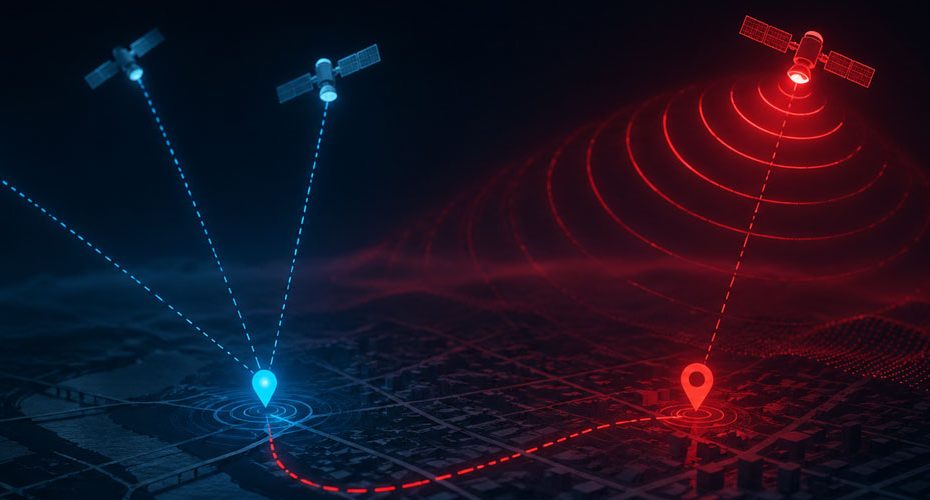
Modern civilization runs on satellite timing and positioning in ways most people never think about. GPS, GLONASS, Galileo, BeiDou — these systems quietly underpin smartphone navigation, military targeting, and the timestamps that keep financial transactions from collapsing into chaos. Spoofing attacks this foundation not by cutting the signal, but by replacing it with a lie. A compromised receiver keeps functioning, displays a position, reports a time — and has no idea any of it is fabricated. That’s what makes spoofing genuinely dangerous in a way that simple jamming never was.
How GNSS Spoofing Works
To understand the attack, you first need to understand what a GNSS receiver actually does. It listens for signals from multiple satellites, measures how long each signal took to arrive, and uses those propagation delays to solve for its own position in three-dimensional space — a process called trilateration. Every satellite transmits on a known frequency using a pseudorandom noise code that the receiver matches against its own internal replica. The delay between transmission and reception, converted to distance, is what makes the math work.
Civilian GNSS signals — GPS L1 C/A being the most widely used — carry no cryptographic authentication whatsoever. There’s nothing stopping someone with the right hardware from generating signals that look, to any receiver, completely legitimate. A spoofer does exactly that. The attack usually starts subtly: fake signals are introduced at power levels close to the real ones, avoiding any jarring discontinuity that might set off an alarm. Then the adversary slowly drifts the timing parameters, nudging the receiver’s computed position or clock away from reality in increments small enough to go unnoticed.
The hardware required for this isn’t exotic. Software-defined radio equipment capable of generating convincing spoofed signals is commercially available for a few hundred dollars. Pair that with open-source signal generation software and you have a functional attack platform. State-level actors operate at a different scale entirely — vehicle-mounted or airborne systems capable of blanketing entire regions, the kind of infrastructure behind the well-documented interference events over the Black Sea and Eastern Mediterranean that began appearing in incident reports around the mid-2010s.
Principal GNSS Spoofing Techniques
The threat is not a single thing. Different attackers, with different resources and goals, use meaningfully different approaches.
Meaconing predates the digital era. The attacker captures genuine satellite signals and rebroadcasts them after a deliberate delay. No synthesis required, no deep knowledge of signal structure — the receiver simply calculates an incorrect position because it’s measuring artificially extended propagation times. Simple, but detectable if you’re looking.
Replay attacks take a similar shortcut: record a real GNSS signal somewhere, play it back later or elsewhere. The problem is that the navigation message contains an embedded timestamp, and that timestamp will quickly diverge from actual UTC, making the fraud obvious to any system that checks.
Generative spoofing is where things get serious. The adversary constructs signals entirely from scratch — satellite geometry, Doppler shifts, carrier phase, navigation message content, all of it synthesized to form a coherent false picture. This is the technique behind ships near Russian ports suddenly reporting their position as Vnukovo Airport, and the aviation anomalies that have sent flight management systems haywire over contested airspace.
Receiver-targeted attacks narrow the focus to a single device, sometimes by physically introducing a signal at the antenna connection. Relevant when the target is high-value and specific — a financial timing server, a particular vehicle, critical communications equipment.
Time-focused infrastructure attacks deserve their own category because navigation isn’t the objective at all. Power grids, cellular base stations, trading platforms — all of them synchronize using GNSS-derived timestamps. Corrupt the time reference by even a handful of microseconds and distributed systems begin to desynchronize in ways that cascade unpredictably.
Detection and Mitigation
Defense works at multiple layers, and no single measure is sufficient on its own.
At the signal level, cryptographic authentication is the most structurally sound answer. Galileo’s OSNMA — Open Service Navigation Message Authentication — reached full operational status in 2024, signing navigation messages with a public-key scheme that any validating receiver can verify. A spoofed message that can’t produce a valid signature gets rejected. GPS has long offered encrypted signals to military users through P(Y) and M-code; the civilian L1C modernization brings analogous protection to the open market, though realistically it will take years before authenticated receivers achieve meaningful market penetration.
Multi-constellation, multi-frequency receivers raise the bar considerably. Simultaneously fabricating coherent signals across GPS, GLONASS, Galileo, and BeiDou on multiple frequency bands is a substantially harder problem than spoofing a single-constellation L1 receiver. Any inconsistency between constellations becomes a detectable fingerprint of the attack.
Fusing GNSS with inertial navigation — accelerometers and gyroscopes — provides a cross-check that’s hard to fool without physical access to the platform. A position jump that the IMU didn’t feel, or a velocity that contradicts measured acceleration, stands out immediately. High-end aviation systems and advanced automotive ADAS have used tight-coupled GNSS-INS integration for this reason for years.
Antenna geometry matters too. Controlled reception pattern antennas can characterize the direction of incoming signals and flag anything arriving from an elevation angle inconsistent with actual satellite orbits. A spoofer on the ground or on a nearby rooftop can’t fake the sky.
At the operational level, practical minimum standards for critical systems look something like this:
- Receivers with OSNMA or equivalent authentication enabled.
- At least one independent position or timing source for cross-validation (cellular, AIS, radar).
- Alerting on sudden discontinuities in position, timing, or carrier-to-noise ratio.
- Physical protection of antenna feed lines against signal injection.
The Broader Picture
This stopped being theoretical some time ago. The airspace around active conflict zones in Eastern Europe and the Middle East has effectively become a live proving ground, with interference events documented frequently enough that aviation authorities now issue routine advisories. Civil infrastructure designed under the assumption that satellite signals are trustworthy is now operating in an environment where that assumption demonstrably doesn’t hold.
The technical solutions exist. Cryptographic authentication, sensor fusion, multi-constellation receivers — none of this is speculative. What’s slow is adoption. There are hundreds of millions of legacy receivers in the field, embedded in systems that won’t be replaced on any near-term timeline, and the regulatory and economic pressure to accelerate that turnover is still catching up to the threat. Until authentication is the norm rather than the exception, layered detection and genuine operational awareness are what stand between critical systems and an attacker with a software-defined radio and an afternoon to spare.