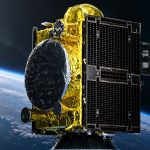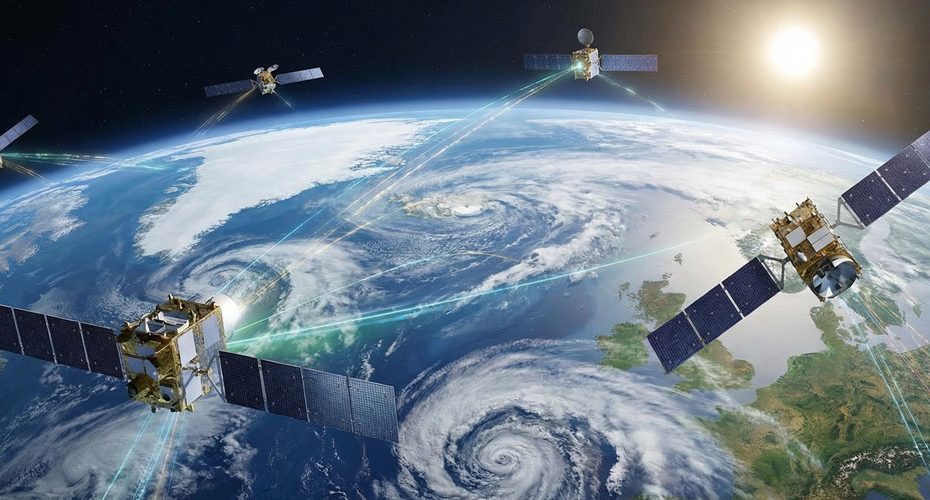
A key piece of microwave hardware developed in the United Kingdom has now proven itself in space. European Engineering Consultancy Ltd (EECL) has confirmed the successful in orbit operation of its ultra low noise amplifiers aboard the European Space Agency’s HydroGNSS climate monitoring satellites.
The twin spacecraft were launched in November 2025 from Vandenberg Space Force Base in California and are currently operating in low Earth orbit as part of ESA’s Earth Observation Scout programme. The satellites were built by Surrey Satellite Technology Ltd (SSTL), which also developed the mission’s GNSS receiver payload.
At the heart of that payload is a set of six multiband ultra low noise microwave amplifiers designed and manufactured by EECL. These devices form a critical early stage of the radio frequency chain, boosting extremely weak reflected satellite navigation signals while maintaining signal fidelity.
That capability is essential for HydroGNSS because the mission relies on detecting GNSS signals after they bounce off the Earth’s surface. Those reflections are thousands of times weaker than the original transmission, making low noise amplification a fundamental requirement for capturing usable scientific data.
GNSS Reflectometry Satellites Use GPS and Galileo Signals to Measure Climate Variables
HydroGNSS represents a growing class of Earth observation missions that rely on GNSS reflectometry rather than traditional active radar systems.
Instead of transmitting their own signals, the satellites measure navigation signals from existing GNSS constellations such as GPS and Galileo after they reflect from oceans, wetlands, soil surfaces, and ice fields.
By analyzing these reflections, the satellites generate Delay Doppler Maps that reveal information about surface conditions and environmental changes.
The mission is designed to monitor several key climate and hydrological indicators including:
- soil moisture levels;
- freeze thaw cycles in permafrost regions;
- wetland and floodplain inundation;
- above ground biomass distribution.
These datasets are particularly valuable for improving climate models, tracking extreme weather impacts, and monitoring ecosystems that are difficult to measure with conventional Earth observation methods.
Early commissioning results indicate that the satellites are successfully acquiring GNSS reflection data and that the RF payload hardware is performing according to design specifications.
Why Ultra Low Noise Amplifiers Are Critical for Space Based Remote Sensing
From an engineering standpoint, the performance of the low noise amplifier stage can determine whether weak signals are detectable at all.
In GNSS reflectometry missions, signal levels arriving at the satellite receiver are extremely faint because they have traveled from the navigation satellite to the Earth’s surface and then back into space.
Any noise introduced at the first amplification stage can degrade the signal to the point where accurate measurements become impossible.
This is why space grade LNAs must deliver three key characteristics simultaneously:
- extremely low noise figure;
- stable gain across multiple GNSS frequency bands;
- high reliability under radiation and temperature extremes.
The successful in orbit validation of EECL’s hardware confirms that the amplifiers are capable of maintaining signal integrity under real operational conditions.
In practical terms, this milestone demonstrates that compact GNSS reflectometry payloads can deliver scientifically valuable data using relatively small satellites, a trend that could significantly expand the number of climate monitoring missions in the coming decade.
Why HydroGNSS Could Influence the Future of Climate Monitoring Satellites
The HydroGNSS mission illustrates an important shift in Earth observation technology.
Traditional radar satellites are powerful but expensive and complex. GNSS reflectometry offers a complementary approach that leverages existing navigation signals as an illumination source, allowing smaller satellites to gather meaningful environmental data at a fraction of the cost.
If missions like HydroGNSS continue to produce reliable datasets, we could see a rapid expansion of GNSS reflectometry constellations designed to monitor agriculture, water cycles, and climate dynamics in near real time.
For industries such as agriculture, forestry, and disaster management, the ability to track soil moisture, flooding, and biomass from space could dramatically improve decision making and environmental forecasting.
About European Engineering Consultancy Ltd (EECL)
European Engineering Consultancy Ltd is a UK based specialist engineering company focused on high performance microwave and RF systems for space, telecommunications, and defense applications.
Founded in 1991 and headquartered in Staffordshire, the company has developed a reputation for designing ultra reliable microwave components used in satellite communications, Earth observation payloads, and deep space missions.
EECL employs highly specialized engineering teams and supports numerous European Space Agency and commercial space programmes. The company has delivered hundreds of RF and microwave assemblies for satellite platforms and advanced communication systems, with its technologies operating across multiple space missions and telecommunications networks worldwide.