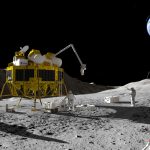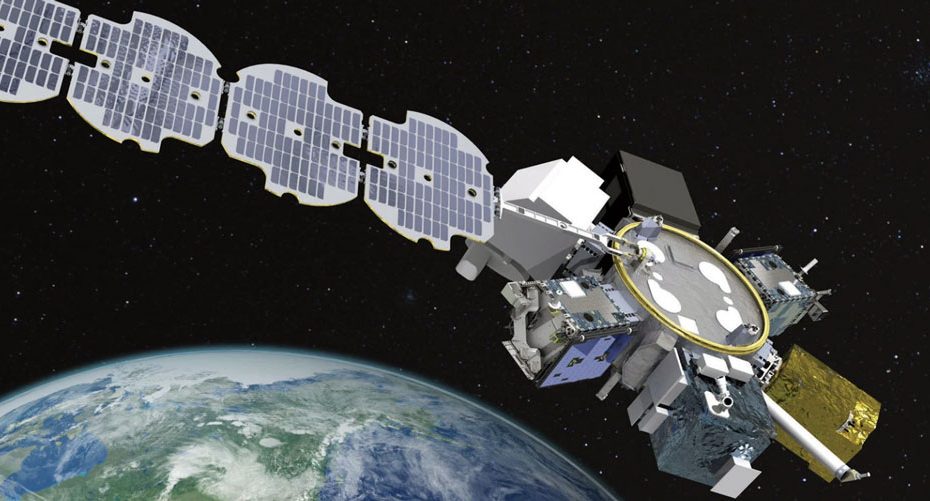
Spacecraft navigation is entering a new phase as Northrop Grumman unveils the LR 450 inertial navigation system designed to operate without GPS, ground beacons, or external positioning signals. The new platform is aimed at spacecraft operating in low Earth orbit, cislunar space, and future deep space missions where traditional satellite navigation simply does not exist.
From an engineering perspective, this is one of the more important developments in spacecraft autonomy this year because the industry is rapidly moving toward distributed satellite constellations, autonomous servicing vehicles, lunar infrastructure, and long duration exploration systems that cannot rely on constant communication with Earth.
mHRG Gyroscope Technology
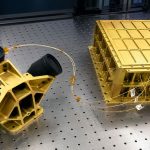
At the core of the LR 450 is a milli Hemispherical Resonating Gyroscope, commonly abbreviated as mHRG. Unlike GPS based navigation systems that determine location using external satellite signals, an inertial navigation unit measures motion internally through rotational and acceleration data.
Hemispherical resonating gyroscopes are considered among the most reliable inertial sensing technologies currently used in aerospace. Instead of spinning mechanical parts found in older gyroscope designs, HRGs use a vibrating hemispherical resonator that maintains extremely stable motion characteristics. That architecture dramatically reduces wear, improves long term stability, and minimizes maintenance requirements.
The “milli” designation points to the miniaturization of the technology. Smaller form factors are becoming increasingly important as satellite manufacturers continue pushing toward compact spacecraft, modular payload buses, and lower launch mass requirements.
Technically, systems like this are valuable because they remain operational even during signal denial, communication outages, or deep space operations where GNSS constellations are unavailable. In simple terms, the spacecraft always knows how it is rotating and moving relative to its previous position.
Deep Space Navigation Demand
The timing of the LR 450 launch is significant. The space sector is entering an era where autonomous navigation is no longer optional.
Future lunar logistics missions, satellite servicing vehicles, autonomous orbital tugs, military spacecraft, and deep space probes all require navigation systems capable of operating independently for extended periods. Communication latency becomes a major problem beyond Earth orbit, making real time manual corrections increasingly impractical.
The LR 450 appears positioned precisely for that transition.
Northrop says the system can support missions ranging from low Earth orbit operations to deep space exploration while maintaining continuous navigation data without external references. The company also emphasizes long operational life and low maintenance demands, which are critical for missions that may operate for years without physical servicing.
What is particularly notable is the connection to the company’s existing Spacecraft Stellar Inertial Reference Unit architecture. Northrop already has decades of heritage in inertial and stellar navigation systems used across military, civil, and scientific spacecraft programs.
Compact Design and Power Efficiency
Another important engineering factor is power consumption.
Modern spacecraft increasingly balance tight power budgets against growing onboard computing, imaging, communication, and propulsion requirements. Inertial systems that can maintain precision while consuming less power become strategically valuable for both commercial and defense operators.
Northrop also indicated that the LR 450 was designed for manufacturing flexibility and scalable integration into different spacecraft architectures. That suggests the system may eventually target both high value government missions and the rapidly expanding commercial satellite market.
Exact performance metrics such as drift rates, angular random walk values, or navigation grade classifications have not yet been publicly disclosed. Without those specifications, it is difficult to directly compare the LR 450 against competing high end inertial systems from companies like Honeywell, Safran, or advanced optical navigation solutions currently under development.
Space Autonomy Race Accelerates
From a broader industry perspective, systems like the LR 450 highlight a larger shift happening across aerospace.
Spacecraft are gradually becoming more autonomous, more software driven, and less dependent on continuous human supervision. Navigation resilience is now viewed as a strategic capability, especially as military planners increasingly consider contested orbital environments where GPS disruption or signal interference could become a real operational issue.
The growing interest in alternative navigation methods also aligns with current research into optical navigation, pulsar navigation, celestial tracking, terrain relative positioning, and AI assisted spacecraft guidance systems.
The LR 450 does not replace all of those technologies, but it strengthens one of the most mature and trusted foundations of autonomous navigation: high precision inertial sensing.
In practical terms, this is the kind of hardware that quietly enables future space infrastructure to function reliably when communication delays, signal loss, or deep space distances make traditional navigation impossible.
About Northrop Grumman
Northrop Grumman is one of the world’s largest aerospace and defense contractors, operating across autonomous systems, spacecraft, avionics, missile defense, cyber technologies, and military aviation. The company employs roughly 95,000 people worldwide and generated approximately $40 billion in annual revenue in recent fiscal reporting. Northrop has contributed to major programs including the James Webb Space Telescope, B 21 Raider, NASA deep space systems, missile defense platforms, and multiple classified national security space programs.