Europe’s first large scale lunar cargo lander will initially depend on mapping data from international partners while ESA develops an independent lunar surveying capability for future Moon missions.
External Maps Support First Missions
The European Space Agency has confirmed that its upcoming Argonaut lunar lander program will initially operate using topographic data collected by other space missions rather than relying on a European produced lunar mapping system.
During the current design phase, ESA is using existing lunar datasets that are already available or can be acquired from external providers. According to ESA officials, this approach will also likely continue through the first Argonaut mission before Europe establishes its own dedicated lunar mapping capability.
Accurate topographic data is one of the most critical requirements for modern lunar landings. Detailed elevation models allow engineers to identify safe landing zones, avoid hazardous terrain, analyze slopes, and plan future infrastructure near scientifically valuable locations.
South Pole Requires Precision
Argonaut’s first mission is planned for the lunar south pole around 2030, one of the most technically demanding destinations on the Moon.
Unlike the relatively flat equatorial regions explored during the Apollo era, the south pole contains steep crater walls, permanently shadowed regions, uneven terrain, and areas with limited sunlight. These conditions make high resolution terrain mapping essential for autonomous landing systems.
ESA officials indicated that current mapping data will come from existing international missions, although they did not specify the suppliers. Among the most capable publicly known datasets are those produced by NASA’s Lunar Reconnaissance Orbiter, India’s Chandrayaan 2 Orbiter, and China’s Chang’e exploration program.
The agency has not disclosed how much acquiring third party mapping data will cost.
Europe Plans Independent Lunar Mapping
Rather than relying indefinitely on foreign datasets, ESA intends to develop its own sovereign lunar mapping capability.
According to the agency, several smaller lunar missions currently under development are competing for selection. Two of those missions are expected to focus specifically on producing detailed maps of the lunar south pole, creating the navigation database needed for future European lunar operations.
This strategy would gradually reduce Europe’s dependence on external providers while giving ESA direct control over the geospatial information required for future cargo deliveries, infrastructure deployment, and scientific exploration.
Argonaut Expands Europe’s Lunar Role
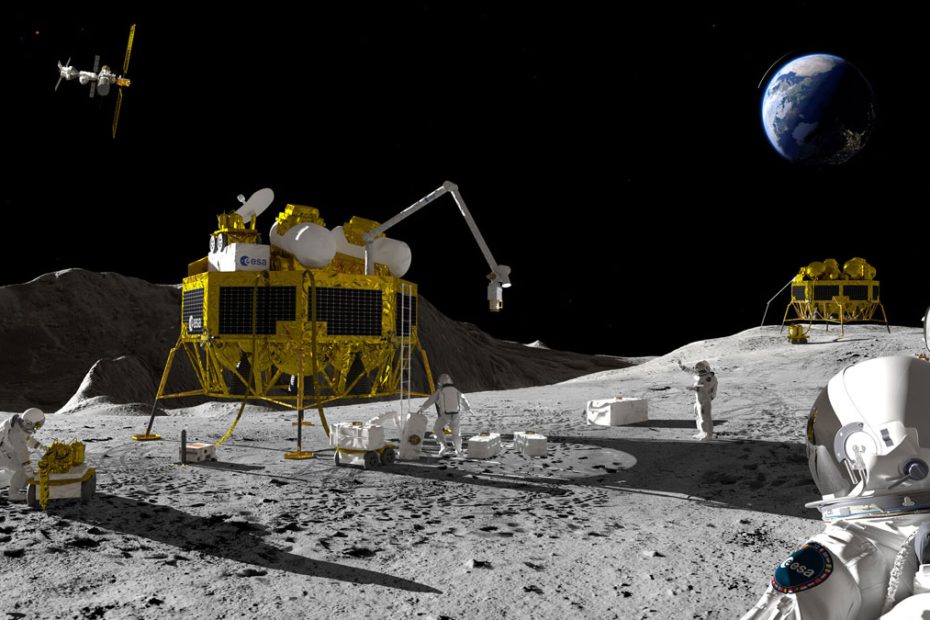
Argonaut represents Europe’s first dedicated heavy lunar logistics system.
The lander is designed to transport up to 1,500 kilograms of cargo to the Moon and will support both European scientific objectives and international exploration efforts, including cooperation within NASA’s Artemis architecture.
ESA currently expects the first landing in 2030, with additional missions planned every two to three years afterward.
Developing an independent landing capability is widely viewed as a major strategic milestone, allowing Europe to contribute more than individual spacecraft components by operating its own lunar transportation system.
Why Lunar Mapping Matters
Choosing to purchase existing mapping data while building an in house capability is a practical engineering decision rather than a technological weakness.
Creating reliable lunar terrain databases requires years of orbital observations, calibration, and validation before they become suitable for autonomous landing systems. Using mature datasets allows ESA to reduce technical risk during Argonaut’s early missions while focusing engineering resources on the lander itself.
Over the longer term, however, owning high resolution lunar mapping data will become increasingly important. As more nations establish permanent operations near the lunar south pole, independent geospatial information will become a strategic asset supporting navigation, infrastructure planning, scientific research, and resource exploration.
About ESA
European Space Agency was established in 1975 and today includes 23 member states working together on space science, Earth observation, telecommunications, navigation, launch systems, robotic exploration, and human spaceflight. The agency operates with an annual budget of approximately €7.7 billion for 2026 and collaborates closely with international partners including NASA, JAXA, and the Canadian Space Agency. Alongside flagship programs such as Copernicus and Galileo, ESA is now expanding its role in lunar exploration through the Argonaut cargo lander and future Moon missions.