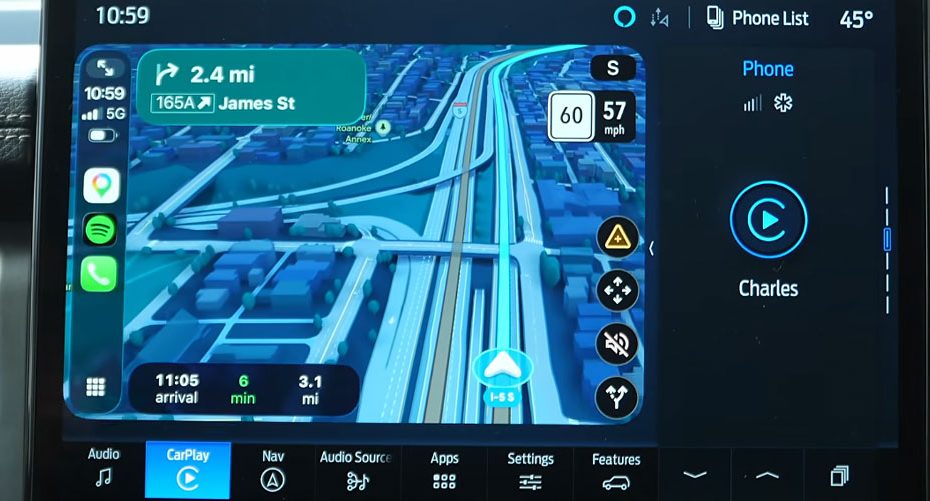
Google has unveiled what it describes as the most significant update to Google Maps in more than ten years, combining conversational artificial intelligence with a redesigned navigation interface that adds immersive 3D visuals and richer real world context. The update introduces a new feature called Ask Maps, powered by Google’s Gemini AI models, alongside a redesigned navigation experience called Immersive Navigation.
Together, the changes represent a shift in how users interact with digital maps. Instead of simply displaying directions or locations, Google Maps is moving toward becoming a conversational assistant capable of answering complex real world questions and planning activities in context.
Gemini Powered Ask Maps Turns Google Maps into a Conversational Travel Assistant
The centerpiece of the update is Ask Maps, a new AI driven feature that allows users to ask complex questions directly within the Maps interface.
Rather than searching for a single location or category, users can now submit detailed requests such as:
- finding a nearby public restroom without long lines;
- locating a place to charge a phone quickly;
- identifying short family friendly hiking routes with nearby amenities.
Ask Maps analyzes real time data from the Google Maps ecosystem and generates a tailored response, presenting recommended locations directly on the map along with contextual explanations.
The feature essentially transforms Google Maps from a navigation tool into what Google describes as a personal concierge for the physical world.
Users access the function through a dedicated Ask Maps button, where queries can be entered conversationally. The system then combines Gemini AI reasoning with the vast location database already maintained by Maps.
At launch, Ask Maps is rolling out to Android and iOS users in the United States and India, with desktop support planned later.
Immersive Navigation Brings 3D Terrain, Buildings, and Real World Context to Driving Directions
Alongside AI driven search, Google has also redesigned the visual navigation experience.
The new Immersive Navigation interface introduces several visual upgrades designed to make maps easier to interpret while driving:
- detailed 3D building models;
- more accurate terrain and vegetation rendering;
- updated color palettes for roads and environments;
- improved visual cues for turns, intersections, and route context.
Google says the redesign aims to eliminate one of the most common frustrations in navigation apps: the uncertainty drivers feel when approaching unfamiliar intersections or complicated road layouts.
By providing more realistic visual representations of surroundings, Immersive Navigation helps drivers better anticipate what the road ahead actually looks like before reaching it.
The feature is already rolling out across the United States and will expand gradually to other regions and devices, including Android Auto, Apple CarPlay, and vehicles with Google built in infotainment systems.
Why This Update Signals a Major Shift for Digital Mapping
From a technical perspective, this update represents something more important than a simple interface refresh.
For years, navigation apps have largely operated as search and routing tools. What Google is now building is closer to a context aware spatial assistant.
Combining conversational AI with location intelligence means users can move beyond simple queries like “coffee near me” and instead ask situational questions such as “Where can I stop on my drive where I can charge my phone quickly and grab food without waiting long?”
That type of request requires AI reasoning layered on top of mapping data, traffic conditions, business metadata, and user preferences.
If executed well, Ask Maps could significantly change how people interact with navigation services.
AI May Finally Unlock the Next Generation of Navigation
From an industry perspective, the move makes sense.
Digital maps have not fundamentally changed in over a decade. Most improvements have focused on incremental routing accuracy, traffic predictions, and satellite imagery.
What AI introduces is the ability to interpret intent, not just location.
If Google can reliably translate natural language requests into actionable navigation results, it could dramatically increase engagement with Maps. The application would become less like a tool and more like a decision engine for real world movement.
However, the success of Ask Maps will depend heavily on the quality and freshness of location data, something that has historically been a challenge even for Google.
The concept is promising, but real world performance will determine whether this becomes a breakthrough feature or simply another experimental AI layer.
About Google
Google is one of the world’s largest technology companies and a dominant player in digital mapping and artificial intelligence. Founded in 1998 and headquartered in Mountain View, California, the company operates under parent organization Alphabet Inc..
Google Maps currently serves more than 1 billion users worldwide every month, making it one of the most widely used navigation platforms on the planet. The platform contains data for over 250 million places and businesses, supports navigation in 220+ countries and territories, and processes billions of directions requests every year.
Google has increasingly integrated artificial intelligence across its product ecosystem, with Gemini models becoming a central component of its AI strategy across Search, Workspace, Android, and now Maps.