The rapid evolution of machine control technology is beginning to transform a segment of the construction industry that historically relied heavily on operator experience rather than digital guidance. At CONEXPO CON-AGG 2026, Topcon is highlighting this shift with the introduction and demonstration of MC-Mobile, a machine control solution designed specifically for compact construction equipment used in utility, trenching, grading, and small-site development work.
For decades, high-precision machine control systems have primarily been associated with large excavators, bulldozers, and graders operating on major infrastructure projects. Smaller machines working on urban utility installations, fiber networks, water lines, and residential construction typically lacked access to the same level of digital guidance.
MC-Mobile aims to change that equation by bringing design-based accuracy to compact machines, enabling operators to work directly from digital project models rather than relying on manual measurements or visual estimation.
MC-Mobile Machine Control Enables Design Model Execution for Compact Equipment Operators
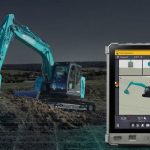
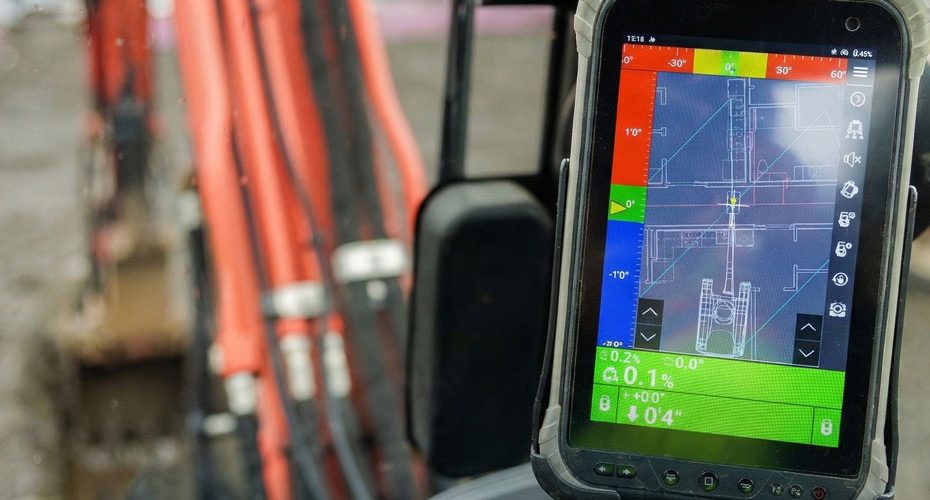
At its core, MC-Mobile allows compact equipment operators to follow exact project models directly on the machine display. Instead of estimating grade or trench depth visually, operators can see real-time positioning relative to the design surface.
This approach significantly reduces the reliance on operator “feel,” which has historically been a major factor in small-scale construction operations.
According to Topcon, the system enables operators to:
- Follow digital site models in real time.
- Achieve design-level accuracy for trenching and grading.
- Reduce human error during excavation and placement tasks.
- Maintain consistent results across multiple operators and shifts.
In practical terms, the technology helps ensure that trench depths, pipe placement, and grading surfaces match engineering specifications on the first attempt.
For contractors working on utilities or underground infrastructure, this can translate directly into fewer corrections and faster project completion.
Precision Machine Control Reduces Rework, Fuel Use, and Operator Training Requirements
One of the most significant operational benefits of machine control technology is the reduction in rework.
Traditional compact equipment workflows often require multiple passes and manual verification using grade stakes or survey equipment. When the work is even slightly off specification, operators must correct it manually, which adds both time and fuel costs.
With MC-Mobile guiding the operator according to digital design models, machines can reach target grade more efficiently.
Key productivity improvements include:
- Fewer excavation passes.
- Reduced machine wear.
- Lower fuel consumption.
- Less dependence on highly experienced operators.
In an industry currently facing labor shortages, the ability for newer operators to achieve accurate results quickly is becoming increasingly valuable.
Precision guidance effectively embeds engineering knowledge directly into the machine interface, helping less experienced crews perform at a higher level.
Bringing High-End Machine Control Technology to Tight Utility Jobsite Environments
Historically, full machine control systems were often too complex or expensive for small contractors operating compact equipment.
MC-Mobile appears to address this gap by focusing on mobility and simplified deployment.
The system is designed to support compact machines commonly used in:
- Utility installation.
- Water and sewer trenching.
- Fiber optic network construction.
- Residential site preparation.
- Small-scale grading projects.
These types of jobs are typically performed in tight urban environments where accuracy is critical and workspace is limited.
By combining compact equipment with digital layout guidance, contractors can achieve the same precision previously reserved for large earthmoving projects.
Why Precision Construction Technology Is Moving Downstream
From a broader industry perspective, the introduction of systems like MC-Mobile reflects a larger shift within construction technology.
For years, the biggest productivity gains came from automating large equipment. However, much of the daily work in infrastructure development occurs at smaller scales.
Utility trenches, foundation grading, pipe installation, and compact site work represent millions of individual tasks across construction projects worldwide.
By bringing machine control technology to compact machines, manufacturers are targeting a massive portion of the market that has historically remained under-digitized.
In many ways, this mirrors what happened in agriculture when precision guidance systems moved from large tractors into smaller specialty equipment.
The result was a dramatic increase in productivity and consistency across farms of all sizes.
The construction industry now appears to be entering a similar phase.
About Topcon Positioning Systems
Topcon Positioning Systems is a global technology provider specializing in precision positioning, surveying, and machine control solutions for construction, agriculture, and geospatial industries.
The company is part of Topcon Corporation, a Japanese technology group founded in 1932 and headquartered in Tokyo, Japan.
Today, Topcon operates in more than 120 countries and employs over 5,000 people worldwide.
Its technology portfolio includes:
- GNSS positioning systems;
- machine control and guidance platforms;
- surveying instruments and software;
- precision agriculture solutions.
Topcon systems are widely used across infrastructure construction, land surveying, mining, agriculture, and industrial automation, where centimeter-level positioning accuracy is critical for productivity and operational efficiency.