Raymarine has introduced the new RCU-1 Wireless Autopilot Remote, adding handheld autopilot control, Point and Go steering, and an industry first Solo Sailor safety mode for Evolution autopilot users. The announcement was made in the company’s official product release.
Handheld Autopilot Control
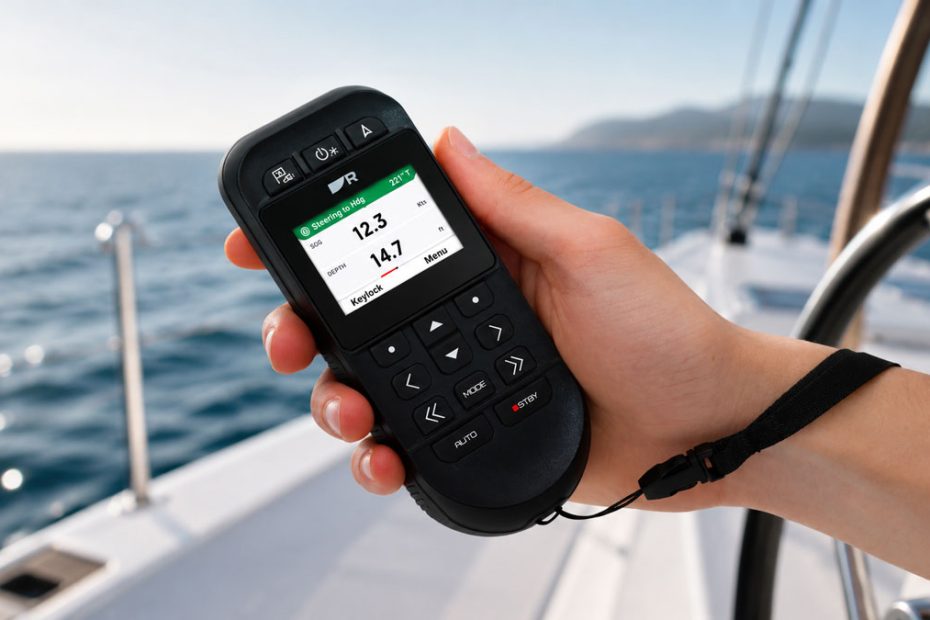
Raymarine’s latest RCU-1 is designed to give skippers full wireless control of compatible Evolution autopilot systems without needing to return to the helm. The remote is aimed at both powerboats and sailing yachts, allowing operators to adjust course while trimming sails, handling fishing equipment, docking, or moving freely around the vessel.
Rather than functioning as a simple button-based remote, the RCU-1 introduces a more intuitive way of changing course through what Raymarine calls Point and Go navigation.
Point and Go Steering
The standout feature is Point and Go steering. Instead of manually entering a heading change, the skipper simply points the handheld remote toward the desired direction, and the Evolution autopilot automatically adjusts the vessel onto the new course.
For many recreational boaters, this can significantly simplify small heading corrections while reducing the need to repeatedly return to the helm.
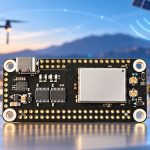
The system works over a Bluetooth connection using Raymarine’s new WG-1 Wireless Gateway, which connects directly to the vessel’s existing NMEA 2000 or SeaTalk NG network.
Raymarine specifies a wireless operating range of up to 30 meters (98 feet), providing coverage across virtually the entire deck of most recreational boats.
Solo Sailor Safety Feature
Perhaps the most significant innovation is the new Solo Sailor mode, which Raymarine describes as an industry first.
If a connected wearer overboard event is detected, the autopilot immediately commands the boat to turn into the wind. For sailors operating alone, this maneuver helps slow the vessel and reduces the distance traveled after the skipper enters the water, potentially improving recovery opportunities.
Although Raymarine has outlined how the feature operates, the company has not published additional technical details regarding compatible overboard devices or supported detection methods.
Display and Waterproof Design
The handheld controller has been engineered specifically for marine environments.
Confirmed specifications include:
- IPX7 waterproof construction.
- Sunlight readable color display.
- Dedicated autopilot control buttons.
- Customizable NMEA 2000 instrument data pages.
- Battery saving functions to extend operating time between charges.
- Ergonomic one hand operation.
Raymarine has not disclosed battery capacity, charging time, operating duration, display size, weight, or internal hardware specifications.
Compatibility and Availability
The RCU-1 is compatible with Raymarine Evolution Autopilot systems when installed together with the new WG-1 Wireless Gateway.
Three purchasing options are currently available:
- RCU-1 remote controller.
- RCU-1 and WG-1 starter kit.
- WG-1 Wireless Gateway sold separately.
According to the official launch information, the complete starter kit includes one handheld remote and one wireless gateway, allowing existing Evolution autopilot owners to add wireless control without replacing their current steering system.
Practical Benefits On The Water
While wireless autopilot remotes have existed for years, Raymarine’s implementation focuses on simplifying everyday operation rather than adding complex functionality.
For cruising sailors, the ability to alter course while remaining on deck can make sail handling more efficient. Anglers can maintain course while managing rods or landing fish, while powerboat owners gain greater freedom when preparing lines or moving around the cockpit.
The addition of Solo Sailor mode also reflects the growing emphasis on safety technologies for short handed cruising, a segment that continues to expand as more owners operate larger vessels with fewer crew members.
About Raymarine
Raymarine is one of the world’s best known marine electronics manufacturers, specializing in navigation, radar, sonar, thermal imaging, autopilot, communications, and integrated vessel control systems. The company became part of FLIR Systems in 2010 and now operates within Teledyne Technologies, following Teledyne’s acquisition of FLIR in 2021. Raymarine products are distributed worldwide and are widely used across recreational boating, commercial marine, and offshore sailing markets.