Norwegian agricultural technology company Monil has launched its virtual fencing and cattle monitoring system in the United States, giving livestock producers a way to manage rotational grazing from a smartphone without installing communication towers or permanent cross-fencing.
The company is initially targeting cattle operations across the Midwest and has established its U.S. base in Kansas City, Missouri. Monil is also building a regional farmer success team to assist producers with collar setup, cattle training and pasture management.
The U.S. launch places Monil in a growing market for livestock technology designed to reduce fencing labor while giving ranchers more detailed information about animal location, activity and health.
Virtual Fencing Without Towers
The Monil system combines solar-powered GNSS collars with a mobile application. Producers draw paddocks, grazing boundaries and exclusion zones directly on a digital map instead of constructing physical interior fences.
When an animal approaches a virtual boundary, the collar produces a directional audio warning. The sound becomes more pronounced if the animal continues toward the boundary. Cattle typically learn to associate the audio signal with the virtual fence after a short training period.
When an animal ignores the warning, the collar can apply a low-level electrical stimulus intended to encourage it to return to the designated grazing area.
The system does not require an on-farm base station, radio tower or Wi-Fi network. Instead, collars communicate through existing 4G cellular infrastructure using LTE-M and NB-IoT standards. Monil currently supports the AT&T and T-Mobile networks in the United States.
This infrastructure-free design could be one of Monil’s most important advantages for U.S. producers. Eliminating towers reduces installation complexity and allows a rancher to begin with a relatively small number of animals.
However, cellular coverage remains a practical requirement. The system may therefore be better suited to farms and ranches with at least basic mobile connectivity than to extremely remote grazing areas with no cellular service.
Solar Collar Weighs 2.2 Pounds
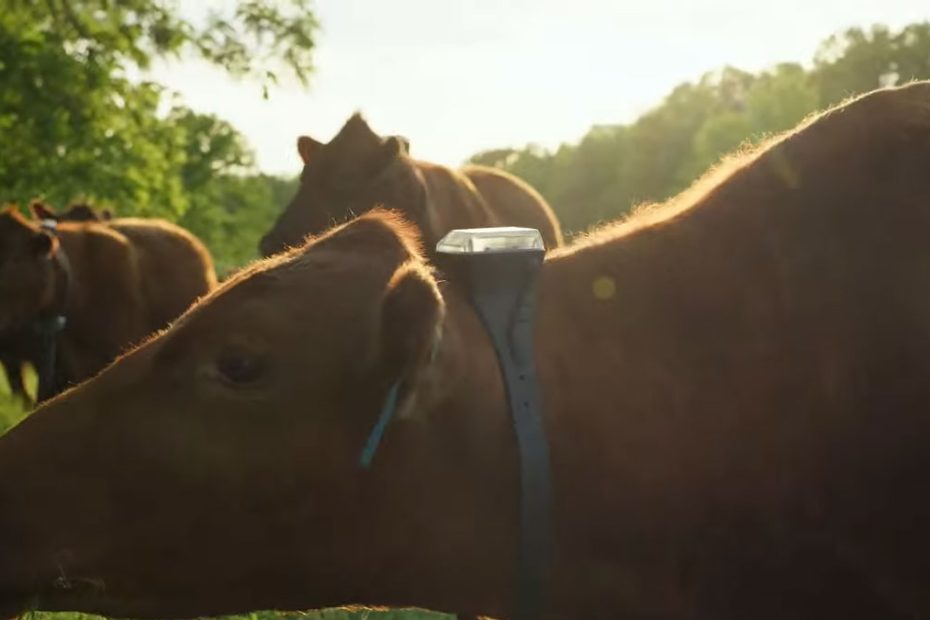
Each Monil collar weighs slightly more than 1 kilogram, or approximately 2.2 pounds, including the locking mechanism. The adjustable collar fits circumferences from approximately 29.5 to 51 inches. Monil describes it as the lightest virtual fencing collar currently available for cattle.
A solar panel positioned on top of the collar charges the internal battery during normal grazing conditions. Monil says the solar system is designed to provide enough energy for a complete grazing season without replacing the battery.
A charging station is also included for situations involving extended winter use, dense forest cover or other conditions with limited sunlight. Tests of the underlying low-power hardware previously showed collars retaining more than 90 percent battery capacity after four months of continuous operation in autumn conditions.
The collars use signals from GPS, Galileo, GLONASS and BeiDou. Combining several satellite constellations increases the number of satellites available to the receiver and can improve positioning reliability when animals move near trees, terrain or other obstructions.
Rotational Grazing From a Phone
Producers can use the Monil application to create new grazing areas, adjust existing paddocks and prevent cattle from entering sensitive locations such as waterways, recently seeded ground or damaged pasture.
Changing a grazing boundary requires editing the map rather than relocating posts and temporary wire. This could make more frequent pasture rotations practical, particularly on operations where labor availability limits the use of intensive rotational grazing.
Virtual fencing may also allow cattle to graze irregularly shaped areas that would be difficult or expensive to divide with physical fencing. Potential applications include cover crops, conservation areas, rented land and seasonal pasture where permanent infrastructure would not be economical.
The technology does not completely eliminate the need for conventional fencing. Secure perimeter fencing, road boundaries and high-risk containment areas will still require careful management. Virtual fencing is more realistically viewed as a replacement for many internal cross-fences rather than every physical fence on a cattle operation.
Location and Health Monitoring
Monil is not positioning the collar only as a containment device. Integrated sensors also collect information about animal location, activity and rumination.
Through the application, producers can view:
- Current cattle locations.
- Historical movement patterns.
- Daily activity levels.
- Rumination behavior.
- Potential heat activity.
- Changes that may indicate illness or injury.
The collar’s inertial sensors can detect prolonged inactivity, which may indicate that an animal requires attention. Data is transmitted to the cloud and presented through the Monil application.
Animal records remain connected to the individual cow rather than permanently attached to one collar. This means a producer can move a collar between animals without losing the historical records associated with each animal.
These monitoring features could increase the economic value of the system beyond fencing. A rancher may justify the investment partly through reduced fencing labor and partly through earlier detection of reproductive or health events.
Six-Collar Starting Point
U.S. producers can begin using the system with as few as six collars. Monil offers a five-year warranty and uses a subscription model under which customers pay for collars that are actively being used.
The low minimum order is strategically important. Large upfront herd requirements can make livestock technology difficult for smaller operations to evaluate. A six-collar entry point allows a producer to test the system on a limited group, evaluate cellular coverage and train cattle before expanding across the herd.
Monil says the platform can scale from small trials to large commercial herds. Its initial Midwest farmer success team will provide localized assistance as the company establishes its U.S. customer base.
Escape Alerts Protect Cattle
If an animal crosses a virtual boundary and continues after three warning sequences, the collar stops delivering additional stimuli. The system then sends a high-priority notification to the producer.
This safeguard is significant from both an animal welfare and operational standpoint. A virtual fence should not continue applying corrections to an animal that is confused, frightened or physically unable to respond.
The alert also makes it clear that virtual fencing remains a management system rather than an autonomous guarantee of containment. Producers must continue monitoring notifications and responding when an animal leaves the assigned area.
Technical Review
Monil’s strongest differentiator is not simply that its fence is digital. Its real advantage is the combination of low collar weight, solar charging, cellular connectivity and no required farm communication tower.
Removing base stations lowers one of the major barriers associated with virtual fencing. It simplifies installation, reduces fixed infrastructure costs and makes the system easier to move between owned and rented land.
The tradeoff is dependence on public cellular networks. A tower-based system can be engineered specifically for a ranch, while a cellular system depends on network coverage that the producer does not control. Before purchasing collars, ranchers should test both AT&T and T-Mobile coverage across every pasture where the system will operate.
Producers should also calculate the cost against their actual fencing and labor requirements. The clearest return will likely be found on operations that frequently move temporary fencing, manage multiple grazing rotations or want to use land where installing permanent cross-fences is impractical.
The herd monitoring component may ultimately become as important as virtual containment. Location, activity and rumination data can turn the collar into a daily management tool rather than equipment used only when pasture boundaries change.
Monil therefore enters the U.S. market with a technically credible product and a practical starting model. Its long-term success will depend less on whether virtual fencing works and more on whether the company can deliver reliable connectivity, responsive regional support and measurable savings under diverse U.S. ranching conditions.
About Monil
Monil is a Norwegian agtech company developing virtual fencing and livestock monitoring technology for cattle producers. Its collars are designed and manufactured in Norway.
The company began shipping commercial collars in 2022. It has since delivered tens of thousands of units across four markets and reports more than 100 million cumulative grazing hours in Europe. Monil says its technology is trusted by more than 2,000 farmers and ranchers.
In May 2026, Monil raised approximately $10 million from Norwegian investors to support its entry into the U.S. virtual fencing market. The company is led by CEO Torstein Nesse and operates its American business from Kansas City, Missouri.
Source: www.monil.com