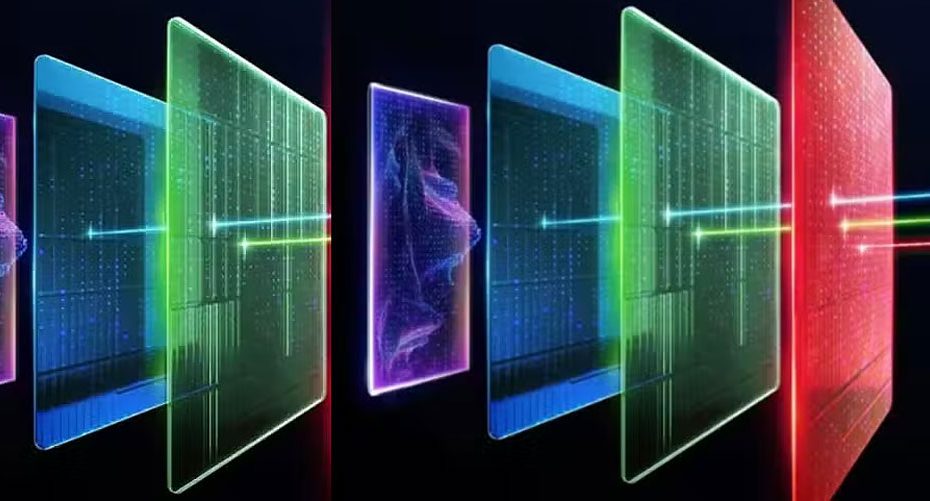
Chinese LiDAR manufacturer Hesai Technology has introduced what it describes as the world’s first full color LiDAR chip, a development that could significantly shift how autonomous systems interpret real world environments. The new chip, named Picasso, was presented during the company’s latest tech open day and is designed to merge color perception with depth sensing directly at the hardware level.
Full color LiDAR chip enables native 3D perception without sensor fusion
Conventional LiDAR systems operate as high precision spatial scanners, capturing geometry but lacking direct color awareness. This limitation forces autonomous platforms to combine LiDAR data with camera feeds through software level fusion, increasing computational load and latency.
Picasso changes that architecture. The chip performs pixel level integration of color and distance data natively, allowing sensors to generate a true color 3D point cloud without relying on external cameras or post processing pipelines. In practical terms, this simplifies perception stacks and reduces the need for redundant sensor fusion algorithms.
For autonomous driving systems, this translates into more direct object recognition. Traffic signals, lane markings, and road signs can be interpreted with both geometric and visual context in a single data stream, closer to how human vision operates.
Up to 4,320 laser channels and 4K perception target high resolution autonomy
The Picasso chip supports configurations scaling up to 4,320 laser channels, positioning it among the highest channel density solutions currently announced in the LiDAR space. Hesai also claims 4K level perception capability, indicating a substantial increase in point cloud density and spatial resolution compared to earlier generations.
Photon detection efficiency exceeding 40 percent is another key metric. Higher PDE allows the sensor to capture more usable signal from emitted laser pulses, effectively improving detection range and clarity under the same power constraints. This is particularly relevant for long range highway autonomy and low reflectivity object detection.
The chip will be integrated into Hesai’s upcoming ETX series LiDAR sensors. These systems are expected to offer flexible channel configurations including 1,080, 2,160, and 4,320 channels, allowing OEMs to balance cost, performance, and application requirements.
Mass production timeline and expansion into broader mobility segments
Hesai plans to begin mass production of ETX series LiDAR units equipped with Picasso in the second half of 2026, with initial deliveries targeting automotive manufacturers. The timing aligns with increasing demand for higher fidelity perception systems as autonomous driving platforms move toward more advanced driver assistance and full autonomy levels.
At the same time, the company is actively pushing LiDAR into lower cost vehicle segments. With manufacturing costs declining, Hesai is targeting models priced below 100,000 yuan, signaling a broader transition from premium applications into mass market adoption.
Beyond passenger vehicles, the company has already begun deploying solid state LiDAR in electric two wheelers produced by Niu Technologies, highlighting a diversification strategy across mobility formats.
New spatial intelligence hardware and entry into robot power modules
Alongside the Picasso chip, Hesai introduced a spatial intelligence device called Kosmo, positioned as a data acquisition platform for physical AI systems. The hardware is designed to capture high quality 3D spatial datasets used for training AI world models, a growing requirement in robotics and autonomous systems development.
The company also confirmed expansion into robot power modules, aiming to establish a presence in core infrastructure for physical AI. While detailed specifications were not disclosed, this move indicates vertical integration beyond sensing into broader robotics hardware ecosystems.
Market impact and technology positioning
The introduction of full color LiDAR at the chip level represents a notable shift in perception system design. By eliminating the dependency on camera LiDAR fusion for color context, manufacturers could reduce system complexity while improving real time performance.
If Hesai delivers on scalability and cost reduction, this approach could accelerate LiDAR adoption across mid range vehicles and emerging robotic platforms. The key variable will be how effectively OEMs integrate this new data modality into existing perception and decision making stacks.
About Hesai Technology
Hesai Technology is one of the leading global suppliers of LiDAR sensors for automotive and robotics applications. In 2025, the company reported its first full year profitability with net income reaching 435.9 million yuan. Total LiDAR shipments grew by 222.9 percent year over year, surpassing 1.62 million units.
Hesai continues to scale production aggressively, with plans to exceed 4 million units of annual manufacturing capacity in 2026. The company’s strategy focuses on reducing costs, expanding into mass market mobility segments, and building infrastructure for the next generation of autonomous and AI driven systems.