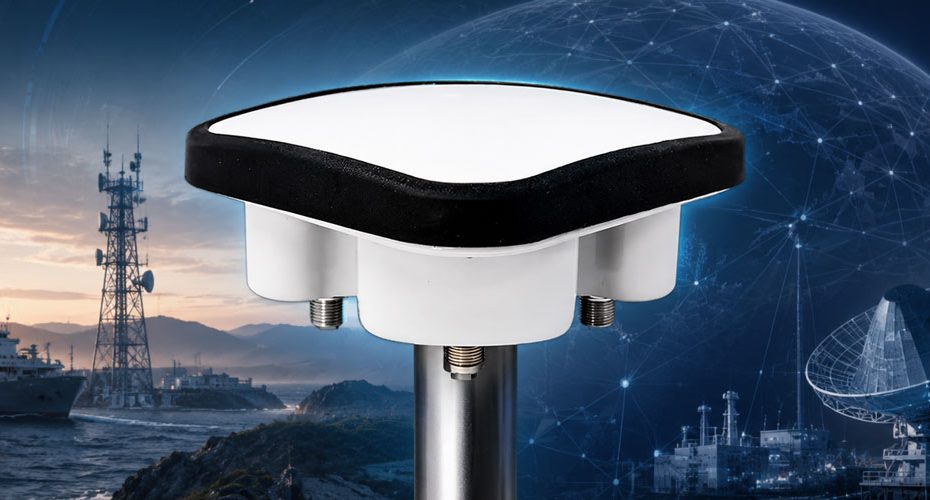
Calian has expanded its anti jamming GNSS portfolio with the launch of the new CR8894PXF+ and CR8854PXF+ pole mount Controlled Reception Pattern Antenna (CRPA) systems. Introduced at ION JNC 2026, the new models are designed to deliver enhanced positioning, navigation, and timing resilience for defense, maritime, telecommunications, and critical infrastructure operators facing growing interference threats.
The new antennas combine flexible installation options with advanced anti jamming technology, giving organizations additional tools to protect GNSS dependent operations in challenging RF environments.
CRPA Frequency Options
The two new antennas support different dual band frequency combinations to match modern multi frequency GNSS receivers.
The CR8894PXF+ operates across L1/E1 and L2/E5b frequencies, while the CR8854PXF+ supports L1/E1 and L5/E5a frequencies.
This approach allows system integrators to select the signal architecture that best aligns with existing receiver platforms while maintaining access to advanced interference mitigation capabilities.
From a market perspective, support for both L2/E5b and L5/E5a configurations is increasingly important as critical infrastructure and defense organizations migrate toward next generation multi frequency navigation systems.
Four Element Anti Jamming Design
The CR8894PXF+ is built around a four element Controlled Reception Pattern Antenna architecture engineered specifically for resilient GNSS operations.
According to Calian, the antenna can be configured to suppress either one or three interference sources per GNSS band. Because the system operates simultaneously across two GNSS frequency bands, operators can achieve a total of two or six independent interference nulls depending on the selected configuration.
The lower GNSS band covers frequencies from 1189 MHz to 1254 MHz, while the upper band covers 1559 MHz to 1591 MHz.
This architecture enables the antenna to reject multiple jamming signals while maintaining reception of legitimate satellite transmissions.
Multi Constellation Support
The CR8894PXF+ supports a broad range of navigation signals across the world’s major GNSS constellations, including:
- GPS L1 and L2
- Galileo E1 and E5b
- GLONASS G2 and G3
- BeiDou B1 and B2b
One particularly notable feature is support for GPS M Code signals on both L1 and L2 frequencies. The wide bandwidth antenna elements are designed to accommodate these military navigation signals, making the platform suitable for defense and government applications that require access to encrypted and highly resilient positioning services.
The ability to support multiple constellations and multiple frequencies simultaneously improves positioning accuracy, signal availability, and resistance to interference or signal degradation.
Pole Mount Installation Benefits
Unlike many CRPA systems developed primarily for mobile military platforms, the new variants are optimized for fixed and marine installations.
Potential deployment environments:
- Communications towers.
- Marine vessels.
- Timing and synchronization facilities.
- Coastal monitoring stations.
- Critical infrastructure sites.
- Defense installations.
The pole mount design provides greater flexibility when selecting antenna locations, allowing operators to improve sky visibility and reduce obstructions caused by nearby structures or equipment.
For marine applications, elevated mounting positions can also help minimize signal blockage from vessel superstructures while improving overall GNSS reception quality.
XF+ Filtering Technology
In addition to directional anti jamming capabilities, both new antennas incorporate Calian’s Extended Filtering Plus technology.
XF+ filtering is designed to improve:
- Out of band interference rejection.
- Cross band isolation.
- Signal integrity.
- Receiver protection in congested RF environments.
This additional layer of filtering becomes increasingly important near high power radio transmitters, radar installations, telecommunications infrastructure, and other environments where electromagnetic interference can impact GNSS performance.
Real Time Interference Monitoring
Beyond simply mitigating interference, the new CRPA systems provide real time situational awareness messaging that helps operators identify and respond to interference events as they occur.
This capability is becoming increasingly valuable as governments, military organizations, and infrastructure operators place greater emphasis on Positioning, Navigation, and Timing resilience strategies.
The ability to detect, monitor, and react to jamming activity can significantly improve operational awareness during both intentional and unintentional interference incidents.
Industry Perspective
What makes the CR8894PXF+ particularly interesting is that Calian is targeting a rapidly growing segment of the GNSS market where anti jamming performance is becoming a core requirement rather than a specialized military feature.
The combination of multi constellation reception, GPS M Code compatibility, dual band operation, and up to six simultaneous interference nulls places the antenna in the high end GNSS resilience category. As interference threats continue to increase around ports, military facilities, communications networks, and critical infrastructure sites, technologies like CRPA are increasingly becoming essential components of modern navigation and timing systems.
About Calian
Calian was founded in Ottawa, Canada, on September 27, 1982. The company has more than 40 years of experience delivering solutions across defense, space, healthcare, cybersecurity, and critical infrastructure markets. Calian became publicly traded in 1993 and now trades on the Toronto Stock Exchange under the ticker symbol CGY. Through a combination of organic growth and strategic acquisitions, the company has expanded into international markets while maintaining a strong focus on mission critical technologies and resilient communications systems.