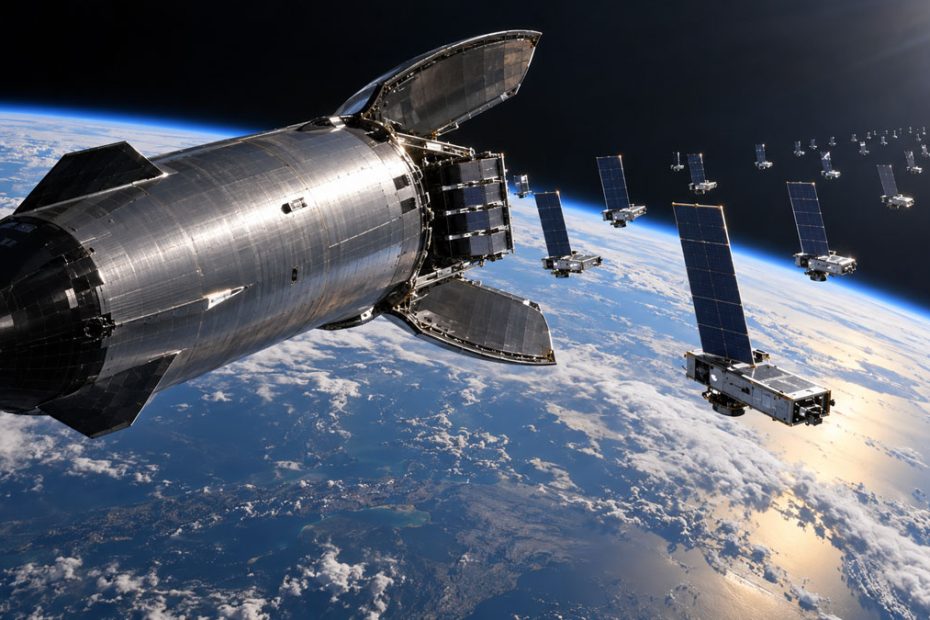
SpaceX achieved its first orbital Starship mission on September 28, 2026, successfully deploying 26 next-generation Starlink V3 satellites after overcoming an engine shutdown during ascent. The 14th flight of the world’s most powerful launch vehicle marked the transition from suborbital testing to operational satellite deployment, although the spacecraft returned to Earth earlier than originally planned.
Launched from Starbase, Texas, the 407-foot (124-meter) rocket delivered its payload into low Earth orbit before completing a controlled atmospheric reentry and splashdown in the northern Pacific Ocean. The flight demonstrated several critical capabilities, including orbital insertion, deployment of operational satellites, an engine-powered deorbit maneuver and controlled return from orbital velocity.
The mission also exposed technical challenges that SpaceX must address before Starship can support routine commercial launches, NASA’s lunar exploration program and eventual human missions to Mars.
Starship Flight 14 Reaches Earth Orbit
Starship lifted off from SpaceX’s Starbase launch complex on September 28 with its Super Heavy booster powered by 33 methane-fueled Raptor 3 engines. The rocket’s two-stage configuration uses the Super Heavy booster for the initial ascent, while the Starship spacecraft provides the propulsion necessary to reach orbital velocity.
During the booster’s climb, one Raptor engine shut down. Despite the loss, Super Heavy continued its ascent and successfully completed stage separation using SpaceX’s hot-staging procedure, which ignites the upper-stage engines before the stages fully separate.
The Starship upper stage then experienced a separate technical problem. One of its six engines, specifically a Raptor Vacuum engine optimized for operation in space, shut down prematurely during the ascent burn.
The remaining five engines continued operating longer than originally planned, allowing the spacecraft to achieve its intended suborbital trajectory.
SpaceX engineers subsequently evaluated the condition of the three sea-level Raptor engines required for orbital insertion and eventual deorbiting. After confirming their operational status, mission controllers authorized Starship’s first orbital insertion maneuver.
Approximately 25 minutes after launch, a single sea-level Raptor engine reignited for a 19-second burn, accelerating the spacecraft into an orbit approximately 276 kilometers (171 miles) above Earth.
This maneuver represented an important difference from the previous 13 Starship flights. Earlier missions deliberately followed suborbital trajectories that brought the spacecraft back into Earth’s atmosphere without requiring a dedicated deorbit burn.
Flight 14 demonstrated that Starship could enter orbit, execute additional engine operations in space and subsequently return along a controlled trajectory.
Starlink V3 Satellites Enter Orbit
Following orbital insertion, Starship deployed 26 Starlink V3 satellites using its integrated payload deployment mechanism.
Unlike the satellite simulators and suborbital deployment demonstrations conducted during earlier tests, these spacecraft were delivered into orbit for integration into SpaceX’s operational communications network.
SpaceX confirmed that contact was established with all 26 satellites through a combination of laser communications, ground infrastructure and Starlink user terminals.
The satellites will undergo initial systems verification, deploy their solar arrays and antennas, and use onboard propulsion to reach their designated operating orbits. Commercial service will begin only after the necessary commissioning procedures have been completed.
According to SpaceX’s published specifications, the 26 satellites represent a combined theoretical downlink capacity of 26 terabits per second.
That figure describes the aggregate designed capacity of the deployed spacecraft, rather than an immediate increase of 26 Tbps in available consumer bandwidth. Actual network improvements will depend on satellite commissioning, orbital coverage, gateway connectivity, available spectrum and demand distribution.
The deployment also marks a fundamental change in Starship’s commercial role. Instead of carrying experimental payloads exclusively, the launch vehicle has now transported satellites intended to generate revenue through SpaceX’s Starlink broadband business.
Starlink V3 Technical Specifications
Starlink V3 introduces substantial improvements in communications throughput, beamforming technology, satellite power generation and inter-satellite connectivity.
The new generation is specifically designed to take advantage of Starship’s much larger payload capacity compared with Falcon 9.
SpaceX has published the following specifications for the V3 satellite platform.
| Technical Parameter | Starlink V3 Specification |
|---|---|
| Maximum downlink capacity | 1 Tbps per satellite |
| Maximum uplink capacity | 160 Gbps per satellite |
| Downlink improvement over V2 | Approximately 10 times |
| Uplink improvement over V2 | Approximately 22 times |
| Downlink beams | 2,048 |
| Uplink beams | 2,048 |
| Laser communication terminals | 6 per satellite |
| Capacity per laser terminal | 400 Gbps |
| RF backhaul capacity | 1.2 Tbps |
| RF backhaul frequency bands | Ka, E, V and W |
| RF backhaul antennas | 4 quad-band antennas |
| Modem chip throughput improvement | Approximately 64 times |
| Solar array power generation | Approximately twice that of V2 |
| Satellites deployed on Flight 14 | 26 |
| Aggregate designed downlink capacity | 26 Tbps |
Specifications are based on SpaceX’s published Starlink V3 technical information. Individual capacity figures describe design capabilities and should not be interpreted as guaranteed end-user speeds.
2,048 Beams and Advanced Beamforming
One of the most significant improvements concerns the satellite’s electronically steered phased-array antennas. Starlink V3 supports 2,048 downlink beams and 2,048 uplink beams, compared with 192 downlink and 144 uplink beams on the preceding V2 generation. The additional beams allow the satellite to divide its coverage area into a much larger number of independently managed communication regions.
SpaceX developed new beamforming processors that can dynamically allocate communications resources according to geographical demand. The upgraded modem chips also support approximately 64 times the throughput handled by the previous generation. From a network engineering perspective, these improvements are particularly important in densely populated areas where available satellite capacity must be distributed among thousands of simultaneous connections.
Rather than relying exclusively on additional satellites to increase regional capacity, the V3 architecture improves how each spacecraft manages its existing spectrum and communications resources. This approach could allow SpaceX to deliver more usable bandwidth per satellite while responding more effectively to changing traffic patterns across its global network.
400 Gbps Laser Communications
Each Starlink V3 satellite carries six optical inter-satellite communication terminals, with a stated capacity of 400 Gbps per laser. These optical links allow satellites to exchange information directly without routing every connection through a terrestrial gateway. The architecture creates multiple potential paths across the constellation, allowing network traffic to be transferred between spacecraft before reaching a ground station closer to its destination.
This capability can be particularly valuable over oceans, remote regions and areas where terrestrial telecommunications infrastructure is limited. Starlink V3 also introduces four quad-band radio-frequency backhaul antennas operating across the Ka, E, V and W frequency bands. Together, these antennas provide up to 1.2 Tbps of RF backhaul capacity, more than eight times the corresponding capability of the previous generation.
The combination of optical crosslinks and higher-capacity radio backhaul should provide SpaceX with greater flexibility in managing traffic between orbital and terrestrial network segments. However, the full benefit will depend on sufficient gateway capacity, effective traffic routing and successful integration with the existing constellation.
Starship Returns Early After Engine Shutdown
Although Starship completed its primary orbital delivery objectives, the mission did not follow its original duration. SpaceX had initially planned a flight lasting approximately 10 hours, during which the spacecraft would complete six orbits before returning to Earth. Following the premature shutdown of the Raptor Vacuum engine during ascent, flight controllers decided to shorten the orbital phase.
The spacecraft instead conducted an early deorbit maneuver and returned to the northern Pacific Ocean approximately three hours after launch. A single sea-level Raptor engine successfully completed the deorbit burn, reducing the spacecraft’s orbital velocity and directing it toward a predetermined reentry corridor. Starship subsequently entered the atmosphere, using its thermal protection system and aerodynamic control surfaces to manage the extreme heating and forces generated during descent.
During the final landing sequence, three sea-level Raptor engines reignited, enabling the spacecraft to transition from its horizontal atmospheric descent attitude into a vertical orientation. The vehicle reached its designated splashdown location north of Hawaii before tipping over and breaking apart in the ocean.
The Super Heavy booster had earlier completed its own return sequence and splashed down in the Gulf of Mexico. Although the booster experienced engine shutdowns and some unsuccessful relights, it executed the planned return to its offshore landing area. Neither stage was recovered for reuse on this mission.
Heat Shield Testing for Starship Reuse
Beyond satellite deployment, Flight 14 provided another opportunity to evaluate Starship’s thermal protection system under orbital reentry conditions. The spacecraft uses a heat shield composed of thousands of individual thermal protection tiles designed to withstand repeated exposure to high-temperature atmospheric entry. During reentry, the spacecraft must dissipate substantial kinetic energy as it decelerates from orbital velocity, while the heat shield protects the underlying stainless-steel structure and the vehicle’s aerodynamic surfaces control its orientation and descent trajectory.
SpaceX incorporated several experimental modifications into the Flight 14 heat shield, including improved tile retention mechanisms and changes intended to reduce the possibility of hot plasma penetrating gaps between individual tiles. The mission also included the planned reuse of two heat shield tiles recovered from the previous Starship vehicle. Three Starlink V3 satellites were additionally equipped with cameras intended to observe Starship’s heat shield after deployment.
These observations are relevant to SpaceX’s longer-term objective of returning spacecraft directly to their launch facilities. For a rapidly reusable vehicle, surviving atmospheric reentry is only part of the engineering challenge. The thermal protection system must also withstand repeated flights without requiring extensive inspection, replacement or refurbishment after every mission. A heat shield that performs successfully once but requires substantial repairs after each reentry would limit the economic advantages of full vehicle reusability.
Why Starship Changes Satellite Economics
The most consequential technical development from Flight 14 may be the successful integration of Starship’s launch capabilities with the Starlink V3 satellite architecture. Previous Starlink generations were designed around the payload limitations of Falcon 9. Their dimensions, mass and deployment arrangements had to accommodate a comparatively smaller launch vehicle. Starlink V3 reverses part of that design constraint by taking advantage of the substantially larger payload envelope available aboard Starship.
SpaceX can develop larger satellites with greater power generation, more communications hardware and substantially higher data capacity because the new launch vehicle can accommodate heavier and more complex payloads. This creates an opportunity to increase network capacity without requiring a proportional increase in the number of satellites. For example, a satellite delivering approximately 10 times the downlink capacity of an earlier generation may provide greater communications capability per deployed spacecraft, although the overall economics also depend on satellite manufacturing costs, operational life, launch expenses and ground infrastructure.
SpaceX previously outlined an objective of deploying approximately 60 Tbps of Starlink capacity on future full-scale V3 launches. Flight 14 delivered 26 Tbps of nominal downlink capacity, establishing an operational starting point rather than demonstrating the maximum payload performance expected from the mature Starship architecture.
The distinction matters because Starship’s intended commercial advantages depend heavily on launch frequency and reuse. A vehicle that can carry large payloads but requires extensive refurbishment, suffers frequent engine problems or cannot be recovered economically will not immediately achieve its theoretical cost advantages. Flight 14 demonstrated orbital payload delivery, while future missions will determine whether that capability can be repeated reliably while progressively reducing the resources required for each launch.
What Flight 14 Means for Moon and Mars Missions
Starship’s first successful orbital mission is relevant to SpaceX’s broader exploration plans, but it does not establish that the spacecraft is ready for interplanetary operations. NASA has selected a specialized version of Starship for its Human Landing System program, which is intended to transport astronauts between lunar orbit and the Moon’s surface. These missions require capabilities that extend considerably beyond deploying satellites in low Earth orbit.
Starship must eventually demonstrate the transfer of large quantities of cryogenic propellant between spacecraft in orbit, extended storage of liquid oxygen and liquid methane, autonomous rendezvous and docking, and reliable propulsion after prolonged periods in space. Lunar missions also require landing systems capable of operating in an environment without an atmosphere dense enough to provide conventional aerodynamic braking.
Mars introduces additional challenges, including interplanetary navigation, long-duration life-support systems, radiation protection and atmospheric entry under conditions substantially different from those encountered on Earth. The spacecraft will also need to manage the logistical challenges associated with delivering large payloads to another planet. SpaceX has outlined an ambitious transportation architecture involving numerous Starship launches, orbital refueling operations and coordinated transfers during the relatively favorable Earth-Mars launch windows that occur approximately every 26 months.
Flight 14 addressed several foundational elements of this architecture: reaching orbit, conducting engine restarts, operating with a real payload and returning through Earth’s atmosphere. Nevertheless, a three-hour orbital flight cannot validate systems intended to function continuously for months. The successful demonstration of orbital insertion and deorbiting is an important prerequisite, but the technical gap between this mission and transporting people to Mars remains substantial.
Technical Analysis: Starship’s Real Breakthrough
Flight 14 is significant because SpaceX demonstrated a complete orbital delivery sequence while managing propulsion anomalies that could have prevented the mission from reaching its primary objectives. The successful orbital insertion following the premature shutdown of a Raptor Vacuum engine provides evidence of the vehicle’s ability to accommodate certain propulsion failures. That is particularly relevant for a launch system equipped with dozens of engines, where reliability depends on both individual engine performance and the ability of the overall system to tolerate isolated failures.
However, the decision to shorten the mission also illustrates the limitations of redundancy. An engine failure may be manageable during ascent, but it can introduce additional operational risk when subsequent maneuvers depend on the continued availability of propulsion hardware. The decision to return early was therefore consistent with the need to demonstrate safe orbital operations before expanding flight duration. The next major engineering challenge is not simply reaching orbit again. It is demonstrating that the same sequence can be performed repeatedly, with reliable propulsion, predictable vehicle performance and progressively shorter turnaround requirements.
There is also an important commercial distinction between Starship’s satellite deployment capabilities and its interplanetary ambitions. Starlink provides SpaceX with an immediate operational application for Starship. Repeated satellite launches can generate revenue while supplying the flight data needed to improve vehicle reliability and reusability. This creates a development model in which commercial missions contribute directly to testing technologies that may later support more demanding lunar and interplanetary operations.
The strategy becomes particularly valuable if future flights successfully demonstrate recovery and reuse of both the booster and upper stage. For now, Flight 14 establishes three concrete achievements: Starship reached Earth orbit, deployed 26 operational satellites and completed a controlled orbital return. Full reusability, routine launch operations and human interplanetary transportation remain separate engineering objectives.
About SpaceX
Space Exploration Technologies Corp., commonly known as SpaceX, is an American aerospace manufacturer and space transportation company founded by Elon Musk in 2002. The company develops launch vehicles, spacecraft, rocket propulsion systems and satellite communications infrastructure, with operations centered on several facilities across the United States.
Its principal programs include the Falcon rocket family, Dragon spacecraft, Starship launch system and Starlink satellite communications network. SpaceX has established a major presence in commercial satellite launches and government space transportation through the development of reusable rockets and spacecraft.
Selected company and technology figures:
- Founded: 2002.
- Founder: Elon Musk.
- Falcon 9: Two-stage orbital rocket with a reusable first stage.
- Falcon Heavy: Heavy-lift launch vehicle using three Falcon-derived first-stage cores.
- Dragon: Spacecraft designed to transport cargo and astronauts to and from low Earth orbit.
- Starship height: Approximately 407 feet (124 meters), including the Super Heavy booster.
- Super Heavy propulsion: 33 Raptor engines.
- Starship upper-stage propulsion: Six Raptor engines.
- Starlink constellation: More than 11,000 satellites in orbit as of late September 2026.
- Starlink V3 capacity: Up to 1 Tbps downlink and 160 Gbps uplink per satellite.
- Starship orbital milestone: First achieved September 28, 2026, during Flight 14.
SpaceX’s long-term development strategy combines reusable launch vehicles with commercial satellite deployment and government space transportation contracts. The company’s Starship program is designed to eventually support substantially larger payloads and more frequent orbital missions than its existing Falcon launch systems.