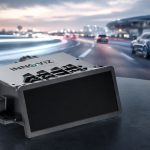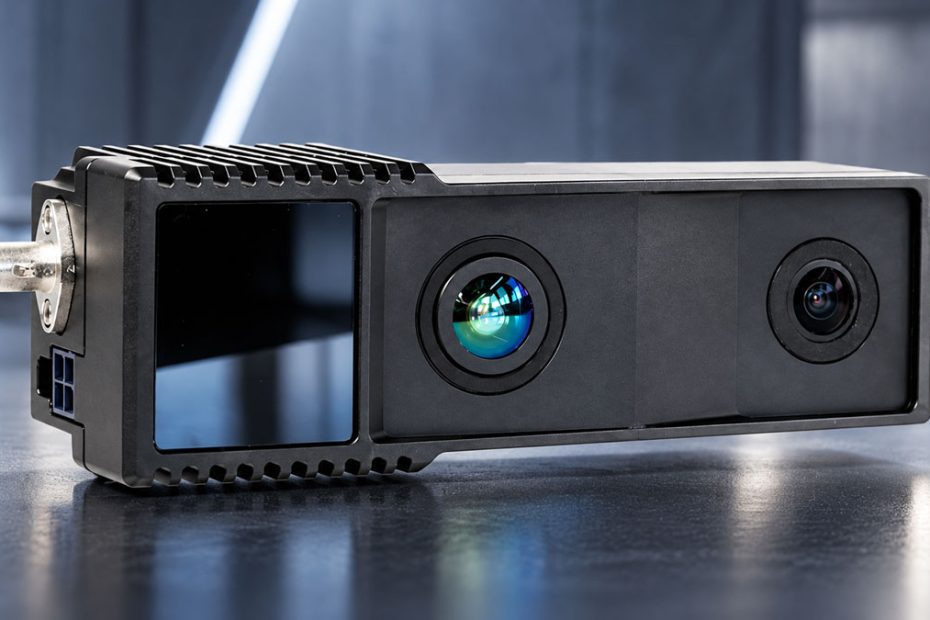
Leopard Imaging and Lumotive have introduced Sirius Max, a new solid-state 3D perception platform that combines RGB imaging, indirect time-of-flight depth sensing and electronically controlled beam steering in a single GMSL2 camera module.
Announced September 24, Sirius Max, officially designated LI-AR0234-AF0130-TX10-GMSL2-140H, is aimed at robotics, autonomous machines, industrial automation, automotive monitoring and edge AI applications. Leopard Imaging and Lumotive say the system can extend iToF depth sensing beyond 20 meters in indoor and outdoor environments while maintaining approximately 1-megapixel depth resolution.
The more interesting part of the design is not simply the range figure. Sirius Max changes how the available illumination power is distributed across a scene. Instead of illuminating the entire field of view continuously, it can direct optical energy toward selected areas and change those regions through software.
Sirius Max Uses Beam-Steered iToF
Conventional indirect time-of-flight cameras commonly use relatively broad infrared illumination. The sensor measures the phase shift between transmitted modulated light and returning light to estimate distance.
That architecture is compact and can produce dense depth maps, but range becomes difficult as distance increases. Only a fraction of the emitted optical energy returns to the sensor, while sunlight, reflections and other infrared sources add noise.
Sirius Max addresses that limitation with Lumotive’s TX10 transmitter architecture. Rather than spreading the available illumination energy uniformly across the scene, the system can electronically steer it toward specific areas.
This effectively lets the perception system concentrate its photon budget where depth information is needed.
For a robot approaching an object, for example, the sensor could dedicate more illumination and measurement time to the object rather than repeatedly scanning every part of the image at identical priority.
Lumotive’s TX10 reference design is based on its LM10 Light Control Metasurface, or LCM, programmable optical semiconductor. The reference architecture supports software-controlled steering direction, beam divergence, dwell time and scan sequence without mechanically rotating mirrors or sensor assemblies.
Depth Range Extends Beyond 20 Meters
Leopard Imaging and Lumotive say Sirius Max extends iToF perception beyond 20 meters while operating indoors or outdoors.
That is an important figure for iToF because the technology has traditionally been strongest at shorter distances than many scanning LiDAR architectures.
Directional illumination helps because optical power is concentrated over a smaller portion of the scene. It can improve signal-to-noise ratio and reduce the amount of irrelevant ambient infrared energy reaching the depth-processing pipeline.
The companies also claim improvements in dynamic range, multipath behavior and saturation noise.
However, the announcement does not yet provide several numbers that will ultimately determine how significant the 20-meter performance is in real applications. Leopard Imaging has not published a complete range-versus-accuracy curve, maximum outdoor illumination level, reflectivity assumptions, depth precision at maximum range or full-frame depth rate when operating at extended distances.
Those specifications will matter when comparing Sirius Max with conventional LiDAR, stereo cameras and other active depth systems.
AF0130 Provides 1.2MP Depth Sensing
Depth acquisition is based on onsemi’s AF0130 smart iToF sensor.
The AF0130 is a 1/3.2-inch stacked backside-illuminated CMOS depth sensor with 1,280 x 960 active pixels, giving it approximately 1.2 megapixels of native depth-sensor resolution. Each pixel measures 3.5 x 3.5 micrometers, and the device uses a global shutter.
Unlike the related AF0131, the AF0130 incorporates a depth-processing ASIC beneath the pixel array. It can calculate depth, confidence and intensity maps internally rather than requiring all depth reconstruction to be performed by an external processor.
The sensor supports modulation frequencies up to 200 MHz and includes dual laser-driver control and laser eye-safety monitoring.
According to onsemi’s public specifications, the AF0130 can reach 60 fps at its full 1.2MP resolution in one operating mode and up to 110 fps at VGA resolution. It uses a two-lane MIPI interface capable of up to 2 Gbps per lane. Onsemi lists operating junction temperatures from -30°C to +85°C.
Those are sensor-level capabilities. Leopard Imaging has not stated that Sirius Max exposes every AF0130 mode or maximum frame rate.
TX10 Makes Scanning Software Defined
Lumotive’s TX10 architecture is what separates Sirius Max from a conventional RGB-D camera.
The TX10 reference design provides as much as 105 degrees of solid-state steering from a single module, with average angular steering resolution of roughly 0.5 degrees across that range. Steering-axis beam divergence can be programmed from approximately 2.5 degrees to 10 degrees depending on the implementation.
Lumotive also specifies a default 140-degree divergence in the non-steering axis, with optical configurations potentially covering roughly 20 to 190 degrees.
A typical TX10 reference implementation operates around 910 nm and can use peak optical power of up to 35 W. Those figures describe Lumotive’s TX10 reference platform rather than confirmed maximum operating parameters for Sirius Max itself.
The absence of mechanical scanning components is also important. Traditional rotating or mechanically actuated LiDAR architectures introduce bearings, motors or moving optical assemblies that can affect packaging, vibration tolerance and long-term reliability.
LCM steering has no mechanical inertia, so scan patterns can also be non-sequential. The system does not necessarily need to sweep continuously from one side of the field of view to the other.
It can jump directly between regions selected by software.
RGB and Depth Share One GMSL2 Link
Sirius Max combines the depth subsystem with synchronized RGB imaging and transfers RGB video, depth information and control data through a GMSL2 connection over a single coaxial cable.
That architecture is particularly relevant for embedded AI platforms used in autonomous machines, where cameras may be positioned several meters from the central computing system.
Rather than treating color imaging and range sensing as independent devices, Sirius Max is designed to produce synchronized RGB and depth information that can be fused by the perception stack.
The LI-AR0234 portion of the product designation also points to onsemi’s AR0234 imaging family. The AR0234 is a 2.3MP, 1/2.6-inch global-shutter CMOS sensor capable of 120 fps at full resolution, although Leopard Imaging has not published a complete Sirius Max RGB specification confirming which of those sensor capabilities are exposed by the finished platform.
One Sensor Can Prioritize Multiple Tasks
Software-defined regions of interest may prove more important than the maximum range specification.
A mobile robot rarely needs identical depth quality everywhere.
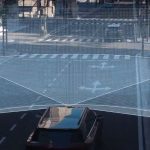
The perception system may need high-frequency depth updates directly in the direction of travel for collision avoidance while requiring slower updates at the sides. A robotic arm may temporarily prioritize the area around a gripper. An autonomous vehicle or machine could allocate additional sensing resources to a pedestrian, pallet or obstacle detected by its RGB perception network.
Sirius Max can potentially change its illumination and scan strategy to match those tasks rather than forcing the downstream AI system to accept a fixed sensor pattern.
Leopard Imaging lists SLAM, cliff detection, collision avoidance, navigation, object handling and visual inspection among the applications that could be handled by the platform.
Why Sirius Max Matters
The most significant aspect of Sirius Max is the attempt to move some perception decisions from post-processing into the optics themselves.
Most AI perception pipelines collect a largely fixed stream of sensor data and decide afterward which pixels, objects or regions deserve attention. Sirius Max adds another layer: the software can influence where the sensor directs its active illumination before the measurement is made.
That can be particularly useful in power-constrained robots.
Instead of increasing laser power across an entire wide field of view to gain additional range, a system can potentially concentrate its available optical power on a smaller region. The same principle can be used to trade field coverage, update rate and sensing distance dynamically.
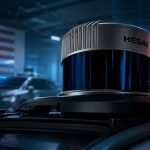
There is still an important distinction between the product description and a complete performance comparison with established LiDAR systems. Sirius Max is described as solid-state 3D LiDAR, but its depth engine is based on iToF rather than the direct time-of-flight measurement architecture commonly associated with long-range automotive scanning LiDAR.
The label matters less than the resulting performance. What will determine Sirius Max’s position in the market is its depth accuracy beyond 20 meters, behavior under direct sunlight, performance on low-reflectivity targets, latency, power consumption and cost.
None of those key comparison figures has been fully disclosed yet.
If Leopard Imaging can maintain useful depth precision and frame rates at its claimed extended range, however, combining dense 1MP-class depth maps, RGB imaging and programmable illumination in one compact module could make Sirius Max particularly attractive for autonomous mobile robots and other machines where conventional multi-sensor perception systems consume too much space, power and integration effort.
About Leopard Imaging
Leopard Imaging was founded in 2008 and is headquartered in Fremont, California. The company develops embedded imaging, AI perception and spatial intelligence systems for robotics, automotive, industrial automation, drones, healthcare and other machine-vision applications.
According to Leopard Imaging, its engineering and manufacturing operations have supported customers and institutions in more than 50 countries, including Fortune 500 companies. The company provides camera design, manufacturing, driver development, image tuning, OEM and ODM services and works with computing platforms from NVIDIA, Qualcomm, NXP, Intel, Ambarella and other semiconductor suppliers.
Leopard Imaging operates manufacturing capabilities in the United States and overseas and recently added a manufacturing facility in Penang, Malaysia. Its listed global presence includes the United States, Europe, Asia and Southeast Asia, and Japan. The company holds certifications including IATF 16949 for automotive manufacturing, AS9100D for aerospace, ISO 9001:2015 and ISO 14001:2015.