Lufthansa Group is preparing to launch its next generation inflight connectivity service, with a Lufthansa Airbus A320neo set to become the first aircraft in the group to offer Starlink powered Wi-Fi to passengers on August 19, 2026.
The first aircraft selected for commercial service is the Airbus A320neo registered D-AINM. Lufthansa Group officially confirmed on August 10 that its new “Lufthansa Group Wi-Fi” service will debut on an A320neo before installations expand to additional aircraft operated by Lufthansa, SWISS, Austrian Airlines and Brussels Airlines.
The launch marks the first operational step in one of Europe’s largest airline connectivity programs. Lufthansa Group plans to introduce Starlink across the fleets of its passenger airlines and complete the rollout by 2029.
Lufthansa Starlink Wi-Fi
Unlike conventional inflight Internet systems that commonly rely on satellites in geostationary orbit, Starlink uses a large constellation of satellites in low Earth orbit. The shorter distance between the aircraft and satellites can reduce network latency and provide an Internet experience that is much closer to terrestrial broadband.
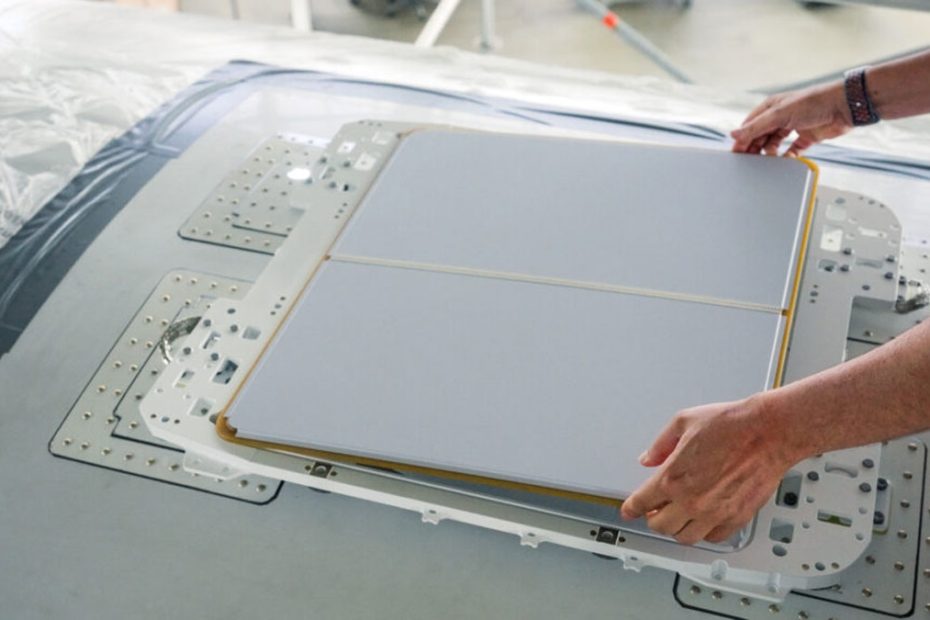
Starlink’s aviation hardware uses electronically steered phased array antenna technology. SpaceX says the low profile antenna architecture is designed to reduce both installation mass and aerodynamic drag compared with more conventional satellite communications hardware.
On larger commercial aircraft, Starlink installations can use two antennas mounted on top of the fuselage to maintain connectivity as the aircraft moves across different satellite coverage areas.
The technology is designed for considerably more demanding applications than basic messaging or email. Starlink has previously stated that supported two antenna commercial aircraft installations can provide up to 1 Gbps of peak aggregate throughput to passengers, although actual speeds available to an individual device depend on network conditions, aircraft load and other factors.
Free Wi-Fi for Lufthansa Passengers
Lufthansa Group says the Starlink service will be available free of charge to Miles & More status customers as well as passengers registered with Travel ID. The service will be offered in every travel class.
That positioning is significant because it moves high speed connectivity away from being primarily a paid premium product and toward becoming part of Lufthansa’s standard digital passenger experience.
Passengers will be able to use the connection for activities such as streaming content, communicating online and collaborating on cloud based documents.
There will nevertheless be restrictions intended to keep connected cabins comfortable for other passengers. Lufthansa’s usage policy asks passengers to use headphones for audio and video and prohibits voice calls, video calls and live streaming from the aircraft.
A320neo Starts the Rollout
Choosing an Airbus A320neo as the first aircraft is particularly relevant because narrowbody aircraft operate a large proportion of Lufthansa Group’s short and medium haul network.
The A320neo belongs to Airbus’ current generation A320neo family. Airbus says the latest A320neo technology can deliver up to 20% lower fuel burn and CO2 emissions compared with the previous generation baseline, while typical airline configurations generally accommodate roughly 150 to 180 passengers.
Starting with a narrowbody also gives Lufthansa an opportunity to deploy the system across aircraft that typically perform several flight sectors per day. In practical terms, this means a single equipped aircraft can expose a relatively large number of passengers to the new service during normal operations.
After the first Lufthansa aircraft enters service, installations are scheduled to expand initially across Lufthansa, SWISS, Austrian Airlines and Brussels Airlines before continuing through the wider group. Lufthansa Group has said its objective is fleetwide Starlink availability across its airlines by 2029.
Starlink Replaces Older Connectivity Systems
The program represents a substantial change in Lufthansa Group’s connectivity strategy.
The company announced its decision to adopt Starlink across its airline fleets in January 2026. Existing connectivity technology will remain operational on aircraft until those individual airplanes receive the new Starlink installation.
This staged approach is operationally important. Retrofitting hundreds of commercial aircraft requires scheduled maintenance access, certified installation hardware, engineering resources and aircraft downtime, making a gradual fleet conversion more practical than a simultaneous switch.
Starlink already lists supplemental type certificate support covering aircraft from manufacturers including Airbus, Boeing, Embraer, Bombardier and ATR, providing the regulatory foundation for installations on a broad range of commercial fleets.
Why Lufthansa’s Starlink Move Matters
The biggest significance of the program is not simply faster Wi-Fi.
Reliable high bandwidth connectivity is increasingly becoming another measurable part of an airline’s onboard product, alongside seating, entertainment, power outlets and cabin service. Once passengers can reliably stream video or work with cloud applications at normal Internet speeds, traditional low bandwidth inflight Wi-Fi becomes much more difficult to position as a premium service.
Lufthansa’s decision to start with an A320neo is therefore a particularly interesting move. Short haul aircraft were historically among the easiest places for airlines to tolerate mediocre connectivity because passengers spent less time onboard. Starlink changes that equation.
There is also a broader competitive consequence. When one of Europe’s largest aviation groups standardizes a LEO connectivity platform across hundreds of aircraft, competing airlines have greater incentive to improve their own inflight Internet offering.
From a technical perspective, the more important test will not be the headline peak bandwidth. It will be consistency when a nearly full A320neo has dozens or potentially more than 100 passengers simultaneously streaming, browsing and synchronizing cloud applications.
If Starlink can maintain a strong passenger experience under that kind of sustained load, Lufthansa’s August 19 launch could prove more important than simply adding another onboard amenity. It could mark another step toward broadband connectivity becoming expected equipment on mainstream European air travel.
About Lufthansa Group
Lufthansa Group is one of Europe’s largest aviation groups and operates passenger airlines including Lufthansa Airlines, SWISS, Austrian Airlines, Brussels Airlines, Eurowings, Discover Airlines, Edelweiss, Air Dolomiti and Lufthansa City Airlines, while ITA Airways is also part of the group’s expanding airline portfolio.
In 2025, Lufthansa Group generated record revenue of €39.6 billion, an increase of 5% from €37.6 billion in 2024, and carried approximately 135 million passengers.
Its reported fleet comprised 737 aircraft at the end of 2025, with Airbus and Boeing accounting for the majority. The average fleet age was 14.4 years.
The Starlink program extends beyond that year end fleet count as Lufthansa Group integrates and develops its broader airline portfolio, making the connectivity retrofit one of the largest projects of its kind in European commercial aviation.
About Starlink
Starlink is SpaceX’s satellite broadband platform and uses a low Earth orbit satellite constellation rather than relying exclusively on traditional geostationary communications satellites.
Its network uses Ku-band communications extensively, while Starlink satellites incorporate multiple phased array antennas for high bandwidth connectivity.
Starlink has expanded beyond residential broadband into maritime, enterprise, mobile and aviation markets. Its aviation platform supports certified installations across multiple Airbus, Boeing, ATR, Bombardier, Dassault, De Havilland and Embraer aircraft types.
For commercial aircraft equipped with supported dual antenna configurations, Starlink has cited peak aggregate throughput of up to 1 Gbps to passengers.
About Airbus
Airbus is one of the world’s largest aerospace manufacturers, producing commercial aircraft ranging from the A220 and A320 families to the A330neo and A350 widebody families, alongside helicopters, defense platforms and space systems.
The A320neo selected for Lufthansa’s first Starlink installation belongs to Airbus’ latest generation single aisle family. The A320neo family covers a broad part of the approximately 120 to 244 seat market depending on model and configuration, while Airbus states that the current generation technology delivers at least approximately 20% lower fuel burn and CO2 emissions compared with previous generation aircraft.
The combination of a modern narrowbody platform such as the A320neo with high capacity LEO connectivity illustrates how cabin technology is increasingly becoming part of the broader aircraft modernization cycle rather than an independent passenger entertainment upgrade.
Source:www.lufthansa.com