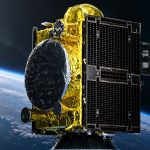
India’s NavIC satellite navigation system can no longer calculate an independent position using only its own signals after the number of satellites providing Positioning, Navigation and Timing services fell to three.
The latest reduction followed the completion of the 10-year mission life of IRNSS-1F. According to India’s Department of Space, the remaining satellites supplying PNT signals are IRNSS-1B, IRNSS-1I and NVS-01. A minimum of four operational navigation satellites is required for a receiver to determine a complete position and correct its internal clock error.
The situation does not mean that NavIC has completely stopped operating. Timing services remain available, several older satellites continue supporting one-way messaging, and consumer devices using GPS, Galileo, GLONASS, BeiDou and NavIC together should continue producing normal location results.
NavIC Standalone Positioning Suspended
India has launched 11 NavIC satellites since the program began. As of March 2026, eight were classified as functional, but only three were broadcasting navigation signals. Five others remained capable of supporting one-way messaging services, including emergency and disaster alerts.
This distinction is important. A satellite may remain operational for communications or messaging even when its navigation payload, atomic clock or orbital position no longer allows it to contribute reliable ranging measurements.
NavIC was created as an independent regional GNSS covering India and an area extending approximately 1,500 kilometers beyond the Indian mainland. Its purpose is not simply to add another signal to smartphones. It also gives India direct control over critical positioning and timing infrastructure used by transportation, telecommunications, surveying, maritime operations and government services.
Why Four GNSS Satellites Matter
A satellite navigation receiver does not directly read its location from a spacecraft. It measures how long radio signals take to travel from several satellites and converts those measurements into estimated distances known as pseudoranges.
The receiver must solve four unknown values: three spatial coordinates and its own clock offset. Although navigation satellites use highly stable atomic clocks, a smartphone, vehicle tracker or survey receiver normally uses a much less accurate internal clock. A fourth satellite measurement is therefore required to estimate and remove that receiver clock error.
With only three valid NavIC PNT signals, the standalone calculation is underdetermined. A receiver may still use NavIC measurements when they are combined with signals from another constellation, but NavIC alone cannot provide a conventional independent three-dimensional position.
The practical consumer impact should remain limited because most modern navigation chipsets operate in a multi-constellation environment. They combine measurements from several GNSS networks to improve satellite geometry, availability and resistance to signal blockage. ISRO also notes that common location devices can receive signals from multiple systems rather than relying exclusively on one constellation.
IRNSS-1F Reaches End of Life
IRNSS-1F was launched in March 2016 and was designed for a 10-year mission. Its retirement was therefore not an unexpected premature failure. The more serious issue is that replacement capacity was not available before the spacecraft left PNT service.
Navigation constellations require continuous replenishment because atomic clocks, power systems, propulsion hardware and electronic components gradually degrade. Operators normally need enough redundancy to remove one or more satellites without falling below the minimum service threshold.
NavIC’s current problem is therefore better described as a capacity and deployment gap than a total system shutdown. Three satellites are still transmitting PNT signals, but the constellation has lost the geometric minimum needed to operate independently. The source material also notes that timing and emergency messaging functions continue despite the positioning limitation.
NVS-02 Orbit Failure Reduced Redundancy
The shortage became more difficult to avoid after the NVS-02 mission failed to add a fully operational spacecraft to the constellation.
NVS-02 was launched on January 29, 2025, aboard GSLV-F15. The launch vehicle accurately inserted the satellite into its transfer orbit, but a spacecraft propulsion system failure prevented NVS-02 from reaching its intended operational orbit. ISRO subsequently classified the satellite as unable to join the operational navigation constellation.
The failure was especially significant because NVS-02 belonged to a planned group of five second-generation satellites intended to replace aging NavIC spacecraft and expand civilian compatibility.
The NVS series adds an L1 civilian signal at 1575.42 MHz alongside the existing L5 and S-band services. L1 compatibility is important because it aligns NavIC more closely with frequencies already supported by mass-market GNSS chipsets. NVS-01 also became the first NavIC satellite to carry an Indian-developed atomic clock.
NVS-03 Ready for Launch
ISRO’s immediate recovery plan centers on NVS-03. The Department of Space said on July 29, 2026, that the satellite was ready for launch, while NVS-04 and NVS-05 were in advanced stages of development.
Once NVS-03 reaches the correct orbit, completes testing and begins transmitting usable navigation signals, NavIC should regain the four-satellite minimum required for standalone positioning.
That recovery will depend on more than the launch itself. The spacecraft must complete orbit raising, deploy its systems correctly, synchronize its clock, pass signal validation and be integrated into the operational control segment. The NVS-02 experience demonstrates why successful separation from a launch vehicle does not automatically produce an operational navigation satellite.
Technical View: Four Satellites Are Not Enough
In my view, the most important lesson is not that NavIC temporarily lost standalone positioning. The more important issue is that the constellation was allowed to operate with too little margin before a predictable satellite retirement.
Launching NVS-03 could restore the mathematical minimum, but four operational satellites would still represent a fragile configuration. Any clock anomaly, payload interruption, maintenance period or unfavorable satellite geometry could again reduce availability.
A strategically independent navigation system needs operational reserves, not merely the minimum number required to calculate a position. ISRO should prioritize a replenishment schedule that maintains multiple spare PNT satellites in orbit, accelerates NVS-04 and NVS-05 deployment, and avoids depending on a single launch to recover national navigation autonomy.
NavIC should also be evaluated as part of a broader resilient PNT architecture. Multi-constellation receivers are excellent for commercial continuity, but they do not replace sovereign capability. India’s strategic objective is fulfilled only when NavIC can operate independently while also strengthening combined GNSS solutions.
The current interruption is therefore a serious warning, but not evidence that the NavIC concept has failed. Its ground segment remains functional, its timing and messaging services continue, and the second-generation spacecraft already include important improvements. The real test will be whether ISRO can establish a launch and replacement cadence that keeps the constellation comfortably above its minimum operating threshold.
About ISRO
The Indian Space Research Organisation was formed on August 15, 1969, and is headquartered in Bengaluru. It operates as the principal space agency within India’s Department of Space, developing launch vehicles, satellites, navigation systems, Earth observation platforms and scientific missions.
The Department of Space received a budget estimate of ₹13,705.63 crore for the 2026 to 2027 financial year, including ₹10,397.06 crore allocated to space technology. Its 2025 to 2026 annual report listed 14,637 employees across Department of Space centers and associated organizations. ISRO also reported 352 active patents, 100 copyrights and 13 trademarks.