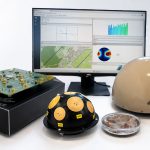
Eviden and Thales have integrated protected Galileo navigation capability into the P3TS military positioning and timing receiver used aboard French Army vehicles. The upgrade is intended to maintain reliable navigation and tactical network synchronization in operational areas where conventional satellite signals may be jammed, spoofed, degraded, or completely unavailable.
Announced on July 28, 2026, the new P3TS PRS configuration combines Eviden’s vehicle-level navigation platform with Galileo Public Regulated Service technology developed by Thales. The result is a European-controlled positioning solution designed specifically for government-authorized users operating in high-risk environments.
Galileo PRS Integration
Galileo PRS is an encrypted navigation service intended for authorized government users and critical security applications. Unlike the constellation’s open signals, PRS is engineered to provide greater continuity, authentication, access control, and resistance to deliberate interference.
Integrating this capability into P3TS gives French Army vehicles access to protected Galileo signals alongside conventional Galileo and GPS open-service signals. The receiver can therefore use several navigation sources while prioritizing the protected service when electronic warfare conditions make civilian signals unreliable.
The integration is significant because modern military vehicles depend on positioning data for much more than displaying their location on a map. GNSS information supports command systems, tactical data sharing, route planning, weapon coordination, sensor alignment, convoy management, and the georeferencing of battlefield observations.
A compromised position can consequently affect several connected systems at the same time.
Two Receiver Options
Eviden and Thales will offer P3TS PRS in two primary configurations.
The first incorporates the Thales TopStar Galileo PRS Core Module. This version provides access to Galileo PRS while continuing to process Galileo and GPS open-service signals.
The second configuration combines GPS reception or the Thales TopStar Smart Receiver with additional anti-jamming technology. This option is intended for platforms requiring stronger protection against high-power radio-frequency interference and more demanding electronic warfare conditions.
Offering two architectures allows the system to be adapted to different vehicle classes, mission profiles, protection requirements, available installation space, and acquisition budgets. A command vehicle operating close to the front line, for example, may require a different level of interference protection than a logistics platform operating farther from the primary threat area.
Timing Without GNSS
One of the most technically important features is the inclusion of a high-precision clock in both configurations.
The clock can preserve timing for tactical radios when satellite reception is interrupted. This matters because military communication networks depend on accurate synchronization for functions such as frequency hopping, encrypted transmissions, time-slot management, network coordination, and the consistent exchange of tactical data.
A vehicle may temporarily lose reliable satellite positioning because of terrain, urban structures, antenna obstruction, intentional jamming, or damage to the external antenna. Maintaining a stable internal timing reference allows communication systems to continue operating during that interruption.
This changes the role of P3TS from a conventional navigation receiver into a positioning, navigation, and timing node supporting several vehicle subsystems.
Protection From Jamming
Jamming and spoofing create different technical problems.
Jamming overwhelms legitimate satellite signals with stronger interference, preventing the receiver from calculating a reliable position. Spoofing introduces false navigation signals intended to make the receiver calculate an incorrect location or time.
Military GNSS protection must therefore do more than increase receiver sensitivity. It requires secure signal access, interference detection, controlled authentication, anti-jamming processing, disciplined timing, and the ability to reject data that does not meet integrity requirements.
The P3TS PRS upgrade addresses these risks through protected Galileo access and, in its more advanced configuration, additional anti-jamming capabilities.
It does not make a vehicle immune to every electronic attack. No satellite navigation receiver can guarantee uninterrupted positioning under all conditions. However, combining encrypted signals, multiple constellations, interference-resistant hardware, and local timing substantially increases the difficulty of denying or manipulating navigation data.
Built for SCORPION
The new receiver builds on the industrialization and operational support program assigned to Eviden by France’s Directorate General of Armaments, commonly known as the DGA.
Eviden also has experience deploying SICS, the SCORPION Combat Information System used to create a shared tactical picture across connected French land forces. Integrating protected positioning into this environment can help ensure that locations transmitted through the combat network are based on more resilient and trustworthy data.
That connection is strategically important. A resilient receiver provides greater value when its secure position and timing information can be distributed to radios, mission computers, command applications, and other onboard systems instead of remaining isolated inside a standalone navigation unit.
European Navigation Autonomy
The project also supports France’s broader objective of reducing operational dependence on the United States-controlled GPS constellation.
GPS will remain an important navigation source, and the P3TS architecture continues to support it. The key change is that French forces gain access to an additional protected service controlled through European institutions and national authorization mechanisms.
This creates an alternative source of secure positioning if GPS availability, access conditions, signal quality, or operational priorities become unfavorable.
For European armed forces, sovereignty does not necessarily mean eliminating foreign technology. In practical terms, it means retaining the ability to operate essential military systems without depending entirely on decisions, infrastructure, or encryption services controlled outside Europe.
Technical Assessment
The most important aspect of this integration is not the addition of another satellite constellation. Multi-constellation reception is already common in civilian and professional GNSS equipment.
The real advance is the combination of protected Galileo signals, anti-jamming capability, high-integrity positioning, and holdover timing inside a receiver designed to connect with an existing military vehicle architecture.
This reflects a wider shift in defense navigation. Armed forces are moving away from treating GNSS receivers as isolated accessories and toward positioning, navigation, and timing systems that must remain integrated with communications, command networks, inertial sensors, vehicle electronics, and alternative navigation sources.
The two-configuration strategy is also commercially and operationally sensible. Installing the most advanced anti-jamming package on every vehicle would increase cost, integration complexity, power consumption, and support requirements. A modular architecture allows higher levels of protection to be reserved for platforms whose missions justify them.
The next major technical step should be deeper integration with inertial navigation, wheel-speed data, vision systems, terrain-referenced navigation, and signals of opportunity. Galileo PRS can make satellite navigation considerably more resilient, but true battlefield navigation resilience requires the vehicle to continue estimating its position even after every usable satellite signal has disappeared.
About Eviden
Eviden is the products and systems brand of Atos Group. Following the March 2026 sale of the Bull advanced computing activities to the French state, Eviden’s portfolio focuses on cybersecurity products, mission-critical systems, and Vision AI.
On a pro forma basis excluding the divested advanced computing operations, Eviden generated approximately €300 million in revenue during fiscal 2025. Atos Group reported approximately 61,000 employees, operations in 61 countries, and pro forma annual revenue of about €7.2 billion following the transaction.
The P3TS program falls within Eviden’s mission-critical systems activity, which includes technologies designed for defense, public safety, secure communications, and real-time operational environments.
About Thales
Thales is a French technology group active in defense, aerospace, cybersecurity, digital identity, and secure communications. Its navigation portfolio includes civil and military GNSS receivers, protected Galileo PRS technology, avionics systems, timing equipment, and interference-resistant positioning solutions.
For the P3TS project, Thales supplies the Galileo PRS technology through its TopStar product family and provides the expertise required to integrate protected satellite navigation and anti-jamming functions into military platforms. The company states that it is the only organization to have developed a Galileo PRS security module in France, giving it a specialized position within the country’s sovereign navigation supply chain.