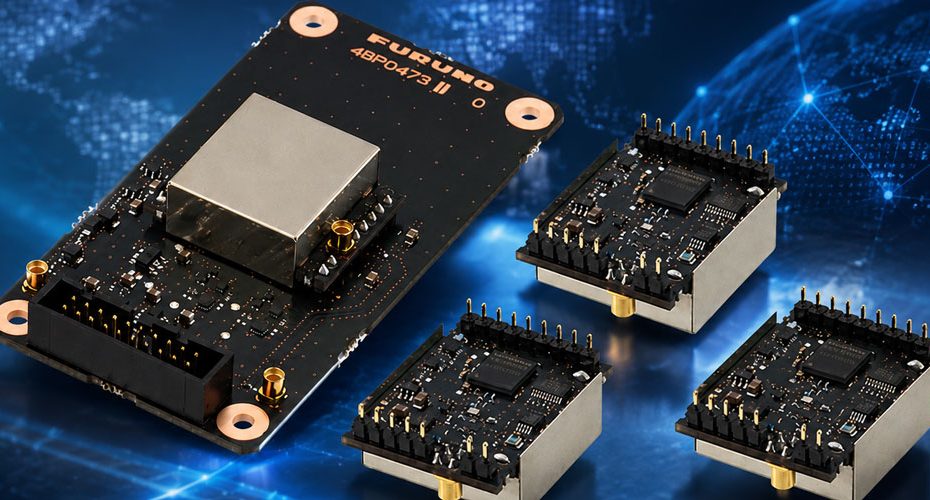
Furuno has announced the upcoming GF-100 Series of dual band GNSS Disciplined Oscillators (GNSSDOs), a new family of timing modules engineered to deliver highly resilient synchronization for critical infrastructure operating in increasingly hostile GNSS environments. Planned for release in November 2026, the lineup consists of four models, GF-102, GF-103, GF-105S, and GF-105G, each combining a dual frequency GNSS receiver with a high stability oscillator to maintain precise timing even when satellite signals are degraded or intentionally disrupted. Unlike conventional GNSSDOs that primarily react to complete signal loss, Furuno’s new platform is designed to actively detect interference and automatically protect the timing solution before synchronization is compromised.
Four Models Target Different Timing Requirements
The GF-100 Series is available in two hardware formats and four performance levels, allowing equipment manufacturers to choose the appropriate balance between holdover accuracy, size, and cost.
| Model | Form Factor | Holdover (24h) | Outputs | Key Features |
|---|---|---|---|---|
| GF-102 | Short | ±20 µs | 10 MHz, 1PPS | Balanced performance and cost efficiency |
| GF-103 | Short | ±5 µs | 10 MHz, 1PPS | Standard choice for a wide range of applications |
| GF-105S | Short | ±1.5 µs | 10 MHz, 1PPS | Flagship holdover performance in a compact design |
| GF-105G | Grande | ±1.5 µs | 10 MHz, 1PPS | Optimized as a direct replacement for the GF-8805 |
All models are scheduled to enter production in November 2026.
Built for Modern GNSS Threats
Accurate GNSS timing has become fundamental to modern telecommunications, electric power grids, financial networks, broadcasting infrastructure, satellite communications, and industrial automation. However, the number of GNSS interference incidents has increased significantly in recent years, making traditional holdover strategies less effective. Conventional GNSSDOs are typically designed to enter holdover mode only after losing satellite reception, such as during antenna failures or cable damage. The challenge is that during jamming or spoofing attacks, receivers may continue tracking corrupted satellite signals instead of recognizing that the timing reference has become unreliable. The GF-100 Series addresses this problem by proactively identifying abnormal GNSS behavior and automatically switching to its internal high stability oscillator before corrupted timing data can affect the connected system. According to Furuno, the entire platform follows a Defense in Depth architecture that combines multiple independent protection mechanisms against both accidental signal degradation and intentional RF interference.
Automatic Holdover Protects Critical Timing
One of the most significant innovations is active holdover during GNSS anomaly detection. When the receiver detects signs of jamming or spoofing, it immediately transitions into holdover mode while continuing to provide stable synchronization using its onboard oscillator. This behavior prevents abnormal satellite data from propagating into telecom, broadcast, or power synchronization networks. The feature can also be enabled or disabled depending on operational requirements.
Independent L5 Reception Improves Reliability
The GF-100 Series moves beyond traditional single frequency timing receivers by supporting dual frequency L1/L5 GNSS reception. More importantly, Furuno implemented fully independent L5 signal acquisition, allowing the receiver to continue searching for and tracking L5 signals even when L1 reception becomes unreliable. This architecture provides additional resilience in environments affected by interference or poor signal quality.
Navigation Message Authentication Adds Another Security Layer
To strengthen protection against spoofing attacks, the new modules support two of the latest satellite authentication technologies:
- Galileo Open Service Navigation Message Authentication (OSNMA).
- Quasi Zenith Satellite System Navigation Message Authentication (QZNMA).
These services verify the authenticity of navigation messages received from satellites, helping prevent false timing references generated by spoofed GNSS transmissions.
Dynamic Satellite Selection and T RAIM
The GF-100 Series also incorporates two advanced integrity technologies designed to improve synchronization accuracy in challenging environments. Dynamic Satellite Selection continuously evaluates satellite quality and prioritizes the strongest signals, reducing timing errors caused by multipath reflections commonly found in dense urban areas. At the same time, Time Receiver Autonomous Integrity Monitoring (T RAIM) constantly evaluates every satellite contributing to the timing solution and automatically removes abnormal satellites before they can influence synchronization performance. Together, these technologies provide multiple independent validation layers rather than relying on a single protection mechanism.
Compact Design Simplifies Equipment Integration
Furuno will offer the new modules in two mechanical formats:
- Short: 34 × 27 × 15.5 mm
- Grande: 100 × 52 × 14.1 mm
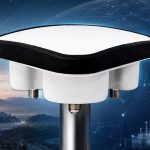
One of the biggest hardware improvements is the GF-105S, which delivers the company’s highest ±1.5 μs holdover over 24 hours in the compact Short package. Previously, this level of performance was available only in the much larger GF-8805. By moving the same performance into the smaller housing, Furuno has reduced required mounting area by approximately 80%, making integration significantly easier for OEM manufacturers. In addition, every GF-100 module remains hardware compatible with the existing GF-880x Series, allowing straightforward upgrades with minimal redesign. For maximum timing performance, Furuno recommends pairing the modules with its AU-500 GNSS antenna, which combines high noise immunity with an IP67 environmental protection rating.
Industry Perspective
The GF-100 Series demonstrates how GNSS timing technology is evolving beyond oscillator accuracy alone. As interference incidents continue to grow worldwide, resilience has become just as important as precision. Rather than relying on a single mitigation technique, Furuno has built multiple independent protection layers including authenticated navigation messages, autonomous integrity monitoring, intelligent satellite selection, dual frequency reception, and proactive holdover operation. That layered architecture is likely to become the new benchmark for next generation GNSS disciplined oscillators deployed in mission critical infrastructure.
About Furuno
Founded in 1948, Furuno Electric Co., Ltd. is headquartered in Nishinomiya, Japan, and is one of the world’s leading developers of marine electronics, GNSS receivers, precision timing systems, radar, sonar, satellite communications, and navigation technologies. The company operates through a global network spanning more than 100 countries and supplies equipment to the maritime, telecommunications, industrial, scientific, and critical infrastructure markets worldwide.