BMW is accelerating the integration of artificial intelligence and robotics in its production network, introducing a new generation of humanoid robots at its Leipzig manufacturing facility in Germany. The move represents the next phase of the company’s iFactory strategy, a long term initiative aimed at merging digital intelligence with physical manufacturing operations.
The robots now entering service are part of BMW’s broader plan to create highly flexible and data driven factories where machines, software, and workers operate within a unified digital ecosystem.
Hexagon Aeon Humanoid Robot Brings Physical AI to BMW Leipzig Production Lines
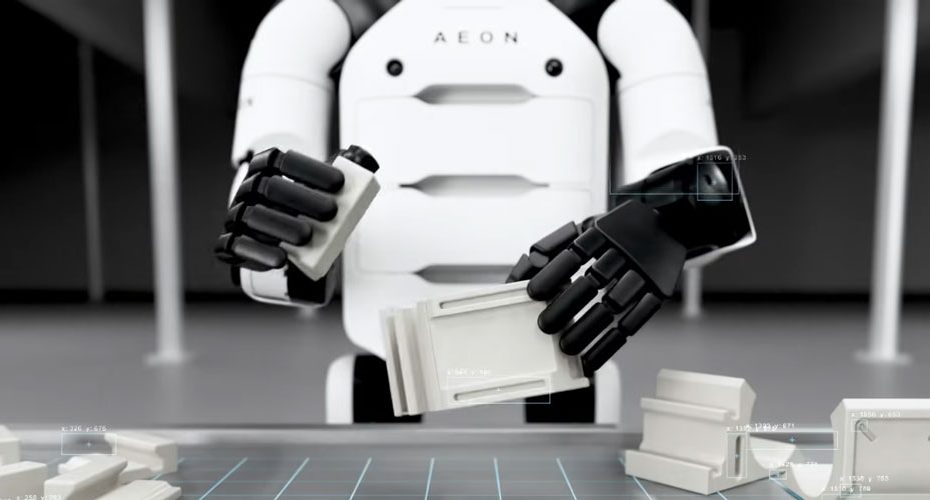
The humanoid system being deployed in Leipzig is called Aeon, developed by Hexagon Robotics. Unlike earlier humanoid machines that walk on two legs, Aeon moves on wheels, a design choice aimed at improving efficiency inside large industrial environments.
According to its developers, wheeled mobility allows the robot to travel up to 2.5 meters per second, making it better suited for covering long distances across factory floors where constant movement between workstations is required.
Technically, Aeon is designed as a multi purpose industrial robot equipped with:
- 22 sensors for environmental awareness;
- 34 degrees of freedom for precise manipulation;
- 360 degree vision systems for real time obstacle detection;
- integrated scanning systems for component inspection.
At BMW’s Leipzig facility, Aeon will assist with battery assembly operations and component manufacturing. The robot is also capable of performing precision quality checks on vehicle doors using integrated scanning technologies.
Another notable feature is the robot’s autonomous battery swapping system. Instead of waiting for charging cycles, Aeon can replace its own battery pack in under 30 seconds, allowing it to maintain continuous operation in a high throughput production environment.
Physical AI Enables Robots to Learn from Simulation and Real World Interaction
A key technological advancement behind Aeon is what BMW describes as physical AI. Unlike earlier industrial robots that rely on rigid programming, this generation of machines can learn tasks through a combination of simulation, imitation learning, and world models.
In practical terms, this means the robot can observe workflows, adapt to changing factory conditions, and safely operate alongside human workers.
Using its sensor array and visual perception systems, Aeon can detect employees, moving equipment, and other obstacles in real time. This ability allows it to function in dynamic environments without the safety constraints that limited many earlier collaborative robots.
BMW iFactory Platform Connects Robots, Machines, and Data Across Global Plants
The Aeon robot operates within BMW’s broader digital manufacturing architecture known as iFactory. The platform is designed to eliminate isolated production systems and instead connect every machine, workstation, and production line through a shared data infrastructure.
At the core of this architecture is a real time streaming data system. Every machine in the production network continuously feeds operational data into a central cloud platform.
This data foundation enables AI systems to monitor production, optimize processes, and support decision making across BMW’s global manufacturing network.
According to the company, more than 1,100 AI driven use cases are already active across BMW plants worldwide. Each implementation reportedly delivers annual efficiency gains exceeding €30,000 per application.
Four AI Maturity Levels Define the Evolution of BMW Smart Factories
BMW classifies the development of AI inside its factories into four stages.
The first stage focuses on operational routines such as computer vision systems that check whether parts are assembled correctly.
The second stage introduces process control, where AI systems actively adjust production parameters using real time data from connected machines.
The third stage uses generative AI models to support factory planning and engineering analysis.
The fourth and most advanced stage involves autonomous AI agents capable of making independent decisions and navigating complex production environments without direct human intervention.
BMW is now moving toward this final stage by combining robotics, large language models, and digital twin environments.
Nvidia Powered Digital Twins Allow BMW to Simulate Entire Factories
An important component of BMW’s manufacturing strategy is the creation of digital twins of its factories. These virtual replicas were developed with the support of Nvidia and are based on high resolution laser scans of production facilities around the world.
The result is a simulation environment that mirrors real factories with millimeter level accuracy.
Within this digital environment, engineers can simulate logistics flows, test robot deployment strategies, and evaluate workplace ergonomics before making physical changes to production lines.
BMW also plans to deploy AI agents inside these virtual environments to assist engineers in planning manufacturing processes and optimizing factory layouts.
AI Driven Energy Optimization Supports BMW Sustainability Goals
Beyond automation, BMW is also applying AI to improve energy efficiency across its manufacturing operations.
Renewable energy sources such as wind and solar introduce fluctuations in electricity availability. BMW’s AI systems analyze these variations and dynamically adjust factory energy consumption to match supply.
Sensors, control systems, and predictive algorithms work together to reduce peak loads and optimize energy usage in real time. This level of optimization would be extremely difficult to achieve using traditional control systems due to the complexity of the variables involved.
Why Humanoid Robots May Finally Work in Real Factories
From a technical perspective, BMW’s approach highlights an important shift in robotics strategy.
Early humanoid robot concepts focused heavily on replicating human motion, often resulting in complex machines that struggled with reliability and efficiency in industrial environments.
The Aeon robot reflects a more pragmatic design philosophy. Instead of insisting on bipedal locomotion, the platform uses wheels for mobility while maintaining humanoid style manipulation capabilities for interacting with tools and components.
Combined with physical AI learning systems and integration into a real time factory data network, this hybrid approach may prove more viable for large scale manufacturing deployments.
If BMW’s pilot programs demonstrate consistent productivity gains, humanoid robots could begin appearing more frequently in automotive factories during the next decade.
About BMW Group
BMW Group is one of the world’s largest premium automotive manufacturers. Founded in 1916 and headquartered in Munich, Germany, the company produces vehicles under the BMW, MINI, and Rolls Royce brands.
The group operates more than 30 production and assembly facilities worldwide and sells vehicles in over 140 countries. In 2024, BMW Group delivered approximately 2.55 million vehicles globally and generated revenue exceeding €155 billion.
The company continues to invest heavily in electrification, digital manufacturing, and artificial intelligence as part of its long term transformation toward software defined and highly automated vehicle production.