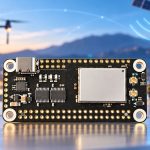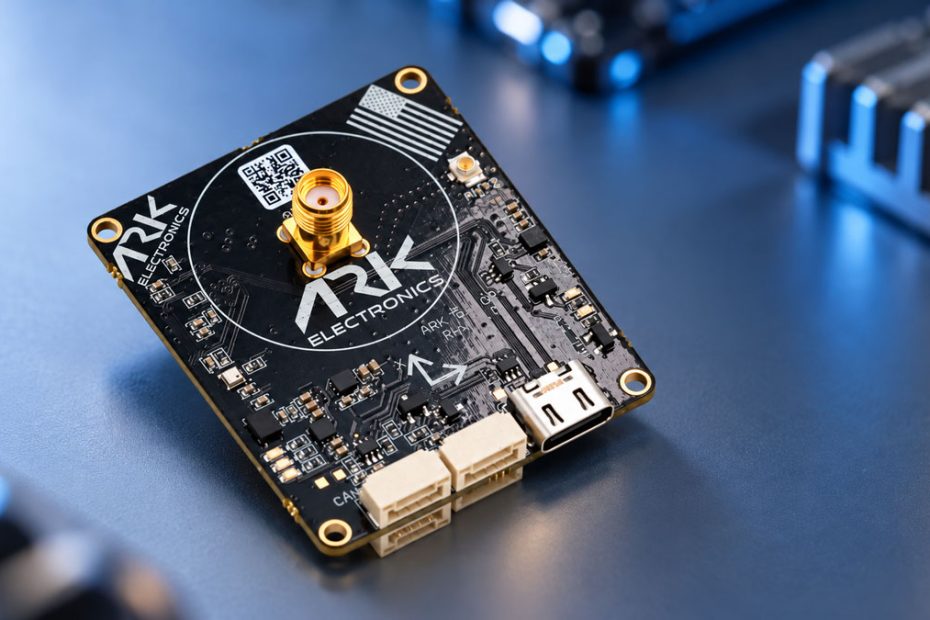
ARK Electronics has expanded its high-precision navigation hardware lineup with the ARK G5 P8 RTK GPS, a compact quad-band GNSS module designed for drones, autonomous robots, and other applications requiring reliable positioning in challenging signal environments. Built around the Septentrio mosaic-G5 P8 receiver, the new module combines centimeter-level RTK positioning capabilities, advanced interference protection, dual-antenna heading, and navigation sensors in a 13-gram package.
The U.S. manufacturer officially announced the G5 P8 on October 5, 2026, alongside the less expensive G5 P6. The new flagship module is offered in three antenna configurations, with prices ranging from $2,375 to $2,550. Its primary selling point is not simply positioning accuracy, but the ability to detect and mitigate interference that could compromise conventional GNSS navigation systems.
Septentrio mosaic-G5 P8 and AIM+ Ultimate Protection
At the center of the ARK G5 P8 is Septentrio’s mosaic-G5 P8, a multi-constellation, quad-band GNSS receiver designed for high-precision positioning and resilience against radio-frequency interference.
The receiver supports all-in-view satellite tracking, allowing it to process available signals from multiple GNSS constellations and frequency bands. This capability improves satellite visibility and measurement redundancy, particularly in locations where buildings, terrain, or other obstacles restrict the view of the sky.
A defining feature is Septentrio AIM+ Ultimate, an interference mitigation system developed to address GNSS jamming and spoofing. Jamming involves radio-frequency interference that disrupts satellite signal reception, while spoofing attempts to deceive a receiver with counterfeit positioning signals.
AIM+ Ultimate adds interference monitoring and mitigation capabilities, giving navigation systems greater awareness of potentially compromised GNSS conditions. The G5 P8 also incorporates end-to-end authentication features for applications requiring additional protection against manipulated navigation information.
These capabilities are particularly relevant for autonomous vehicles operating near industrial facilities, communications infrastructure, and regions experiencing deliberate GNSS interference. However, interference protection should not be interpreted as a guarantee of uninterrupted positioning under every jamming or spoofing scenario.
Dual-Antenna RTK and 100 Hz Position Updates
The ARK G5 P8 supports both single-antenna positioning and dual-antenna heading, with the operating configuration selectable through software commands.
In dual-antenna mode, the receiver can determine vehicle heading from the relative positions of two GNSS antennas. This is especially useful for autonomous platforms that need reliable orientation information while stationary or moving slowly, when heading derived from successive position measurements becomes less dependable.
The Septentrio receiver also provides raw GNSS measurements and low-latency positioning output at rates of up to 100 Hz, equivalent to a new receiver solution every 10 milliseconds.
Such high update rates can benefit fast-moving drones, robotic platforms, and navigation systems that integrate GNSS measurements into real-time control algorithms. Nevertheless, actual positioning performance also depends on correction availability, satellite geometry, antenna installation, and the receiving system’s processing capabilities.
The 100 Hz receiver capability does not automatically mean that every connected autopilot will receive or process position updates at that frequency. The final output rate may depend on communication settings and system integration.
Integrated IMU, Magnetometer, and Barometer
Beyond satellite navigation, ARK Electronics has equipped the G5 P8 with three additional motion and environmental sensors.
The ST IIS2MDC magnetometer provides magnetic field measurements that can contribute to heading estimation. A Bosch BMP390 barometric sensor measures atmospheric pressure for altitude-related calculations, while an InvenSense ICM-42688-P six-axis IMU supplies accelerometer and gyroscope measurements.
An STM32F412VGH6 microcontroller manages the module’s onboard functions and communications. A buzzer and dedicated status indicators provide additional operational feedback.
This sensor combination simplifies integration with flight controllers and robotic navigation systems by consolidating several commonly required components into one hardware module. However, the presence of an IMU does not by itself establish a complete inertial navigation solution capable of maintaining RTK-level accuracy during prolonged GNSS outages.
ARK G5 P8 Technical Specs
| Parameter | Specification |
|---|---|
| GNSS receiver | Septentrio mosaic-G5 P8 |
| GNSS tracking | Multi-constellation, quad-band, all-in-view |
| Positioning | RTK, centimeter-level capability |
| Interference protection | Septentrio AIM+ Ultimate |
| Security | End-to-end authentication support |
| Maximum receiver update rate | 100 Hz |
| Antenna configurations | Single or dual antenna |
| GNSS heading | Dual-antenna heading |
| Magnetometer | ST IIS2MDC |
| Barometer | Bosch BMP390 |
| IMU | InvenSense ICM-42688-P, six-axis |
| Microcontroller | STM32F412VGH6 |
| Communications | DroneCAN, USB-C, UART |
| CAN interfaces | 2 × Pixhawk-standard 4-pin JST-GH |
| Supply voltage | 4.6 to 5.4 V |
| Specified current | 360 mA |
| Dimensions without antenna | 48 × 40 × 15.4 mm |
| Weight without antenna | 13 g |
| Weight with one antenna | 43.5 g |
| Weight with two antennas | 91 g |
| Manufacturing | United States |
| Compliance | NDAA-compliant, according to manufacturer |
DroneCAN Integration and Antenna Options
The module uses DroneCAN communication and features two Pixhawk-standard CAN connectors, making it suitable for integration with compatible unmanned vehicle control architectures.
A USB-C interface, a separate UART connection with pulse-per-second signaling, and a debugging connector expand its integration and maintenance options. The manufacturer also provides support for firmware updates through DroneCAN.
Visual indicators show GNSS fix status, RTK status, and general system operation.
ARK Electronics offers three purchasing configurations:
- $2,375: Module without antennas.
- $2,455: Module with one full-frequency helical GNSS antenna.
- $2,550: Module with two full-frequency helical GNSS antennas.
The dual-antenna version also includes the necessary antenna connection hardware. With both antennas installed, the unit’s overall dimensions increase to 91.5 × 40 × 51 mm.
The ability to configure antenna operation without replacing the receiver could be useful for developers working with different vehicle platforms or evaluating several navigation architectures.
Why GNSS Interference Protection Matters
The G5 P8 represents an important distinction in the development of modern RTK receivers: positioning precision and positioning trustworthiness are separate engineering requirements.
Conventional RTK systems can deliver centimeter-level accuracy when satellite measurements and correction data are reliable. However, a precise positioning solution offers limited operational value if a receiver cannot recognize that the underlying GNSS signals are being manipulated or disrupted.
In this respect, the G5 P8’s strongest technical advantage is its combination of high-precision GNSS with interference awareness, rather than its 100 Hz update rate alone.
For professional drone operations, autonomous inspection vehicles, and robotic platforms, recognizing deteriorating signal conditions can help the control system decide when GNSS data should be treated cautiously or supplemented by other navigation sources.
The product also illustrates a broader shift toward integrating navigation security into compact embedded receivers instead of relying exclusively on external signal-monitoring equipment.
There are practical limitations. The G5 P8 is considerably more expensive than conventional RTK modules, and its advanced interference capabilities will need to justify that premium in real-world deployments. The available manufacturer information does not establish how much positioning availability improves under specific jammer power levels, spoofing methods, or antenna installations.
For system designers, independent interference testing, autopilot compatibility, and navigation fallback behavior will therefore remain important evaluation criteria.
ARK G5 P8 vs. G5 P6
ARK Electronics introduced the G5 P8 alongside the G5 P6, providing two options based on the Septentrio mosaic-G5 generation.
Both modules offer quad-band RTK GNSS, single- or dual-antenna operation, integrated navigation sensors, and DroneCAN connectivity. The P6 uses Septentrio’s mosaic-G5 P6 with AIM+ Premium interference protection and starts at $1,035.
The P8 builds on that platform with AIM+ Ultimate, additional interference situational awareness, end-to-end authentication capabilities, and its advertised 100 Hz update rate. Its entry price is $2,375.
This creates a substantial price difference of $1,340 between the base configurations. For general commercial RTK applications, the P6 may offer sufficient functionality. The P8 is more clearly positioned toward systems where GNSS interference resilience and navigation integrity are critical design priorities.
ARK Electronics
About ARK Electronics
ARK Electronics is an American electronics manufacturer founded in 2018 and headquartered in Murray, Utah. The privately held company specializes in navigation modules, flight controllers, embedded computers, sensors, and supporting hardware for unmanned aircraft and robotic systems.
According to its LinkedIn company profile, ARK Electronics has 11 to 50 employees and reports more than 25 years of combined industry experience. The company designs, manufactures, and tests its products in the United States, with an emphasis on NDAA-compliant hardware and applications requiring dependable domestic supply chains.
Its product range includes RTK GNSS receivers, inertial sensors, optical flow and distance sensors, power modules, and flight-control electronics. ARK also contributes to open-source ecosystems such as PX4 and ArduPilot, while selected products are included in the Blue UAS Framework.