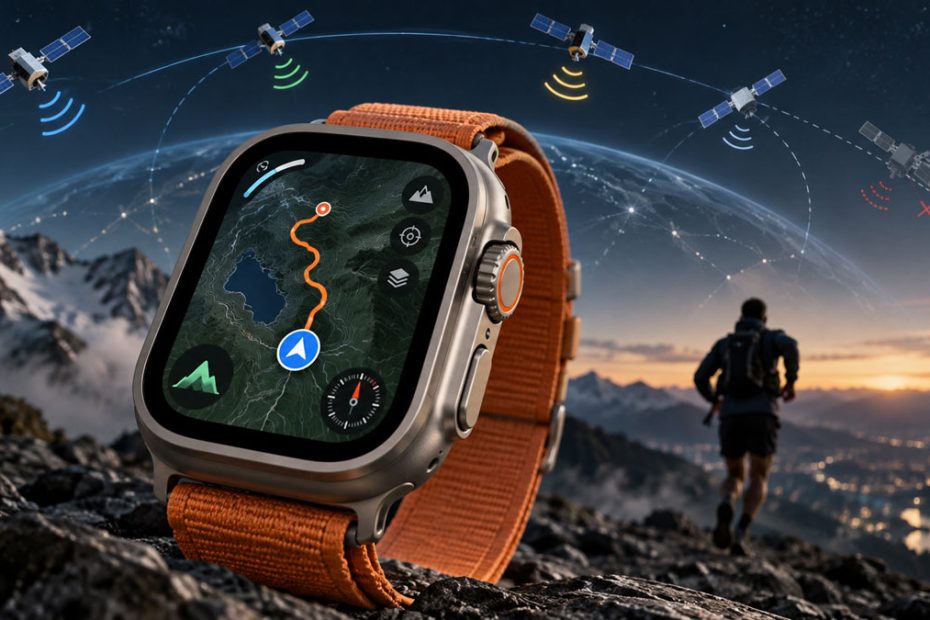
Apple has quietly removed GLONASS support from the Apple Watch Ultra 4, reducing the number of supported global and regional satellite navigation systems while retaining the dual-frequency positioning architecture that has become one of the Ultra line’s key technical advantages.
According to Apple’s official specifications, the Apple Watch Ultra 4 supports GPS, Galileo, QZSS and BeiDou. GLONASS, Russia’s global navigation satellite system, is no longer listed. By comparison, the previous Apple Watch Ultra 3 supported GPS, GLONASS, Galileo, QZSS and BeiDou with L1 and L5 precision dual-frequency positioning.
Apple has not publicly explained why GLONASS was removed, making the change more interesting from an engineering perspective than the specification sheet alone might suggest.
Apple Watch Ultra 4 GNSS Support
The Ultra 4 continues to use precision dual-frequency positioning, an important feature for a watch designed for runners, hikers, cyclists and other users who regularly depend on accurate location data in difficult environments.
Dual-frequency GNSS receivers can use signals transmitted on different frequency bands to better compensate for ionospheric errors and multipath effects. Those advantages become particularly important around tall buildings, steep terrain, tree cover and other locations where satellite signals can arrive at the receiver after reflecting from surrounding surfaces.
Apple now lists four supported navigation constellations for the Ultra 4:
- GPS
- Galileo
- QZSS
- BeiDou
GLONASS has disappeared from that list.
That does not necessarily mean the Ultra 4 has fewer useful satellites available in real-world conditions. Modern GNSS performance depends on considerably more than the number of constellation names printed on a specification page.
Satellite geometry, supported frequencies, signal quality, antenna performance, receiver sensitivity and positioning algorithms can all have a larger effect on the final location solution.
Ultra 3 Included GLONASS
The difference becomes clear when Apple’s specifications for the two generations are compared directly.
Apple describes the Ultra 3 as supporting “L1 and L5 precision dual-frequency GPS” with GPS, GLONASS, Galileo, QZSS and BeiDou. The Ultra 4 specification instead lists precision dual-frequency GPS using GPS, Galileo, QZSS and BeiDou.
In other words, this appears to be a deliberate platform change rather than a documentation omission carried over from an older model.
The decision is also notable because Apple has not eliminated GLONASS across its entire watch lineup.
The Apple Watch Series 12 still lists GPS, GLONASS, Galileo, QZSS and BeiDou, although Series 12 uses precision L1 GPS rather than the Ultra’s dual-frequency positioning system.
That difference suggests Apple may be making separate GNSS design decisions for its mainstream and high-end watch platforms.
Why Apple May Have Removed GLONASS
There are several possible technical explanations, although none has been confirmed by Apple.
GNSS receivers do not simply count satellites and select the largest possible number. Every additional constellation introduces its own signals, timing characteristics, orbital data and receiver processing requirements.
GLONASS is also technically different from several newer GNSS implementations. Historically, its frequency allocation and signal architecture required receivers to handle inter-frequency and inter-channel hardware biases differently from systems such as GPS and Galileo.
Modern receiver designs can compensate for these effects, so GLONASS support itself should not be considered inherently inaccurate. However, if Apple determined that GPS, Galileo, BeiDou and QZSS already provide sufficient satellite geometry and frequency diversity for the Ultra 4, the additional constellation may have offered diminishing benefits.
Removing it could potentially simplify GNSS processing, receiver calibration and testing.
It could also reduce some processing activity and therefore save power, but expectations should remain realistic. GNSS is only one component of the Apple Watch power budget, and Apple has not claimed that dropping GLONASS produces a measurable battery-life improvement.
Fewer Constellations Do Not Mean Lower Accuracy
The most important point is that GNSS accuracy cannot be judged simply by comparing the number of supported constellations.
A receiver tracking 30 high-quality signals with good geometry on multiple frequencies can produce a better position than another receiver tracking more satellites affected by multipath, interference or poor geometry.
This is especially relevant to a wearable device.
Unlike a surveying receiver mounted above an obstruction-free antenna, a smartwatch operates beside the human body, changes orientation constantly and has extremely limited antenna dimensions. The GNSS chipset, antenna design and positioning algorithms therefore have to work together much more aggressively.
Apple has spent several generations improving this system in the Ultra family.
The company’s decision to retain dual-frequency positioning while dropping GLONASS suggests that the engineering priority is signal quality and positioning consistency rather than maximizing the number of advertised constellations.
What It Means for Ultra 4 Users
For most Apple Watch Ultra 4 owners, the change is unlikely to create a noticeable reduction in navigation performance.
GPS and Galileo alone provide large global satellite constellations. BeiDou adds another extensive global network, while Japan’s QZSS can improve availability and geometry in the Asia-Pacific region.
Modern multi-constellation positioning can therefore provide substantial satellite availability without GLONASS.
There may still be specific locations or satellite geometries where another constellation would have helped. GNSS availability changes continuously as satellites move across the sky, so eliminating any constellation removes one potential source of measurements.
However, the practical question is not whether one constellation disappeared. It is whether Apple’s new receiver configuration produces a better or worse position solution during actual outdoor use.
That will require controlled testing rather than conclusions drawn from a specification sheet.
Our Technical View
From a GNSS engineering perspective, Apple’s decision is more interesting than alarming.
Adding every available constellation was once an obvious selling point for consumer GNSS devices. That approach makes less sense as receivers become increasingly sophisticated.
The industry is gradually moving from “how many constellations can the receiver track?” toward “which signals produce the most reliable positioning solution?”
For a compact battery-powered device such as the Apple Watch Ultra, there is a strong argument for optimizing around the most useful signal combinations rather than keeping legacy compatibility simply because the chipset can support it.
I would therefore not describe the removal of GLONASS as either an upgrade or a downgrade yet.
The more significant question is whether Apple’s GNSS algorithms can maintain better track consistency, distance measurement and position stability with the new configuration. If independent running, hiking and urban canyon tests show equal or improved results, the disappearance of GLONASS will ultimately be little more than an architectural change.
Claims of improved battery life should be treated even more cautiously. Processing fewer signals can theoretically reduce computational load, but without measurements from Apple or independent testing, any real-world endurance gain remains speculative.
What the change does show is that Apple appears increasingly comfortable optimizing its GNSS implementation rather than treating support for every major constellation as a requirement.
About Apple
Apple Inc. is a Cupertino, California-based technology company whose product portfolio includes the iPhone, Mac, iPad, Apple Watch, AirPods and a rapidly growing range of digital services.
For its fiscal year ended September 27, 2025, Apple reported $416.2 billion in net sales, up 6 percent from $391.0 billion a year earlier. The company’s Wearables, Home and Accessories category, which includes Apple Watch, generated $35.7 billion in fiscal 2025 revenue. Apple reported approximately 166,000 full-time equivalent employees worldwide at the end of the fiscal year.
The Apple Watch product family dates back to 2015, while the ruggedized Apple Watch Ultra line was introduced in 2022 with a stronger focus on endurance sports, outdoor navigation and professional-grade activity tracking.