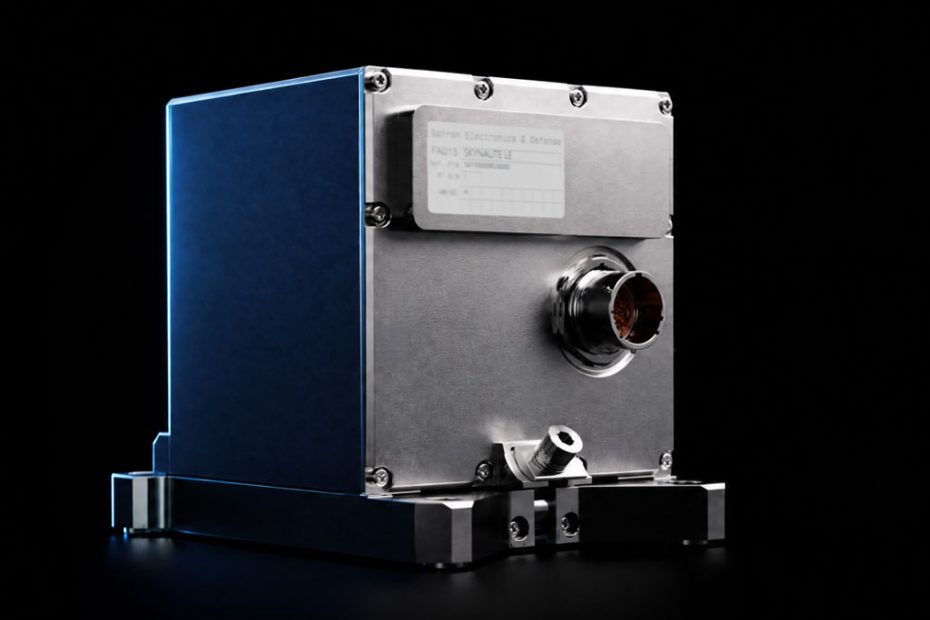
French aerospace group Safran has announced that its SkyNaute hybrid inertial navigation system will equip the Airbus A220, marking the technology’s first application in commercial air transport. Announced on October 20, 2026, the selection brings a navigation platform originally developed for demanding military environments into the commercial airline market.
Developed by Safran Electronics & Defense, SkyNaute combines high-precision inertial sensors with Global Navigation Satellite System (GNSS) positioning. Its principal advantage is the ability to maintain reliable navigation when satellite signals become unavailable, are deliberately jammed, or are manipulated through spoofing.
The agreement comes as GNSS interference has become a serious operational concern for airlines, particularly on routes crossing regions affected by military activity. Unlike satellite-dependent positioning, inertial navigation provides an independent source of aircraft motion and orientation data, allowing navigation to continue during interruptions to external signals.
SkyNaute Inertial Navigation Technology
At the center of SkyNaute is Safran’s patented HRG Crystal hemispherical resonator gyroscope technology. Rather than relying on conventional spinning mechanical gyroscopes, HRG sensors measure rotation through the vibration patterns of a precision hemispherical resonator.
This architecture minimizes mechanical wear while providing highly stable angular measurements. Combined with accelerometers and navigation processing algorithms, the gyroscopes enable SkyNaute to continuously estimate aircraft attitude, velocity, heading, and position.
During normal operation, GNSS measurements help correct the gradual position errors that accumulate in an inertial navigation system. If satellite signals disappear or become unreliable, SkyNaute can continue calculating the aircraft’s trajectory using its inertial sensors.
The distinction is important: inertial navigation does not require continuous communication with satellites, but its position uncertainty still grows over time. SkyNaute’s engineering advantage lies in limiting that drift sufficiently to support demanding aviation navigation requirements.
SkyNaute Technical Specifications
Safran’s published product documentation provides detailed performance figures for the SkyNaute system. These are product-level specifications and do not necessarily describe the final certified configuration installed on the A220.
| Specification | SkyNaute Published Data |
|---|---|
| Navigation architecture | Hybrid inertial/GNSS |
| Gyroscope technology | HRG Crystal hemispherical resonator |
| Weight | 3 kg (6.6 lb) |
| Volume | 3 liters |
| Power consumption | Approximately 20 W |
| Operating temperature | -40°C to +70°C |
| Position accuracy, inertial CEP50 | Less than 1 nautical mile/hour |
| Position accuracy, hybrid CEP50 | Less than 5 meters |
| Heading accuracy, RMS | Less than 0.2° inertial, 0.1° hybrid |
| Roll and pitch accuracy, RMS | Less than 0.05° |
| RNP 0.1 coasting | More than 10 minutes |
| RNP 0.3 coasting | More than 20 minutes |
| RNP 1 coasting | More than 1 hour |
| Data interfaces | ARINC 429, RS422, Ethernet, discrete I/O |
| Software assurance | DO-178C DAL A |
| Hardware assurance | DO-254 DAL A |
Safran also reports a 35% reduction in size and weight compared with reference navigation systems in the same performance category.
The combination of a compact 3-liter enclosure, low power consumption, and aviation-grade reliability is particularly relevant for commercial aircraft, where avionics integration must account for equipment weight, available installation space, electrical demand, and maintenance requirements.
Navigation Without GNSS Signals
One of SkyNaute’s most important published capabilities is its ability to maintain specified Required Navigation Performance levels during temporary satellite navigation outages.
Safran reports that the system can support RNP 0.1 performance for more than 10 minutes without GNSS updates. Its stated coasting capability extends beyond 20 minutes at RNP 0.3 and one hour at RNP 1.
These classifications represent different levels of horizontal navigation accuracy requirements, expressed in nautical miles. For example, RNP 0.1 generally requires the aircraft to remain within 0.1 nautical mile of the intended path for at least 95% of flight time, together with the applicable monitoring and alerting requirements.
Such performance is significant because commercial aircraft cannot simply assume that GNSS positioning will remain available throughout a flight.
However, it is essential to distinguish the navigation system’s published accuracy from authorization to conduct a particular flight procedure. Actual operational capability also depends on the certified aircraft installation, flight management system integration, navigation integrity monitoring, and regulatory approvals.
GNSS Spoofing Risks for Airbus A220
The SkyNaute selection addresses an issue Airbus itself has documented.
In an April 2026 technical safety publication, Airbus explained that the A220 can experience erroneous position calculations when exposed to GNSS spoofing. Under certain conditions, large artificial position shifts can cause the flight management system to reject other navigation references and revert to dead-reckoning navigation.
The A220 already has alternative navigation sources, including inertial references and ground-based radio navigation. When GPS signals are lost, its flight management system can select other available sources according to a defined priority sequence.
Spoofing creates a more complicated challenge than simple signal loss because a receiver may continue delivering apparently valid but incorrect coordinates.
A high-quality inertial reference provides an independent means of checking whether satellite-derived position changes are physically consistent with the aircraft’s measured motion.
Nevertheless, installing a more capable inertial navigation system does not automatically eliminate every spoofing-related failure mode. The effectiveness of that protection depends on how navigation data is validated, integrated, and used by the aircraft’s other avionics systems.
HRG Sensors and Aircraft Reliability
SkyNaute has already been selected for military aircraft, helicopters, and unmanned aerial vehicles operated by European defense organizations. In July 2026, Safran also announced that Eve Air Mobility had selected two SkyNaute systems per aircraft for its electric vertical takeoff and landing program.
These applications demonstrate the system’s adaptability to different operating conditions, including helicopter vibration, temperature variations, and environments where electronic interference is a concern.
For commercial airlines, the benefits extend beyond navigation accuracy. HRG technology uses a resonating sensor rather than a conventional rotating gyro assembly, reducing mechanical wear and potentially supporting longer equipment service life.
Safran’s published specifications assign the HRG sensor technology a mean time between failures exceeding one million hours. This figure refers to the gyroscope technology rather than a guaranteed maintenance interval for the complete A220 navigation installation.
What SkyNaute Means for Commercial Aviation
The most interesting aspect of the Airbus A220 selection is not that Safran has developed another accurate inertial navigation system. It is that GNSS resilience is becoming a more visible consideration in commercial avionics procurement.
For years, the relationship between inertial systems and satellite positioning has largely been described in terms of complementary accuracy. GNSS provides highly accurate absolute positioning, while inertial sensors ensure continuity between external position updates.
The growing threat of intentional interference changes the engineering priority. An aircraft must not only calculate its position accurately when GNSS is working, but also recognize when satellite information should no longer be trusted.
SkyNaute’s published coasting performance is particularly relevant in this context. Rather than treating GNSS loss as an immediate loss of precision, its inertial architecture provides a measurable window during which navigation performance can remain within defined limits.
In my assessment, the larger opportunity for Safran lies in making interference resilience a standard characteristic of future commercial navigation architectures rather than a specialized military requirement.
There is also an important limitation to the announcement. Safran has not publicly specified the A220 installation schedule, the number of units covered by the selection, or whether existing aircraft will receive the system through retrofit programs. The precise avionics integration architecture has not been detailed either.
Those details will determine how quickly the technology delivers operational benefits to airlines and whether the program develops into a substantial aftermarket opportunity.
Safran Expands HRG Production
Safran is preparing for increased demand for its inertial sensor technology through a major manufacturing investment in France.
In June 2026, Safran Electronics & Defense announced a €120 million investment to expand and modernize its Montluçon facility, where HRG technology is developed and industrialized.
The project aims to triple annual HRG production capacity from 10,000 to 30,000 units by 2032.
That expansion is strategically important because the technology serves multiple markets, including commercial aircraft, military platforms, helicopters, and drones. A larger manufacturing base could allow Safran to support higher production volumes while spreading development and industrial costs across several aircraft categories.
For the A220 program, the combination of mature inertial technology and expanding production capacity may be just as important as the navigation specifications themselves.
About Safran
Safran is a French aerospace and defense technology group headquartered in Paris. Its operations cover aircraft propulsion, aviation equipment, interiors, defense electronics, and space technologies.
The company reported €31.3 billion in revenue for 2025 and employs more than 110,000 people worldwide.
Safran Electronics & Defense, the division responsible for SkyNaute, has approximately 19,000 employees across five continents. Its activities include inertial navigation, avionics, optronics, flight controls, precise timing, and guidance systems.
With the Airbus A220 selection and its planned expansion of HRG production to 30,000 units annually, Safran is positioning its inertial navigation technology for broader adoption across both civil and defense aviation.
Source: www.safran-group.com