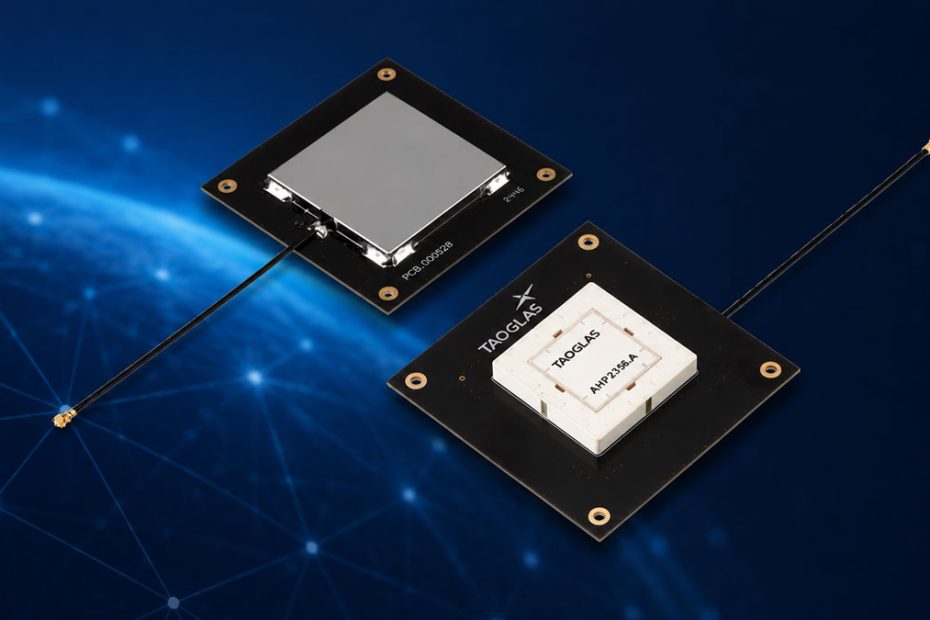
Taoglas has expanded its high precision GNSS portfolio with the introduction of the AHP2356A, a compact active patch antenna engineered for demanding positioning applications. Now available through Mouser Electronics, the new antenna combines a dual stage low noise amplifier architecture with broad multi band satellite support to improve positioning reliability in environments where signal quality is often compromised.
As precision positioning becomes increasingly important for autonomous machines, precision agriculture, robotics, surveying, and industrial automation, antenna performance is becoming just as critical as the GNSS receiver itself. The AHP2356A is designed to maximize signal integrity before data even reaches the receiver.
Dual stage LNA architecture
At the heart of the AHP2356A is an integrated two stage low noise amplifier (LNA) that enhances weak satellite signals while maintaining a low noise figure. Compared with conventional single stage active antennas, the dual stage design delivers stronger signal amplification together with improved rejection of unwanted radio frequency interference.
The result is cleaner satellite reception, greater positioning stability, and improved navigation performance in environments affected by RF congestion, industrial equipment, or partial sky visibility.
Multi constellation GNSS support
The antenna simultaneously supports several of the world’s major satellite navigation systems, allowing receivers to track more satellites and maintain higher positioning accuracy.
Supported frequency bands:
- GPS L1 and L2
- QZSS L1 and L2
- Galileo E5b
- GLONASS G1
- BeiDou B1I
Using multiple constellations increases satellite availability while improving positioning continuity in urban environments, under tree canopies, near structures, and in other challenging operating conditions.
Compact mechanical design
The AHP2356A measures only 35 × 35 × 6 mm, making it suitable for embedded systems where installation space is limited.
The antenna has been optimized using a 70 × 70 mm ground plane, helping maintain stable radiation characteristics and consistent gain despite its compact footprint.
For simplified integration, Taoglas supplies the antenna with:
- 100 mm 1.37 mm coaxial cable.
- I PEX MHF I RF connector.
- Integrated active amplifier.
- Factory tuned design for precision GNSS applications.
- Target applications.
The AHP2356A is intended for systems where positioning accuracy directly affects operational performance.
Typical applications include:
- Precision agriculture guidance systems.
- Autonomous agricultural machinery.
- Surveying instruments.
- Robotics.
- Asset tracking.
- Fleet management.
- Industrial automation.
- Navigation equipment.
- Intelligent transportation systems.
- Autonomous mobile platforms.
These markets increasingly require centimeter level positioning when paired with RTK, PPP, or other high accuracy correction services, making antenna quality an important factor in overall system performance.
Technical specs
| Specification | Details |
|---|---|
| Antenna type | Active GNSS patch antenna |
| LNA | Integrated dual-stage low-noise amplifier |
| Dimensions | 35 × 35 × 6 mm |
| Ground plane | Optimized for a 70 × 70 mm ground plane |
| Cable | 100 mm 1.37 mm coaxial cable |
| Connector | I-PEX MHF I |
| Supported systems | GPS, QZSS, Galileo, GLONASS, and BeiDou |
| Frequency bands | GPS/QZSS L1 and L2, Galileo E5b, GLONASS G1, and BeiDou B1I |
| Primary benefits | Low noise figure, strong out-of-band rejection, enhanced signal clarity, and stable GNSS reception |
Industry perspective
Modern GNSS receivers are capable of tracking dozens of satellite signals simultaneously, but receiver performance ultimately depends on the quality of the incoming RF signal. By integrating a dual stage amplifier and supporting multiple satellite constellations in a compact package, the AHP2356A addresses one of the most important challenges in precision positioning: maintaining reliable signal quality before processing begins.
As autonomous equipment and precision agriculture continue moving toward higher levels of automation, robust front end antenna performance is becoming a key differentiator for navigation system designers.
About Taoglas
Founded in 2003, Taoglas has grown into one of the world’s leading developers of advanced RF technologies, serving customers in more than 100 countries. The company designs antennas, RF components, GNSS solutions, cable assemblies, and wireless connectivity products for industries including automotive, agriculture, industrial IoT, healthcare, telecommunications, aerospace, and defense. Taoglas maintains engineering and manufacturing operations across North America, Europe, and Asia, supporting thousands of OEM projects with a portfolio that includes several thousand standard and custom RF products.