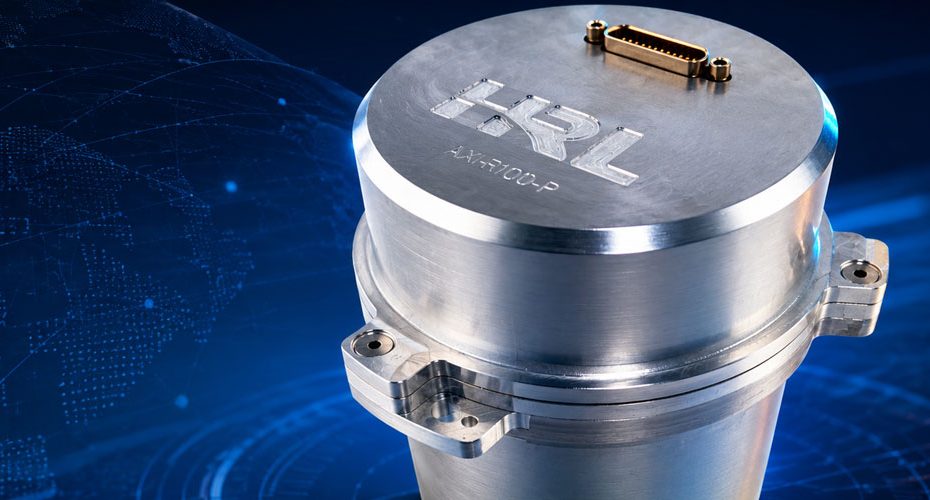
HRL Laboratories has unveiled the AXI R100, a new inertial measurement unit (IMU) designed to deliver near navigation grade performance in a compact MEMS based package. The announcement was made during the 2026 Joint Navigation Conference (JNC), where the company positioned the new sensor as a solution for autonomous systems operating in GPS contested and GPS denied environments.
As electronic warfare capabilities continue to evolve and GPS jamming becomes increasingly common across military and civilian sectors, demand is growing for navigation systems capable of maintaining accurate positioning without relying on satellite signals. HRL believes its latest inertial sensing technology can help address that challenge while remaining significantly smaller and more affordable than traditional navigation grade systems.
AXI R100 Targets the Gap Between Tactical and Navigation Grade Sensors
The AXI R100 is based on HRL’s proprietary silicon MEMS gyroscope technology. According to the company, the new sensor surpasses the performance of current state of the art tactical grade MEMS inertial sensors while approaching navigation grade accuracy levels.
HRL has not yet released detailed technical specifications such as bias instability, angle random walk, heading drift, or gyro noise performance. As a result, direct comparisons with competing high end MEMS, fiber optic gyro (FOG), or ring laser gyro (RLG) systems are not currently possible.
What is known is that the AXI R100 was designed to provide longer periods of accurate dead reckoning when GNSS signals are unavailable. This capability is becoming increasingly important for autonomous military vehicles, drones, aircraft, precision guided munitions, and next generation robotic systems.
Designed for Harsh Operating Conditions
According to HRL, the AXI R100 has been tested under demanding vibration, shock, and thermal conditions representative of aerospace and defense applications.
Potential applications:
- Drone navigation systems.
- Autonomous ground vehicles.
- Aircraft navigation.
- Missile guidance systems.
- Stabilization platforms.
- Precision pointing systems.
- Advanced automotive autonomy solutions.
The company states that the product is already ready for pre production orders and has been developed with integration into operational platforms in mind.
MEMS Manufacturing at Automotive Scale
One of the most interesting aspects of the AXI R100 is not only its performance claims but also the manufacturing approach behind it.
HRL says the sensor was developed using high volume automotive design methodologies and is compatible with wafer scale semiconductor manufacturing processes. This could potentially allow production volumes that are difficult to achieve with traditional navigation grade inertial technologies.
Historically, navigation grade inertial systems have been expensive, relatively large, and often reserved for high value military or aerospace platforms. If HRL succeeds in delivering near navigation grade performance through scalable MEMS production, it could help lower the cost barrier for a wide range of autonomous applications.
Industry Analysis
The AXI R100 reflects a broader trend currently shaping the navigation industry. Defense organizations and autonomous vehicle developers are searching for alternatives to continuous GPS dependence, particularly as jamming and spoofing threats become more sophisticated.
While several manufacturers have improved MEMS gyroscope performance over the past decade, relatively few have publicly claimed navigation grade adjacent accuracy combined with high volume semiconductor manufacturing.
The most important unanswered question remains real world drift performance during extended GNSS outages. Until detailed specifications and independent testing data become available, the AXI R100 should be viewed as a promising technology announcement rather than a proven disruption of the inertial navigation market.
Nevertheless, if HRL’s claims are validated in operational deployments, the AXI R100 could become one of the more significant MEMS inertial sensor developments in recent years, particularly for autonomous defense systems, drones, and future automotive applications.
About HRL Laboratories
HRL Laboratories is a California based advanced research company jointly owned by Boeing and General Motors. The organization traces its roots back to 1948 and conducts research across aerospace, defense, microelectronics, artificial intelligence, quantum technologies, advanced materials, and precision sensing systems. HRL has spent more than 20 years developing MEMS inertial sensing technologies and remains one of the leading innovators in next generation navigation and positioning solutions.